

PERFORMANCE PHILOSOPHIES
Since it was launched in 2014, the Performance Philosophy book series has published over 30 titles on a wide variety of topics addressing the relationship between performance and philosophy (performance-as-philosophy and philosophy-as-performance) within a broad range of philosophical traditions (including critical theory, epistemology, the philosophy of language, phenomenology, aesthetics & the philosophy of art, deconstruction, political philosophy…) and performance practices (theater, dance, art, literature, music and sound studies among others). The series has found a home at a couple different publishing houses and now happily lives at Bloomsbury!
The Series Editors have recently (as of Dec. 2025) shifted the focus of the series by pluralizing its name: Performance Philosophies. We are now looking forward to publishing monographs, essay collections, creative writing, poetic approaches, and other formats of scholarship and artistic research focused on anti-colonial, post-colonial, and decolonial philosophies of performance, as well as works that address the performative aspects of Latin American, African, Caribbean, Indigenous, and Asian philosophies. We continue to be committed to an understanding of creative practice as expressions of (non-standard) philosophical thought and insight, and to publish non-standard writing by performance makers and other cultural practitioners. We are particularly interested in works seeking to interrogate the relations of power that are transversal if not also constitutive of philosophy, performance, and of life itself. This sharpened focus on power, on scholarship that analyzes, critiques, and imagines it anew, is driven by our interest in considering the liberatory politics and emancipatory potentials of performance philosophies as a field of inquiry.
Power has been philosophically understood in a variety of ways: as the collective expression of organized class consciousness in a struggle over the mode of production that determines a social order (Karl Marx); as the organized contestation against the psycho-social effects of colonial relations and their aftermath (Frantz Fanon); as a microphysical relation of forces living across a multiplicity of technologies that always invites resistance (Michel Foucault); as the capacity of plural collectives to inaugurate new worlds (Hannah Arendt); as that set of forces that form a subject but are, simultaneously, re-articulated anew by the very subject that they help to form (Judith Butler); as the collective exercise of actions capable of sustaining the ‘good life’ (buen vivir) in which socio-natural and spiritual relations enable the autonomy of communal existence (Mariana Mora); as a beautiful experiment, a kind of social poesis of how to live otherwise, that refuses confinement and captivity (Saidiya Hartman)…
Performance, broadly understood, actively participates in all these forms of power. Notably, performance does so as an anti-essentializing artistic and life practice, that renders undoable/re-doable what hegemonic forms of power would like to present as natural, as second nature. We do not intend to choose between these conceptualizations of power, nor is it our aim to privilege some over others. Rather, we are interested in how these and many other understandings of power can inform the ways in which the relationship between performance and philosophy can be reconsidered as a practice of refusal that is not only reactive but inventive as well, prefigurative. We are looking for projects interested in exploring and questioning, from a variety of perspectives, methodologies, archives, approaches and formats of thinking and knowledge production: in what ways do or might performance philosophies contest sedimented relations of power, or help to further naturalize them? How do some forms of refusal and contestation become relationally dependent on erasing, displacing, or rendering invisible others within different performance philosophies? What are the emancipatory or liberatory horizons opened by alternative practices and formats of various performance philosophies?
The series is edited and curated by Laura Cull Ó Maoilearca, Will Daddario, Alice Lagaay and Andrés Fabián Henao Castro in collaboration with Colleen Coalter, the Commissioning Editor for Bloomsbury.
How to submit a manuscript
Performance Philosophies now lives at Bloomsbury! Laura Cull Ó Maoilearca, Andrés Fabián Henao Castro, Will Daddario, and Alice Lagaay are the series editors. You can contact them through the Bloomsbury editor, Colleen Coalter, whose information is below. Authors are welcome to submit full manuscripts or proposals. Please use the application linked here.
Colleen Coalter
Senior Publisher|Philosophy
Bloomsbury, 50 Bedford Square, London, WC1B 3DP
Email: [email protected]
for free print-at-home zines, click here
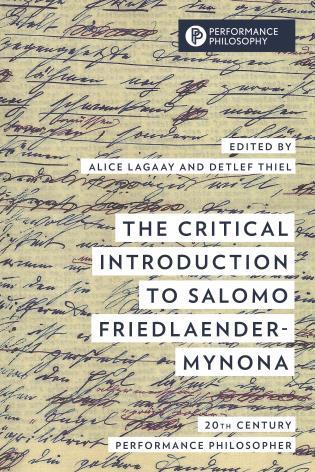
20th Century Performance Philosopher, edited by Alice Lagaay and Detlef Thiel (2020)

Previous titles in the series include:
Encounters in Performance Philosophy (2014), edited by Laura Cull and Alice Lagaay
Žižek and Performance (2014), edited by Broderick Chow and Alex Mangold
Adorno and Performance (2014), edited by Will Daddario and Karoline Gritzner
Performance and Temporalisation: Time Happens (2015), edited by Stuart Grant, Jodie McNeilly, and Maeva Veerapen
Choreographing Problems: Expressive Concepts in European Contemporary Dance and Performance (2015), by Bojana Cvejić
Actors and the Art of Performance: Under Exposure (2016), by Susanne Granzer
The Theatre of Death: The Uncanny in Mimesis (2016), by Mischa Twitchin
Embodied Philosophy in Dance: Gaga and Ohad Naharin’s Movement Research (2016), by Einav Katan-Schmid
Performing Antagonism: Theatre, Performance & Radical Democracy (2017), edited by Tony Fisher and Eve Katsouraki
Baroque, Venice, Theatre, Philosophy (2017), by Will Daddario
Inter Views in Performance Philosophy: Conversations and Crossings (2017), edited by Anna Street, Julien Alliot, and Magnolia Pauker
Performance Studies and Negative Epistemology: Performance Apophatics (2017), by Claire Chambers
Theatricality and Performativity: Writings on Texture from Plato’s Cave to Urban Activism (2018), by Teemu Paavolainen
Beckett, Deleuze and Performance: A Thousand Failures and A Thousand Inventions (2018), by Daniel Koczy
A Philosophical Autofiction: Dolor’s Youth (2019), by Spencer Golub
Performance Phenomenology: To The Thing Itself (2019), edited by Stuart Grant, Jodie McNeilly-Renaudie, and Matthew Wagner
Performing Citizenship: Bodies, Agencies, Limitations (2019), edited by Paula Hildebrandt, Kerstin Evert, Sibylle Peters, Mirjam Schaub, Kathrin Wildner, and Gesa Ziemer
Politics of Practice: A Rhetoric of Performativity (2019), by Lynette Hunter
Seeing As Practice: Philosophical Investigations into the Relation Between Sight and Insight (2019), by Eva Schürmann
Pragmatist Pragmatist Philosophy and Dance: Interdisciplinary Dance Research in the American South (2019), by Eric Mullis
The Object of Comedy: Philosophies and Performances (2019), edited by Jamila M. H. Mascat and Gregor Moder
Framing Uncertainty: Computer Game Epistemologies (2020), by Markus Rautzenberg
Series Editors
Laura Cull Ó Maoilearca, Lector of the Academy of Theatre and Dance, Amsterdam, and Professor of Performance Philosophy by special appointment University of Amsterdam, Netherlands
Will Daddario – Independent Researcher, Asheville, NC, USA
Alice Lagaay – Professor of Arts, Culture & Society, University of Groningen, Netherlands
Editorial Board
Prof Emmanuel Alloa, Professor in Philosophy, University of Freiburg, Switzerland
Dr. Luciana Da Costa Dias, Associate Professor of Aesthetic and Theatre Theory, Federal University of Ouro Preto, Brazil
Prof. Lydia Goehr, Professor of Philosophy, Columbia University, USA
Prof. James R. Hamilton, Professor of Philosophy, Kansas State University, USA
Prof. Bojana Kunst, Professor of Choreography and Performance, Institute for Applied Theatre Studies, Justus-Liebig University Giessen, Germany
Prof. Nikolaus Müller-Schöll, Professor of Theatre Studies, Goethe University, Frankfurt am Main, Germany
Dr. Fumi Okiji, Assistant Professor, Women, Gender, Sexuality Studies, University of Massachusetts, Amherst, USA
Prof. Martin Puchner, Professor of Drama and of English and Comparative Literature, Harvard University, USA
Prof. Alan Read, Professor of Theatre, King’s College London, UK
Prof. Freddie Rokem, Emeritus Professor of Theatre Arts, Tel Aviv University, Israel
Prof. Phillip Zarrilli, Emeritus Professor of Performance Practice, University of Exeter, UK
Prof. Cosimo Zene, Emeritus Professor in the Study of Religions and World Philosophies, SOAS, UK
