Júlia Abs, University of São Paulo
Now, it is precisely because history unfolds in the sensible element of human gestures and images that the political-aesthetic gaze is not only possible but also necessary.
Didi-Huberman (2017a, 112, translation by the author)
The body-archive represents a dialectical process that encompasses both the emergence and disappearance of embodied expressions—its theatrical gestures and dance movements—within the context of performance. Drawing on Walter Benjamin’s concept of the dialectical image, this discussion situates the body-archive at the intersection of dance studies and performance philosophy, particularly in relation to the concepts of archive, memory, and the paradoxical temporality of the body. The body-archive not only formulates and reflects upon ideas or essences tied to these phenomena but also serves as a medium for their articulation. Gestures, analogous to language, become privileged inscription sites, capturing the intricate interplay of memory processes. With the body-archive as medium, gestures and their visual traces or images can be interpreted as temporal inscriptions, offering a means to decipher time itself. This reading of the dialectical image seeks to investigate the gestural dimensions of Benjamin’s epistemological model, advancing a nuanced understanding of gesture and its ethical implications as central to the philosophical critique of art.
Walter Benjamin (1977, 1991a), in his “Epistemo-Critical Prologue” (Franko 2017) to The Origin of German Tragic Drama (Ursprung des deutschen Trauerspiels), advocates for understanding the philosophical idea not as a concept, law, or univocal thesis, but a configuration. In this framework, ideas do not rely on universality or classificatory reasoning; rather, their significance arises from their affirmed position within the montage process. The outcome of this contemplative presentation is a discontinuous totality, akin to a mosaic composed of thought fragments (Benjamin 1991a, 209–210), which mimetically corresponds to the discontinuity inherent in the world of ideas or essence of phenomena themselves (Machado 2013). In this article, I propose to examine the body-archive as a philosophical idea, articulated as a dialectical image or an “idea-language”—an aesthetic presentation of philosophical inquiry expressed through the montage process.
In his 18 theses in On the Concept of History, Walter Benjamin (2006; 1991b) formulates a theory of history that critically negates traditional notions of linear chronological progression. Instead, he reconceptualises history as a present struggle or a quest for happiness. This framework emerges from the interplay between theology (Jewish Messianism) and politics (historical materialism), which, together, inform his distinctive approach. For Benjamin, our image of happiness is inherently tied to unfulfilled aspirations from the past, thereby endowing the present with a profound responsibility towards history. Rather than viewing history as a linear trajectory surpassing the past in pursuit of an idealised future, Benjamin foregrounds a redemptive act that brings the past into the present. Each present moment, therefore, carries the weight of a historical task: to actualise latent potentialities of past events, upon which the realisation of happiness depends. This perspective ultimately underscores the ethical and political dimensions embedded within Benjamin’s conception of history.
In The Origin of German Tragic Drama, Walter Benjamin (1977; 1991a) introduces several foundational concepts, crucial to understand the dialectical image. Among these, his notion of origin (Ursprung) stands out. Benjamin defines origin not as a fixed point in time, but as a “coming-into-being”—a dynamic and fluid process that captures the transformative essence of historical phenomena. These understandings challenge conventional linear or static conceptions of historical facts, instead presenting history as an ongoing, unfolding process rather than a straightforward chronological sequence. Thus, historical truth emerges not from a mere accumulation of events, but from the reflective constellation of past and present moments. In this sense,
Origin [Ursprung], although an entirely historical category, has, nevertheless, nothing to do with genesis [Entstehung]. The term origin is not intended to describe the process by which the existent came into being, but rather to describe that which emerges from the process of becoming and disappearance. Origin is an eddy in the stream of becoming, and in its current it swallows the material involved in the process of genesis. […] On the one hand it needs to be recognized as a process of restoration and reestablishment, but, on the other hand, and precisely because of this, as something imperfect and incomplete. […]. (Benjamin 1977, 45; 1991a, 226)
Walter Benjamin does not conceive origin in a causal sense, as an emergence, nor does he define it as the chronological starting point of linear historical events. Instead, he portrays origin as a dynamic force, akin to a vortex, which disrupts the ordinary flow of historical phenomena and draws them towards a point of convergence. This movement is characterised by the tension between two opposing forces: one directed outward, towards an endpoint, and the other pulling inward, towards the source. Drawing on classical, modern, conceptual, and post-conceptual dance, alongside choreography and technological influences, which are mixed up in dialectical images, I propose to uncover the remnants of one within the other throughout the history of contemporary dance. In doing so, I aim to explore the spatial and temporal dysfunctions where genealogical images intertwine with bodily memory traces. These distinctive originating phenomena are the focus of this article.
As the body-archive embodies both forgetting and an incomplete, disordered, and fragmentary form of remembrance, I intend to investigate, within it, what a body is and what a body can do. The body is not merely an object of utility; rather, I seek to uncover the uses of the body through the assemblage of images—in correspondence, in dance, among contemporary and historical images, as well as technological ones, with their physiological influx. Together, these elements constitute what can be understood as a Brechtian “theatrical body” of estrangement (Olgária Matos, personal communication, September 2024).
Montage is a foundational element of Bertolt Brecht’s poetics and praxis. The act of assembling is not merely about arranging elements in isolation but orchestrating their differences, clashes, confrontations, and conflicts. Montage, therefore, emerges as the art of organising contrasts. Needless to say, a body-archive can be seen as a montage. The configuration of elements—images, texts, or theatrical scenes—approaches co-presence through a dynamic lens of conflict, actively disrupting established orders of appearance. The decision to employ montage—practised by Brecht in dramaturgy, Igor Stravinsky in music, and Walter Benjamin in philosophy—entails generating displacements and recompositions of disparate elements. Montage unites and juxtaposes heterogeneous forms, eschewing traditional hierarchies or scales of significance. These forms are projected onto a shared plane of proximity, often foregrounding them on the stage to provoke new meanings, associations, and critical reflections—particularly, though not exclusively, within the field of the performing arts.[1]
The disassembly of elements enables the perception of everything that symptomatically traverses the order of discourses, most notably their contradictions. Exposition through montage rejects a global or objective reflection, instead arranging and recomposing elements to interpret reality through fragments rather than seeking to explain it comprehensively. Montage uncovers profound fissures rather than surface-level coherences, exposing local disturbances—it describes the swirling eddies within a river rather than the overall direction of its flow. By generating new relationships between disparate elements, montage rearranges and recomposes, revealing deeper layers of meaning. Its political significance lies in its critical engagement with reality, actively reconfiguring the relative positions of things, discourses, and images (Didi-Huberman 2017a).
Within this context, artists must critically engage with the concept of the document-archive, employing a variety of techniques, including confrontation, comparison, and documentary montage (Didi-Huberman 2017a). These practices are designed to reveal the interruptions, contrasts, and anachronisms embedded in the archival process. As Didi-Huberman (2017a, 35, translation by the author) asserts, “If seeing allows us to understand and even foresee something about the historical and political state of the world, it is because the montage of images grounds all its effectiveness in an art of memory.” What is ultimately at stake in the aesthetics of montage is an unyielding confrontation with contradictions, resulting in an inevitable non-synthesis—a deliberate refusal to resolve tensions into a harmonious or unified whole (Didi-Huberman 2017a, 87).
I propose, within the medium of the body-archive, montage as an heuristic instrument to explore theatrical gesture and dance movement. Consequently, this research adopts an inherently interdisciplinary methodological framework. The practical methodology involves activating digital archives, employing digital dance annotations,[2] and embodying movement derived from selected choreographies. Additionally, I edit and assemble stills or photographic images from these works to construct a mosaic that serves as both an analytical and creative tool. Performances of these choreographies are analysed alongside the discourses surrounding them, situating the concept and practice of the body-archive within the theoretical constellations embedded in the choreographic works: Trio A (1966) by Yvonne Rainer; Darkland (2010) by myself, and Nom donné par l’auteur (1994) by Jérôme Bel. Still images extracted from video recordings of these works have been carefully selected and arranged to effectively apply the montage procedure. This analysis investigates various dimensions of the modern body-archive along two main axes. First, it examines the conceptual dance movement in Europe during the 1990s and its dialectical tension with my own choreographic practice. Second, it explores the postmodern or minimalist dance of the New York Judson Church generation in the 1960s and 1970s, along with contemporary reactivations and reinterpretations of these ideas in my current reenactment of Trio A.
Darkland (Abs 2010) is the title of a choreography in which I assumed the dual roles of director and performer.[3] Through this work, I encountered, in Benjaminian terms, a moment of rupture: the death of modern dance. André Lepecki, who attended the piece’s premier event and subsequently wrote about it, identified the ‘phantom matters’ that emerged in the reception of Darkland: an unresolved mourning, through which the ghost of modern dance materialised on stage.[4] In that moment, modern dance lingered within my body; it acquired the sign of a ghost in confrontation with an audience intent on surpassing it. On that white linoleum stage, modern dance became spectral, and my body was compelled to negotiate with what Lepecki terms “terrain accidents” described as “nothing more than the inevitable marks of history’s convulsions” (Lepecki 2010, 15). But what, precisely, were these convulsions?
The audience that attended Darkland (2010) sought to introduce conceptual dance to Brazil. However, the necessary means were lacking, and, more importantly, historical processes or a critical consciousness of dance history capable of facilitating genuine transformation were absent. This condition aligns with what Arabella Stanger (2021, 3) describes as dancing on a “violent ground”, a terrain “from which utopian choreographic projects emerge.” The promise of an intellectual dance, directly influenced by a group of European artists from the 1990s—represented here by Jérôme Bel—“depends on material conditions of imperial, colonial, and racial subjection” (Stanger 2021, 3). In this sense, I quite literally danced on a “violent ground”, where the material conditions of struggle, conflict, and domination actively shaped and traversed my dancing body in real time. This context led me to the notion of the body-archive functioning as a dialectical image of the death of modern dance. What did modern dance signify, and what did it rupture? What remains of it? What traces of modern dance persist in my personal history, and what endures within this archive? The body-archive, as a dialectical image, is a “precipitate” of meanings—a site where extremes, antitheses, and metaphors coexist in unresolved tension, giving rise to senses of time, space, body, and subjectivity. In this regard, the body-archive constitutes a rupture.
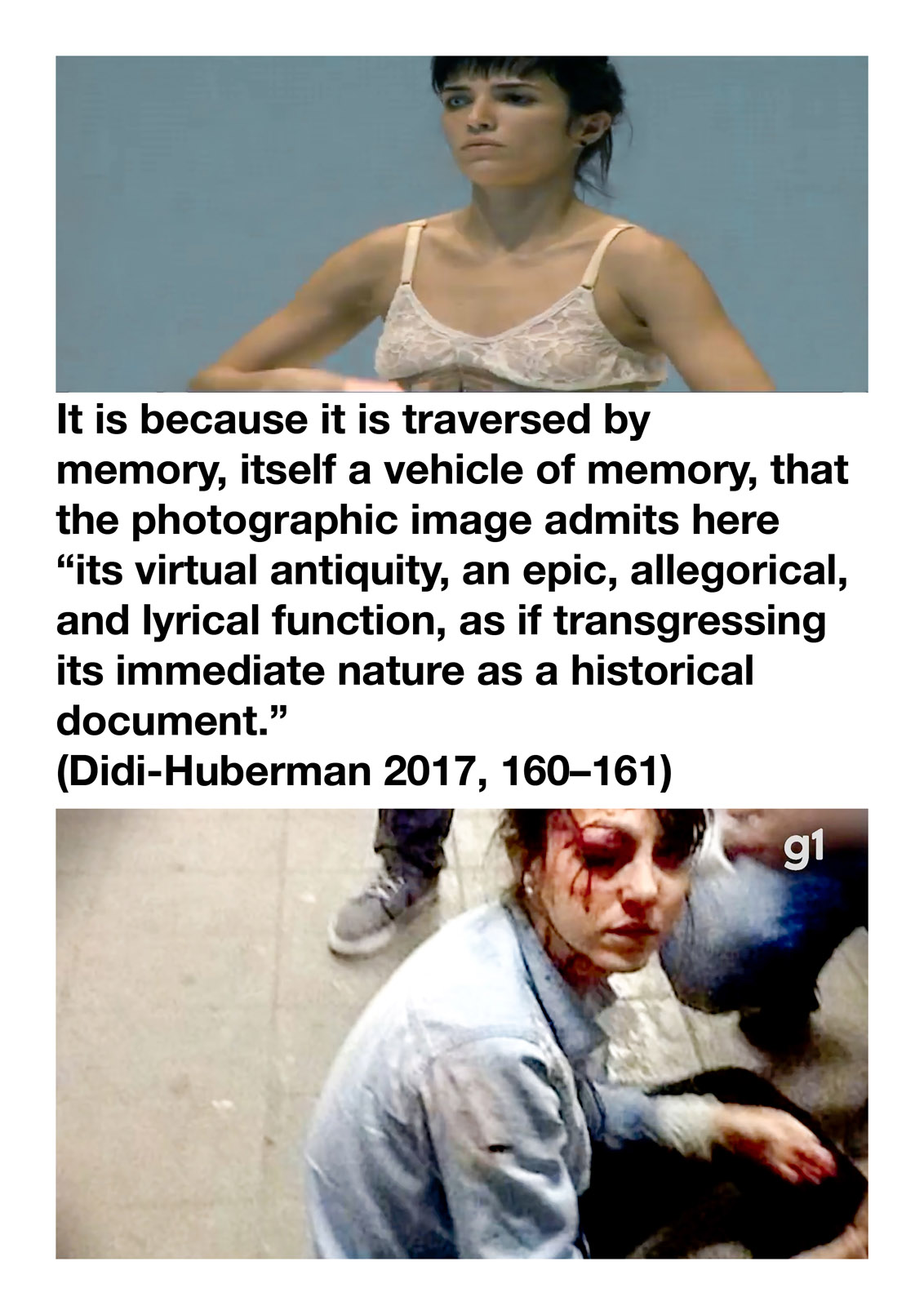
I will examine a disruption that occurred during my performance of Darkland (2010) as a dialectical image: one of my contact lenses fell out, rendering me metaphorically blind. In that moment, I was haunted by memory, with my body serving as a conduit for cultural memory, revealed through the video still (Figure 1) in certain archetypal forms: the blind prophet, the sacrificial victim in Le Sacre du Printemps, Joan of Arc, among others. The image heightens this sense of virtual antiquity with an allegorical function, transcending its immediate role as a historical document and instead illustrating the anachronism inherent in the dialectical process. As Didi-Huberman (2017a, 160–161) suggests, to exist within history is also to be “haunted by memory.” This perspective, aligned with Aby Warburg’s, allows one to speak of survivals (Nachleben) without dismissing the universality and timelessness of archetypes. The body-archive—expressed through theatrical gesture and dance movement—proves to be particularly adept, much like photography, at capturing these intersections and apparitions of memory within history.
Walter Benjamin (1999, 475) offers multiple definitions of the dialectical image across various texts and writings, including the following:
To thinking belongs the movement as well as the arrest of thoughts. Where thinking comes to a standstill in a constellation saturated with tensions—there the dialectical image appears. It is the caesura in the movement of thought. Its position is naturally not an arbitrary one. It is to be found, in a word, where the tension between dialectical opposites is greatest. Hence, the object constructed in the materialist presentation of history is itself the dialectical image. The latter is identical with the historical object; it justifies its violent expulsion from the continuum of historical process. [N 10a, 3] (On the Theory of Knowledge, Theory of Progress).
What was the constellation imbued with tension? It was the death of modern dance, embodied in my own body and perceived by the audience in that moment of performance. This violent constellation—dancing on a violent ground—was saturated with the presence of death, rendering both modern and conceptual dance immobilised. In that instant, a “constellation filled with tensions” (Machado 2013, 153, translation by the author) became tangible—an image that the researcher continues to examine through this scientific “construct.” This perspective aligns with the understanding that “the objects of history are not pure facts” but always “produced by a subject under different constellations and tensions” (Machado 2013, 153, translation by the author). These dialectical tensions—the dynamic interplay of forces and the oppositions between distinct historical periods—constitute the core of this reflection. Here, the body-archive emerges as a medium, enabling an exploration of the body as a repository of memory, where historical ruptures, survivals, and resonances are inscribed and rendered visible.
What constitutes an interruption (Unterbrechung) within Bertolt Brecht’s framework? In this context, the interruption—arising from the process of co-presence—is both factual and theatrical in nature. Beneath factual events lies a complex network of relationships, a virtual extension that encourages the observer to heuristically multiply their perspectives. Yet, this interruption is more profoundly aligned with the core concept of the dialectical image: a sudden flash of perception emerging within a process fraught with danger. In the scene from Darkland, this danger lay in being traversed by the history of dance—a history insufficiently mourned, demanding justice, a stance, and clarification. These themes will be explored in detail in the following sections.
In this section, I approach the still image from Darkland (Figure 1) as a dialectical image mediated through the body-archive. Through a montage structured around two central categories of dance, movement, and the dancer as subject, I examine how the “death” of modern dance becomes perceptible in the work. Engaging with André Lepecki’s interpretation of Darkland, I argue that the emergence of “ghostly matters” (Lepecki 2010, 15) in the reception of the piece reveals that modern dance has not reached a definitive historical end. Rather, it persists as an unresolved historical force embodied within my own formation as a dancer.
At the time of creating Darkland, the modern subject still constituted the primary paradigm through which I understood movement, body, and dance, even though the thematic concerns of the work already pointed toward contemporary approaches to corporeality and choreography.[5] The work therefore became suspended between two epistemic regimes. While its aesthetic and conceptual concerns attempted to engage contemporary questions, its movement production remained grounded in the modern paradigm of the “inner scene,” in which the subject’s interiority is externalised through expressive motion. This tension shaped not only how affects and sensations were communicated to the spectator, but also how expressive conceptions of movement continued to guide my choreographic decisions.
The contradictions of Darkland emerge precisely from this disjunction. On the one hand, the work pursued a contemporary notion of the Freudian concept of Unheimlich, the uncanny, through theatrical apparatuses of disjunction, including the de-figuration of the body and heterogeneous assemblages of bodies and things. On the other hand, the subject producing these gestures remained attached to modern conceptions of expression and subjectivity. It is precisely this unresolved coexistence of temporalities that allows the dialectical image to emerge within the work. By confronting the persistence of modern subjectivity within contemporary choreographic procedures, Darkland reveals the anachronistic temporal layers that continue to inhabit choreographic practice.
In the creation of Darkland, these contradictions did not emerge solely at the level of discourse or historical positioning but became materially embedded in the choreographic methods themselves. I employed compositional procedures aimed at uncovering the nuanced qualities of the “inanimate” world, driven by a desire to transcend the familiar and venture into the uncharted: to discover, explore, and shape the unknown. To achieve this, I utilised techniques specifically designed to destabilise habitual movement patterns, including props such as platform shoes to unbalance the body; the deliberate fragmentation and interruption of movement through bodily articulations; and the use of a corset that restricted the mobility of the spine and upper body. While these procedures sought to approach contemporary notions of de-figuration, disjunction, and the Unheimlich, the body that negotiated these apparatuses still operated through the expressive logic of the modern subject. The intention was therefore to generate expressions and forms that had not previously existed within the framework of this poetics or philosophical inquiry, grounded in the modern belief that movement could function as a kind of tabula rasa: a space through which the subject might access and reveal something entirely new, both for oneself and for the spectator.
Through this process, the work gradually constituted itself as an autonomous choreographic structure. What was sought was the unleashing of subconscious material, emotional, affective, and expressive, as if it could emerge for the first time through the body, prior to codification or historical sedimentation, and thereby appear as an unprecedented event within choreographic experience. In order to do this, I sculpted the body’s musculature into a finely attuned and highly sensitive instrument, capable of responding to the fetishised body while unfolding and articulating its emotional implications in a singular and distinctive manner. The choreographed interplay between individual movement phrases became the foundation of the work’s structure, and this relational process ultimately endowed the piece with a modern sense of aesthetic autonomy. Yet the very procedures through which this autonomy was constructed, fragmentation, disjunction, bodily destabilisation, and the de-figuration of expressive coherence, simultaneously pointed toward contemporary questions of emancipation, in which dance no longer appears as a self-contained aesthetic form but as a field negotiated through social, cultural, and political forces. It is precisely this unresolved dialectic between autonomy and emancipation that traversed Darkland’s performance.
According to André Lepecki, Darkland revealed a symptom of what he describes as the “brutality and violence to neutralise the space” (Lepecki 2010, 14), as the choreography unfolded upon a white Marley floor. Embedded within the modern choreographic imaginary persists the fantasy that the dance floor constitutes a blank, neutral, and ahistorical surface upon which movement can freely emerge. Yet the very act of producing such neutrality requires the repression of instability, friction, and historical sedimentation, allowing the dancer to move uninterrupted by slips, stumbles, or ruptures.
Within this supposedly neutral white space, however, I found myself continually negotiating with what Lepecki describes as “topographical accidents”: traces of historical convulsions erupting through the floor itself. Although I was still operating within the amnesiac ahistoricism often associated with dance as a language, my body remained traversed by an urgent demand for historical consciousness. Despite every attempt to maintain equilibrium, the floor remained dialectically slippery.
This instability emerged not only from the material conditions of the choreography, but also from the tension between my own subjectivity and the audience’s perception. What remained unresolved was the figure of the modern dancer-subject itself: a historical construct grounded in particular ways of producing movement, communicating expression, and conceiving the artwork as an autonomous form. It is precisely this unfinished condition that continues to traverse contemporary choreographic practice.
Figure 1. Abs (2010) performing Darkland and an anonymous person protests in the Free Fare Movement (MPL), which organized a series of demonstrations against the increase in bus fares from R$3 to R$3.20. Source: X (2010), and g1 (2023).
Within the dialectical image of Darkland, one can perceive a suspended tension between Modern Dance and Conceptual Dance, forming what may be understood as a violent ground of subjectivation forces. In Brazilian choreographic production at that moment, paradigms inherited from Modern Dance continued to operate through an insufficiently critical understanding of the relation between movement and subjectivity, particularly within the legacy of somatic approaches to the body. Movement frequently remained tied to the expression of an interiorised subject, even when choreography sought to destabilise fixed corporeal identities.
At the same time, Conceptual Dance emerged in Brazil as a sign of aesthetic innovation and critical contemporaneity. Yet the institutional and material conditions necessary to sustain processes of self-reflection and critique remained fragile. The precarious cultural infrastructure made it difficult to consolidate either a stable art market or a continuous critical discourse around dance. Unlike many European contexts, contemporary dance in Brazil had not yet exhausted its aesthetic forms, precisely because artistic circulation was not fully determined by the accelerated neoliberal flows that had already reshaped European choreographic production.
The body-archive, manifested as a dialectical image, functions as a mode of presenting an idea through the intersection of paradoxical materials within the body itself. It enables the coexistence of opposites, of excesses and extreme historical forces that remain unresolved, incomplete, and in constant tension. Through the body-archive, it becomes possible to perceive the encounter between earlier and later histories of dance, between modern and conceptual choreographic paradigms, as well as between processes of historical restoration and historical incompletion.
In this sense, the body does not merely carry memory metaphorically; it is itself an archive through which historical temporalities persist, collide, and re-emerge. As Walter Benjamin suggests, the idea intersects with the historical world (Benjamin 1991a). To confront our mythologies and archaisms therefore requires, as Georges Didi-Huberman writes, “not to fear invoking them, working critically and imagistically (bildlich) on the signs of their forgetting, their decline, and their resurgences” (Didi-Huberman 2010, 185, translation by the author). From this perspective, contemporary dance becomes inseparable from its own historicity. Choreography no longer appears as the production of pure presence or autonomous expression, but as a discursive field traversed by surviving historical layers, unresolved temporalities, and the continuous reconfiguration of subjectivity itself.
This section delves deeper into the problem of modernism in dance and examines how 1990s European conceptual dance engages with its heritage, using Jérôme Bel’s early work as a key example of this process. Modernism in dance operates on what Bojana Cvejić (2015, 20) describes as the “subjectivation of the body through movement and the objectivation of movement through the body,” which together constitute “the organic regime of dance.” These ideas “connect the body and movement into one organic whole, where the former is comprehended through inner (emotional) experience, and the latter through physical activity (task, action)” (20). Jérôme Bel’s choreographies disrupt this organic regime by rejecting both the body as a source of authentic movement and the object of movement to which the body is physically bound. When movement and the body are no longer intertwined within this organic paradigm, their relationship in the act of expression or in the form of the object ceases to manifest naturally. Instead, this relationship remains fragmented, requiring construction or reinvention by deliberate procedures of conjunction between body and movement, rather than through their seamless synthesis (Cvejić 2015). The critical and self-reflective questions concerning the nature of dance—posed by Jérôme Bel and other European conceptual dance artists—have profoundly influenced this research over many years. These debates remain unresolved and may, in fact, resist final resolution, as they evade synthesis through the dialectical image process. In this sense, Jérôme Bel confronts a fundamental crisis in the conceptualisation of dance: why did the flow of dance movement come to an end?
According to Jérôme Bel, what replaces dance in his choreographies are the rules of choreography themselves, which are exposed as language. By staging the codes and conventions of dance, Bel reflects on its modes of production and representation. He does not operate within a framework structured by music, nor do his dancers express internal motivations that propel them into movement. Dance and thought are deeply intertwined in his works, with concept taking precedence over physical movement. In Bel’s approach, the concept is staged and functions as a visible reflection on dance—a reflection that does not necessarily produce dance in a conventional sense. However, while such reflections may develop without coded movements, they cannot unfold without the bodies that carry and articulate the thinking process. Bel asserts that there is no distinction between the artwork and discourses surrounding it. As Gerald Siegmund (2017, 56) observes, “His artistic work is a discourse,” one that Bel himself describes as written specifically “for the ‘black box’” (Bel and Siegmund 2012, 73). Writing for the “black box” of theatre grants dance a maturity that reflects on its history and modes of production and reception. This disrupts established ways of understanding and interpreting dance, as “writing for the stage implies a different responsiveness from audiences—one that is intellectual rather than kinaesthetic or even emotional” (Siegmund 2017, 8). By approaching the body as a linguistic sign, Bel, alongside other artists of his generation, ultimately fostered a new way of thinking about dance, the body, choreography, and performance. In the following analysis of Jérôme Bel’s first piece, Nom donné par l’auteur (1994), I will explore its conceptual implications, highlighting the key elements of Bel’s discourse on dance and examining the evolving roles of the choreographer and the author within this discourse.
Nom donné par l’auteur (1994) is characterised by the objectivation and reification of the codes of dance and theatre; in it, objects form phrases and statements aided by two dancers. Frédéric Seguetti and Jérôme Bel focus solely on moving objects on stage during the performance, resulting in a neutral and sober behaviour, leaving no room for affection and emotion. There is an absence of everything typically attributed to dance, namely movement, work on the energy of the moving body, affection, and emotion, while we observe the immobility of objects and the mechanical way they are moved by the dancers. “The only operation I produced in Nom donné par l’auteur is the reification of bodies. So, there are no more bodies, but the choreography remains through the objects” (Bauer 2008, 42), commented Bel in an interview. The use of objects, the absence of any sort of theatrical illusion, the subtraction of the dancers’ presence to ground zero—these were strategies devised by Jérôme “for choreography to appear where paradoxically there would not even be a hint of the least dance step! In fact, all that remained of this operation was the skeleton of a dance show: a choreography-skeleton devoid of its dance-flesh” (Bel and Siegmund 2012, 73). The presence of choreography becomes visible because all elements of dance have been rendered absent.
The structure of the choreography in Nom donné par l’auteur could be analysed as an algebraic equation: “a dance piece minus dancing equals choreography” (Siegmund 2017, 63). What is being emptied is the idea that the dancing body can express a truth that existed independently of its context or its symbolic constitution. The two dancers are placed on the same level as the objects with which they form alternating combinations, which deflates the idea of subjectivity as something intrinsically filled up. In Jérôme Bel’s pieces, the subjects are marked by their absence, to then being identified with the symbolic order of the theatre as a void or a non-place. The stage, the subjects, and the objects stare at us and emphasise the symbolic order of which they are equational parts.
Structured with these mathematical equations, the choreography works to produce meanings. Following Gerald Siegmund’s interpretation, what is exposed in Nom donné par l’auteur is the impossibility of fully apprehending the body, as it is always open to possible combinations, precisely due to its linguistic framing, and thus the authenticity of the body is always subject to distortions. Bel translates this process by making the body absent, just as he empties up the stage. “This hollow marks the point at which the symbolic order gazes at the spectators and speaks to them” (Siegmund 2017, 63). I agree with Siegmund that Jérôme Bel is the author of a dance discourse that addresses the linguistic character of bodies and choreography. At the start of this research, I felt betrayal by the death of dance because what I saw (in conceptual pieces) was merely the violent absence of movement. As I became aware of my own work, reconstructing the disruptive history of conceptual dance, exemplified in this study by Jérôme Bel, I grew to understand that, through this movement, artists questioned and broke through the closed worlds of performances (informed by the idea of autonomy in modern art) and expanded the language of dance and its cultural and social relationships.
The neutral mode of writing that allowed Jérôme Bel to conduct his analysis of the state of art of his time, even if neutral, has its own style. According to Roland Barthes (1970), style precedes writing; in the author’s words, style becomes a bodily phenomenon. Bel’s style manifests through the elimination of dance as a kinaesthetic phenomenon, and he is the one who founded a discourse of dance that addresses the audience through the linguistic means of the body and choreography. He is also a pioneer for his gesture of breaking rules and conventions to expand the possibilities of the field, his pursuit of the “new,” which is produced by individual positions in relation to art, not least the citation-reference to Marcel Duchamp in the objects of Nom donné par l’auteur. Regarding this initial phase of Jérôme Bel’s work, the empty theatre is equivalent to a linguistic proposition that provides a space—the non-place of language and the non-place of theatre—for the subject to be. The subject takes this place using language and discourse. Nom donné par l’auteur is Bel’s first creation situated in this more radically conceptual phase, which can be characterised by the prominence of “subjects of discourse” (Siegmund 2017, 72).
The body-archive, manifested as a dialectical image, serves as a mode of presenting an idea: the intersection of paradoxical materials within the body. This notion enables the coexistence of opposites, of extreme ideas and excesses—always negated, incomplete, and unresolved. By employing the body-archive as a conceptual tool to interpret Jérôme Bel’s work, we can observe the tension between earlier history (modern dance) and later history (conceptual dance), between restoration (of memory, of history) and an unfinished process. This tension creates a convergence of preceding and subsequent phenomena, which, though seemingly extreme and disparate, revolve around their origin. Through this process, the idea—that the body is and has an archive and therefore embodies memory—gains historical expression. As Walter Benjamin suggests, the idea intersects with the historical world (Benjamin 1991a; Machado 2013). This same interpretative lens is echoed in Gerald Siegmund’s analysis of Jérôme Bel’s work and Roland Barthes’ semiotic approach, constructed from observations of society, culture, art, and the history of dance. To contemplate our mythologies and engage with our archaisms, it becomes essential “not to fear invoking them, working critically and imagistically (bildlich) on the signs of their forgetting, their decline, and their resurgences” (Didi-Huberman 2010, 185, translation by the author). With Jérôme Bel, dance became discursive, as did the history of performative dance.
Reenactment and activation constitute two methodological operations through which the body-archive engages the historical life of dance. Rather than treating the past as a fixed object of reconstruction, these practices approach history as an active field of relations in which temporalities intersect, re-emerge, and acquire new forms of intelligibility. In this sense, the body-archive functions not only as a medium but also as an idea-language through which historical experience becomes available to critical reflection. Such an approach introduces a political dimension to research, understood as an active and self-reflexive engagement with the conditions through which dance produces, transmits, and remembers itself. It is in this context that my work resonates with practices developed by the European generation of the 1990s, including the critical examination of professional protocols, choreographic reenactments, and the activation of dance archives.
Why reenact or activate an archive? The body-archive fulfils a dual reconstructive function. On the one hand, it allows us to move against the current of historical narratives, resisting the ways in which history is naturalised in the present. On the other hand, it operates through temporal fissures, producing reconstructions that resemble an editorial practice of cuts, rearrangements, and reassemblies, elements that culminate within the body-archive as a montage process. Such operations transform reconstruction into a process of rewriting rather than reproduction. Within this methodological framework lie two Benjaminian categories that are central to the formation of the dialectical image: translation and remembrance.
André Lepecki (2016) approaches the body-archive and reenactment through Walter Benjamin’s theory of translation, particularly as articulated in “The Task of the Translator” (Benjamin 1991c, 1996). For Benjamin, works of art are inherently incomplete. Translation therefore cannot be understood as a duplication of an original work but rather as a process that expands its possibilities of meaning and existence. As Olgária Matos (2022, 26, translation by the author) observes, translation “is not a duplication of the original, for by being repeated it is strengthened with unprecedented axes of understanding,” enriching both the culture from which it emerges and the culture into which it is translated.
Building on Benjamin, Lepecki argues that translations “animate” works, sending them “into endless future iterations” that actualise potentialities not yet expressed in the original (Lepecki 2016, 115). Translation thus exceeds the transfer of a work between languages, cultures, or places. Rather, it becomes a medium through which “new forms of their yet unlived lives” emerge (Lepecki 2016, 115). The life of the work extends beyond the historical moment of its creation, unfolding through encounters with new contexts, bodies, and modes of reception. In this sense, the original is not a fixed entity but a dynamic one, continually transformed through its relations with the living world.
As Matos (2022) further notes, translation introduces an anachronism between the original and the moment of its renewal, allowing heterogeneous temporalities to coexist. Benjamin distinguishes this process from mere continuity or posthumous survival (Überleben). Rather, translation produces a Fortleben: a continuation of life through transformation, distance, and historical displacement. The work survives precisely because it changes. From this perspective, reenactment should not be understood as the reproduction of an original choreography. Rather, it operates as a translational practice through which a work continues its historical life. By activating unrealised potentialities and generating new relations between past and present, reenactment allows choreography to persist through transformation, opening the possibility for the emergence of new dialectical images.
In the recent renewal of dance history, both in artistic and scholarly research, the activation of dance archives has emerged as a significant methodological practice. I propose the activation of digital archives as a means of embodying knowledge of dance and choreography, allowing historical materials to be engaged not as static documents but as living traces capable of generating new experiences in the present. Such an approach assumes that history is not organised through linear succession but through temporal crossings in which different times intersect, forming constellations between past and present.[6]
Benjamin’s notion of remembrance (Erinnerung) offers a way of understanding this process. Remembrance is not the recovery of a lost past but a critical interruption of the flow of historical time, a moment in which past and present enter into a transformative constellation. As Benjamin argues, remembrance creates the possibility of altering the present through a renewed encounter with what has been (Machado 2013, 44). Reenactments and activations operate precisely within this temporal field. They seek to produce an experience in which the past persists not as repetition but as a force capable of generating new meanings and new forms of perception.
It is in this sense that I approach the archival traces of the artists I study. Through a pose, a gesture, or a movement phrase, the body may encounter a pulsating residue of another historical moment. One pose from Trio A (1966) by Yvonne Rainer became the focal point of a dialectical image that emerged during the reception of my translation of the work, undertaken under Rainer’s own supervision. This image offers a concrete example of how reenactment and activation enable the past to survive through transformation rather than reproduction.
My engagement with Trio A (1966) emerged through a sustained process of translation involving digital media, digital dance annotation (Motion Bank System), and the embodied study of the choreography itself. This process eventually culminated in a direct encounter with Yvonne Rainer in New York (2025), whose feedback revealed that reenactment is never a matter of simple transmission. Even when a work appears to be faithfully transmitted, its embodiment demands clarification, adjustment, and renewed conceptual and technical precision, as the choreography discloses a distinct relation between movement, energy, and execution embedded within the phrase itself.
If the archive harbours a latent danger, a threat through which its surviving elements disrupt and unsettle the present, what emerges when a choreography returns through reenactment? What forces are activated when traces of postmodern dance are brought into the present through the body? Rather than preserving a work in its original state, reenactment exposes the tensions between survival and transformation, between what seeks to remain and what demands actualisation. It is from this perspective that I approach Trio A (1966), asking not what the work was, but what continues to insist within it and through it.
On 6 November 2024, I premiered my reenactment of Trio A (1966) following years of dedicated study of the piece. I was able to embody Yvonne Rainer’s work through digital media, digital dance annotation (Motion Bank System), and a rigorous practice of embodying each movement from the choreography. This endeavour was later undertaken under the direct guidance of Yvonne Rainer, as I required her permission for the copyrights necessary to perform Trio A within a programme dedicated to dance history in São Paulo, Brazil. Since 2024, I have been collaborating with Yvonne Rainer, following my initial outreach regarding my research on her oeuvre. While she recognised certain qualities in my interpretation of Trio A, she also noted the need for adjustments, further clarifications, and greater precision in some of its core conceptual elements. The result of this collaboration was my publicly presented Trio A Lecture-Performance (Abs 2024). From this performance, I will extract a pose-arabesque derived from Trio A’s original choreographic phrase, which will serve as an element within the dialectical image of “The Nymph and the Punk” (Figure 2).
Within the context of transmissibility, the distinction between Nachleben and Fortleben becomes particularly significant in this context. While Nachleben designates the survival of a work across time, Fortleben refers to its continuation through transformation. The archive persists, but it does so by entering new constellations of meaning. This tension became especially apparent through the coexistence of different embodiments of Trio A. Among them, I focus on a pose-arabesque performed by Emily Coates, a long-time collaborator of Yvonne Rainer, whose interpretation offers a remarkable degree of precision and fidelity to the work. My own version, by contrast, emerges through a different relation to the archive. If Coates’s interpretation approaches the preservation of the choreography as a historical form, mine seeks to activate the unrealised virtuality embedded within it. The original work remains present in both cases, yet it persists through different historical forces. It is precisely from this tension between preservation and actualisation that the dialectical image of The Nymph and the Punk emerges. The continuation of Trio A’s distinct new life, its Fortleben, unfolds through this unfinished process of transformation, grounded in the raw, critical, and unresolved energies that I define as the Punk subject.
The theatre is empty, the lighting is dim, and a block composed of ten cement bricks sits downstage to the left. I am wearing Adidas Originals trousers paired with a white shirt and black socks. I am dancing while quoting the first arabesque from Trio A’s (Rainer 1978) original phrase—the one that appears at the very beginning—though I am not performing the full phrase in this scene. My movement departs from select poses drawn from Trio A, combined with concepts derived from William Forsythe’s Improvisation Technologies, to actualise, unlock, and reveal latent potentialities embedded in the geometric movement patterns virtually stored within some movements from the piece. The original soundtrack for Trio A Lecture-Performance consists of collaged recordings collected during my academic research travels. These include sounds from museum visits, long walks in Berlin and other German cities, and tracks of dark, deep techno, characteristic of Berlin’s sonic landscape. This scene represents a transformative exchange of Trio A—a dialogue of steps, sweat, and an ongoing re-creation of its images and resonances. The improvisational choreographic devices employed allow me to both incorporate and “excorporate” (Brandstetter, 2000) the essence of Trio A, navigating its ever-evolving actualisations.
The theatrical space is the now-iconic setting of Judson Memorial Church—a sanctuary characterised by its linoleum floor and choir loft—where Emily Coates performed one of the “last instants” (Rainer 2024) of Trio A’s original phrase. Her rendition stands as the most precise interpretation I have ever witnessed (via video), wherein the dialectic of Trio A’s rejection of classical ballet movements paradoxically unveils an extraordinary mastery of ballet technique itself. Coates’s execution of the first arabesque from Trio A’s original phrase unfolded against the marble backdrop of the sanctuary, evoking myth, symbol, and the lingering image of the Nymph. Yet, in Emily’s interpretation, the Nymph becomes a completed process—a final iteration—elevated to a timeless, classical stature, almost transcendental, as though residing above the Olympus. In contrast, my interpretation of the same arabesque emerges from a reflective engagement with Judson’s past, infused with both melancholy and rebellion and shaped by the ethos of a cultural explosion that empowered artists to experiment and interrogate artistic form from the raw “do it yourself” punk mentality. This cultural upheaval was part of a broader social transformation, marked by the civil rights movement, camp aesthetics, explorations into human consciousness, the Vietnam War, feminism, the Black Panthers’ activism, among others. Artists of this era were not merely creating; they were protesting, rebelling, and inventing entirely new artistic forms. Thus, within the dialectical image of the “Nymph and the Punk,” an ancient dynamic resurfaces: the enduring dialectic between Apollo and Dionysus.
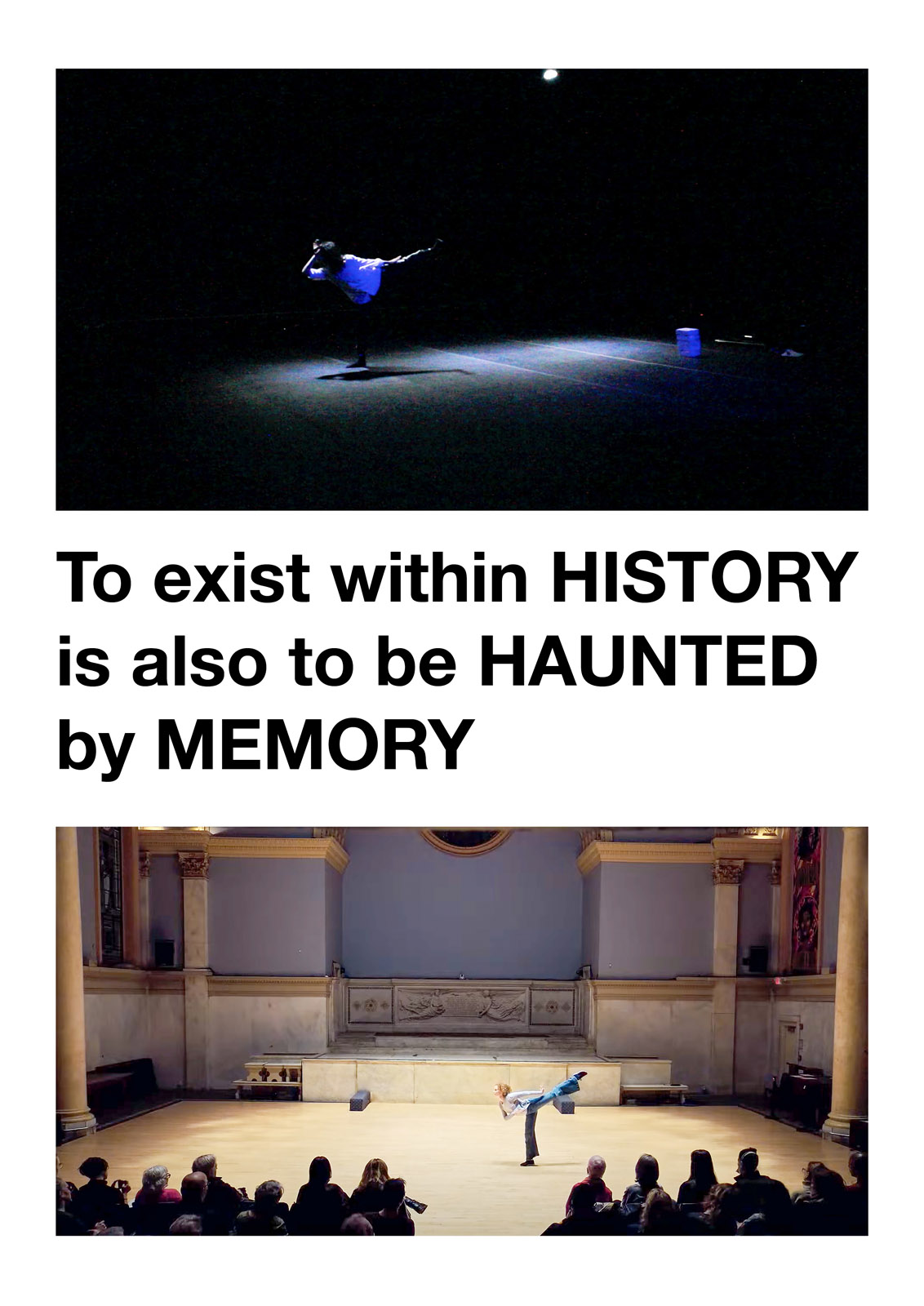
Figure 2. Abs (2024) and Emily Coates (2024) pose-arabesque from Trio A (1966). Source: Abs (2024) and Rainer (2024).
From these encounters emerges the dialectical image of The Nymph and the Punk. The Punk seeks the rebellious energy of revolution and change, whereas the Nymph preserves and is conservative in its nature. The dialectical image reveals the opposing, yet interwoven, forces at play in both interpretations: one represented by a classical, Apollonian “final” moment of dance embodied by Emily Coates, and the other manifested in my own future-oriented interpretation—an afterlife of Trio A infused with a raw, punk-grunge sensibility reflective of the 1980s era, a sensibility shaped by my generational experience. My reenactment of Trio A serves simultaneously as an effort to preserve the work in its singular, original form—hence my meeting with Yvonne Rainer to learn this archive directly, transmitted through her body—and as an attempt to unlock, release, and actualise the manifold virtual potentials embedded within the original choreography. This act becomes a “re-enchantment” of the space—a revitalisation of its spirit—transposing to the present what the 1960s generation could not fully realise in their utopian projects. However, in the face of contemporary fascist resurgence, these unfulfilled projects now resurface with renewed urgency. As André Lepecki (2016, 120) observes, there is a palpable “pressure towards embodied actualisations” within the processes of archiving and reenacting dance. Drawing on the dialectical image, I propose that this pressure emerges as a historical necessity—a demand for a past process to be realised, urgently and tangibly, in the present. The “re-enchantment” and its contemporary actualisations thus stand as imperative responses to our historical moment. But what does it truly mean to revivify the spirit?
To offer one instantiation of the dialectical image, the punk represents a rupture. Why are our desires so often manifest through rupture, with such intense force? Are they to be perceived as tragic or Dionysian? Perhaps because we yearn for what makes us protagonists of rebellion, as “what moves us arises, is extracted, from the depths of an inextinguishable pain, which is its homeland, its original environment” (Didi-Huberman 2017b 307, translation by the author). This dimension of culture as tragedy is deeply embedded in the works of Friedrich Nietzsche, Sigmund Freud, Aby Warburg, and, of course, in my own actualisations of Trio A. The Nymph endures in Yvonne Rainer’s arabesque. Emerging from the iconic pose-gesture-movement of classical ballet, the peculiarities within Yvonne’s gesture—such as the arm flexed towards the forehead—acquire a heightened intensity in the present moment. These elements consign the arabesque to the spectral temporality of survivals. In the anachronistic clash between the Now (Trio A Lecture Performance) and the Then (classicism with Emily Coates), style opens itself to its own future—to its capacity for transformation and reformulation. This is the power of survivals both in gestures and images, for “every intense discovery, every radical new development—involves a return to original words (Urworte)” (Didi-Huberman 2017b, 161, translation by the author).[7]
Aby Warburg’s Nymph embodies a critical function capable of “reversing all values attributed to images and gestures in the traditional practice of art historians […]” (Didi-Huberman 2017b, 305, translation by the author). In this capacity, the Nymph carries “something akin to a critical wind, and soon a methodological storm destined to revolutionise our historical and philosophical approach to images and gestures” (Didi-Huberman 2017b, 305, translation by the author). This dynamic mirrors precisely what occurred with the reception of Trio A in 1966 in the United States and later in Europe during the mid-1990s: a profound reversal of the values traditionally ascribed to dance imagery and gestures. Yvonne Rainer herself embodies this critical wind—a force that has, in turn, generated and continues to generate self-reflexive methodological storms surrounding dance media, choreography, and their expansion into other realms of human activity. Herein lies the power of the Nymph as a cultural trace within Trio A: the Nymph offers a means to recognise, in the visual history of peoples and their gestures, the rebellious dynamics embedded within specific figures. The “Nymph and the Punk” are two nymphs belonging to distinct historical temporalities, yet they dialectically inhabit the same historical factual present. Remarkably, they might even share the same month, year, and the poignant farewell of Yvonne Rainer to both peace and life itself. These two nymphs intersect and cross paths: the first serves to preserve, while the second seeks to actualise the virtualities already embedded within the choreography—potentials residing latently in the very artwork.
I hope to have shown, through Walter Benjamin’s model of thought and the two dialectical image montages, the concept of the body-archive as a mode of engaging with historical time and materials embedded within artworks—materials that carry an inherent demand for actualisation. The actualisation of an artwork sets in motion processes shaped by the virtual realities that surround it: latent potentials that may not yet have been realised or may not have found a dancer’s body through which to materialise the corporeal expressions of the original work. The task of the artists, in this context, is to attune themselves to these virtual forces and bring them into actuality, recognising that the work remains perpetually incomplete6. Therefore, reenactments and activations represent creative investments aimed at generating difference—a difference that signifies a process that is inherently inventive, self-differentiating, and continuously open to new possibilities. The body-archive is a dialectical image that perpetually enables the restart of history—choreographically, theoretically, and technically.
Walter Benjamin’s concept of the dialectical image offers a framework to understand historical consciousness as a critical and imagistic tension, dynamically intertwining past and present in the conception of history. When considering dance, the body, the archive, and memory through Benjamin’s philosophical lens—particularly his approach to exposing the thought process—it becomes evident that bodies intersect across time in a continuous chain of reciprocal emissions, translations, transmissions, receptions, and exchanges of temporality, gestures, movements, and affects within diverse historical and political contexts. Within this framework, the afterlives of dance works are imbued with infinite potential to be perpetually reactivated in the present, particularly when historical moments summon specific spectral materials demanding reappearance. I propose engaging with the notion of the body-archive as an anticipatory language, oriented towards what is perpetually arriving. The spectral, in this sense, prompts us to ask: where does it emerge from? What does it witness? What does it demand? Why does it resist burial? It is, fundamentally, a mourning yet to be realised.
[1] For instance, Georges Didi-Huberman (2017a) examines Bertolt Brecht’s montage process in two of his works: Arbeitsjournal 1938–1955 (1977) and Kriegsfibel (1955), or its French edition, ABC Abécédaire de la guerre (1985). In these works, Brecht constructs a veritable atlas of images, encompassing an extensive array of visual documents and photojournalistic records of the Second World War. According to Didi-Huberman, these works generate knowledge through montage. In the act of assembling and disassembling images, certain symptoms and transversal relations emerge. As a result, politics and aesthetics become intricately intertwined within the photographic material and the captions penned by Brecht.
[2] Using the Motion Bank System, I developed practical annotation methods within the context of dance research. These methods focus on analysing choreographic structures, exploring generative procedures of dance movement, and examining the dancer’s subjectivity. My digitally annotated procedures form the foundation to activate selected choreographies using Dancing Digital Annotation, a specialised software developed as part of the Motion Bank project.
[3] In 2010, I co-directed the group Vitrola Quântica (2007–2013) alongside filmmaker Daniel Augusto and a group of dancers who collaborated with me on different projects.
[4] “These still unfinished endings […] extend the materiality of history into a spectral concreteness (the concrete virtuality of the ghost), which makes the past resonate and act as contemporary with the present” (Lepecki 2010, 13–15, translation by the author).
[5] My bachelor dance training (2003–2006) at Universidade Anhembi Morumbi in São Paulo had a pedagogical plan based on the Klauss Vianna Technique, which is structured around a holistic conception of the body commonly known in Brazil as Somatic Education. The ideas of spontaneous self-expression, the holistic concept of a thinking body, and the primacy of physical sensations and emotions as the meaning and value of dance movement were the guiding principles of the programme centred on the concept of the performer-creator. In general terms, the performer-creator is the author of their movements and their original works; based on somatic techniques, including those of Klauss Vianna, there is a tendency to work with the internal scene as a means of dancer-audience communication.
[6] Rebecca Schneider (2011, 37) describes this encounter as the experience of finding “one time resident in another time,” a logic embedded in the very notion of remains. The activation of archival materials therefore does not restore the past in its entirety. Rather, it allows fragments, traces, gestures, and residues to persist in the present. This persistence is necessarily incomplete, fractured, and contested. What survives does so because it continues to demand attention, whether as an unresolved historical tension, an unfulfilled mourning, or a claim for justice.
[7] These original gestures function as “plastic materials destined to undergo successive impressions, ceaseless displacements, and antithetical reversals” (Didi-Huberman 2017b, 161, translation by the author).
Abs, Júlia. 2010. “Darkland”. Video, 40 min., 1 sec. https://vimeo.com/78307850.
Abs, Júlia. 2024. “Trio A Lecture-Performance”. Video, 48 min., 52 sec. https://vimeo.com/1033598650.
Barthes, Roland. 1970. Writing Degree Zero. Translated by Annette Lovers and Colin Smith. Beacon Press.
Bauer, Una. 2008. “Jérôme Bel: An Interview.” Performance Research 13 (1): 42–48. https://doi.org/10.1080/13528160802465516.
Bel, Jérôme, and Gerald Siegmund. 2012. “Jérôme Bel: In conversation with Gerald Siegmund”. In Dance, edited by André Lepecki. Whitechapel Gallery and The MIT Press.
Benjamin, Walter. 1977. The Origin of German Tragic Drama. Translated by John Osborne. Verso.
Benjamin, Walter. 1991a. “Erkenntniskritische Vorrede. Ursprung des deutschen Trauerspiels.” In Walter Benjamin, Gesammelte Schriften I, edited by Rolf Tiedemann and Hermann Schweppenhäuser. Suhrkamp.
Benjamin, Walter. 1991b. “Über den Begriff der Geschichte.” In Walter Benjamin, Gesammelte Schriften I, edited by Rolf Tiedemann and Hermann Schweppenhäuser. Suhrkamp.
Benjamin, Walter. 1991c. “Die Aufgabe des Übersetzers.” In Walter Benjamin, Gesammelte Schriften IV, edited by Tillman Rexroth. Suhrkamp.
Benjamin, Walter. 1996. “The Task of the Translator.” In Walter Benjamin, Selected Writings, Volume 1: 1913–1926, edited by Marcus Bullock and Michael W. Jennings. Harvard University Press.
Benjamin, Walter. 1999. “On the Theory of Knowledge, Theory of Progress.” In Walter Benjamin, The Arcades Project. Translated by Howard Eiland and Kevin McLaughlin. Harvard University Press.
Benjamin, Walter. 2006. “On the Concept of History.” In Walter Benjamin, Selected Writings, Volume 4: 1938–1940, edited by Howard Eiland and Michale W. Jennings. Harvard University Press.
Brandstetter, Gabriele. 2000. “Choreographie als Grab-Mal das Gedächtnis von Bewegung.” In Re-Membering the Body. Körper-Bilder in Bewegung. Mit Stress, einem Bildessay von Bruce Mau mit Texten von André Lepecki, edited by Gabriele Brandstetter and Hortensia Völckers. Hatje Cantz.
Brecht, Bertolt. 1955. Kriegsfibel. Eulenspiegel.
Brecht, Bertolt. 1977. Arbeitsjournal: 1938–1955. Aufbau Verlag.
Cvejić, Bojana. 2015. Choregraphing Problems: Expressive Concepts in European Contemporary Dance and Performance. Palgrave Macmillan.
Didi-Huberman, Georges. 2010. O que vemos, o que nos olha. 2nd ed. Editora 34.
Didi-Huberman, Georges. 2017a. Quando as imagens tomam posição. Editora UFMG.
Didi-Huberman, Georges. 2017b. “Através dos Desejos. (Fragmentos sobre o que nos subleva).” In Levantes, organized by Georges Didi-Hubermann. Translation by Edgar de Assis Carvalho, Eric R. R. Heneault, Jorge Bastos, and Mariza Perassi Bosco. Edições Sesc.
Foster, Susan L. 2011. Choreographing Empathy: Kinaesthesia in Performance. Routledge. https://doi.org/10.4324/9780203840702.
Franko, Mark. 2017. “The Conduct of Contemplation and the Gestural Ethics of Interpretation in Walter Benjamin’s ‘Epistemo-Critical-Prologue’”. Performance Philosophy 3 (1): 92–107. https://doi.org/10.21476/PP.2017.31166.
g1. 2023. “Junho de 2013, 10 anos depois: onde estão os integrantes que deu início aos protestos no Brasil”. Video, 1 min., 23 sec. https://g1.globo.com/sp/sao-paulo/video/junho-de-2013-veja-as-imagens-que-marcaram-os-protestos-11669686.ghtml.
Lepecki, André. 2010. “Planos de Composição”. In Criações e Conexões: Cartografia Rumos Itaú cultural Dança 2009–2010, edited by Christine Greiner, Cristina Espírito Santo, and Sonia Sobral. Itaú Cultural.
Lepecki, André. 2016. “The Body as Archive: Will to reenact and the afterlives of dances.” In Singularities: Dance in the Age of Performance, edited by André Lepecki. Routledge.
Machado, Francisco. A. P. 2013. Imagem e consciência da história: pensamento figurativo em Walter Benjamin. Translated by Milton Camargo Mota. Edições Loyola.
Matos, Olgária. 2022. “A poética do Nome: Walter Benjamin e a divina euthymia”. In Momentos filosóficos: variações benjaminianas. São Paulo: Cefa Editorial.
Rainer, Yvonne. 1978. Trio A. https://www.youtube.com/watch?v=2EXFjfStP7c.
Rainer, Yvonne. 2024. “Yvonne Rainer: A Program of Film and Choreography”. https://www.youtube.com/watch?v=fmRp1v_5pA4.
Schneider, Rebeca. 2011. Performing Remains: Art and War in Times of Theatrical Reenactment. Routledge.
Siegmund, Gerald. 1998. “Im Reich der Zeichen: Jérôme Bel.” Ballett International 98 (4): 34–37.
Siegmund, Gerald. 2017. Jérôme Bel: Dance, Theatre, and the Subject. Palgrave Macmillan. https://doi.org/10.1057/978-1-137-55272-3.
Stanger, Arabela. 2021. Dancing on Violent Ground: Utopia as Dispossession in Euro-American Theater Dance. Northwestern University Press. https://doi.org/10.2307/j.ctv1wd02q7.
Vianna, Klauss. 2005. A Dança/Klauss Vianna. 3rd ed. Summus.
Júlia Abs is a contemporary artist, performer, choreographer and researcher based in São Paulo, Brazil. Her work lies at the intersections of contemporary dance, the philosophy of art and performance, digital technologies, and visual arts. She is currently a postdoctoral researcher in the Department of Philosophy at the University of São Paulo (USP) and a guest researcher at the Interdisciplinary Nucleus for Sound Communication (NICS) at the University of Campinas (UNICAMP). She holds a PhD from USP’s Interdisciplinary Graduate Programme in Aesthetics and Art History (2024) and was a guest researcher at the Institute for Applied Theatre Studies at Justus Liebig University Giessen. Her research explores the body as a site of memory and transformation, choreography as a mode of knowledge production, and the relations among embodiment, technical media, and cultural infrastructures. Her practice spans performance, video, choreographic notation, curatorial work, and transdisciplinary artistic research.
© 2025 Júlia Abs
Except where otherwise noted, this work is licensed under a Creative Commons Attribution-NonCommercial-ShareAlike 4.0 International License.