Theo Panagopoulos, University of the West of Scotland
The archive is dormant, never dead. (Vatulescu and Stoler 2025, 442)
In July of 2023, I accidentally came across a collection of film archives, stored at the Moving Image Archive (MIA) of the National Library of Scotland in Glasgow. I discovered the archives online after stumbling upon multiple listings on the National Library website and was particularly drawn to the fact that multiple films in the collection presented 1930s and 1940s Palestine in colour, a rare find for any researcher. After realising that the footage was sitting undigitised and unseen for almost half a century, buried in the vaults, I initiated the digitisation process. The archival films depict rare footage of British Mandate Palestine, filmed by a Scottish medical missionary named Herbert Watt Torrance. They present moments of the missionary’s life in the city of Tiberias, his observation of people and flowers, as well as his travels around British-occupied Palestine. The collection had been donated by the missionary’s family back in the late 1970s but was sitting in the vaults of the National Library of Scotland for decades till the films were sent to me newly digitised on 4 October 2023. The recently emerged moving images offer a unique, albeit skewed, look at a multifaceted, vivid, and diverse Palestinian society living in the city of Tiberias, a population that would be the first to forcefully be displaced only just a decade later.
When thinking of institutional archives connected to colonial pasts, ideas of power and ideology emerge around how memory is conserved. Archives do not only capture the history of specific moments in time but also highlight the perspectives of those who narrate and control how they get recorded. One of the most crucial contributions to archive studies come from French philosopher Jacques Derrida, whose work Archive Fever (1996) reflects on the power of the archive by exploring the role of the subject to the process of archiving. He argues that “there is no political power without control of the archive, if not of memory” (4). He traces the archive etymologically back to ancient Greece and its notion of arkheion, a physical space of power that stores official documents depending on rules that dictated what was worth remembering and forgetting. Since Derrida’s important work, archive scholars have offered an important understanding of the archive as more than the description of a physical location but as an interplay of power and ideology. In this article, I discuss archives through the framework of the inherent ideologies they carry and as sites of epistemological and creative examinations. It is vital to challenge the understanding of archives as singular repositories of historical knowledge and expose power structures that allow hegemonic narratives to dominate till this day. The dichotomy between what is considered valuable and what disposable through the framework of memory and limbo is central in analysing the ideological components that archives carry within their own categorisation.
According to Ann Laura Stoler, a leading scholar in archive studies, archives have been systematically used by colonial powers to control knowledge and reconstruct historical narratives of a colonised population. For Stoler (2009), colonial archives are defined as a “site of knowledge production” and a “repository of codified beliefs” (97), which still shape the complex relationship between Western and colonised countries, even when formal colonial ties are disbanded. In most cases, colonial archives construct an image of populations that lay beyond the horizon of the Western world in ways that fit the Western colonial worldview. The archive is, thus, not a mere and static storage of documents, images, and knowledge; rather, it establishes its operational function through visual, written, aural, juridical, social, and cultural practices related to colonialism. Those practices become even more meaningful when related to diverse historical, social, and political contexts. In the case of the Torrance archival collection, the history of its creation is intrinsically linked with the history of Palestine during British occupation and the eventual creation of the State of Israel in 1948.
What does it mean to unearth this footage at a time when the images’ temporalities do not only speak about the past but heavily refer to Palestine’s present and the uncertain future? At a time when many humanitarian organisations have concluded that Israel has been perpetrating a genocide in Gaza,[1] looking at vivid images in colour of a pre-1948 Palestine feels pertinent when juxtaposed to the circulation of phone images of violence and destruction in social media. The rarity of archival images regarding Palestine also points to a long legacy of theft, censorship and destruction of Palestinian personal and institutional archives by the Israeli state (Masalha 2012; Sela 2017). The exile and denial of Palestinians to return to their homeland has strongly severed the ties of the diaspora to the rest of the Palestinian population and has challenged the maintenance or restoration of Palestinian history, thus further fragmenting the Palestinian narrative. Palestinian archives can be found between a few institutional spaces that exist and are scattered in historical Palestine, the occupied West Bank, the besieged Gaza Strip, and throughout the diaspora. This disruption of Palestinian narratives, as well as the general erasure of Palestinian history within official Israeli archives (Sela 2009), heightens the importance of the potential that the Torrance collection carries in restoring important Palestinian imagery. Israel’s settler imaginaries and their inequalities through manifestations of settler colonialism, such as occupation, apartheid, and mass violence, offers an imperative to create counternarratives that attempt to “displace, rather than only disprove, colonial truths, to identify and reckon with claims they still have upon Palestinians now” (Stoler 2022, 573).
As a researcher of Palestinian heritage myself, currently living as an immigrant in Scotland, the opportunity to discover archival imagery of Palestine which depicts the time when my own grandparents were still living there before being expelled in 1948 felt like a personal calling; a calling to engage with Palestine through multiple temporalities and beyond the intellectual and mental but, more so, to experience it through the embodied manifestation of grief and remembrance. Similar to memory itself, notions of archives are intrinsically linked to the body and to the felt sense. Derrida (1995) himself used the embodied notion of “archive fever” to explain the tendency to hold back death and forgetfulness by recording, repeating, and recalling through texts, objects, and data. He explained that the act of archiving mirrors how humans archive in their bodies; how they repress and remove memory. By investigating the archive as a body-centric process that troubles Cartesian ideas of the duality between mind and body, I explore the rare possibilities that the Torrance archive opens for creative activation through the body and performance. The archival collection allows for a critical academic investigation on how bodies are seen, understood, and culturally reproduced through images, as well as how they get “othered” through ideologies of power.
In this article, I initially explore how the archived films within Torrance collection view Palestinian bodies in contrast to Scottish bodies, through their colonial, Orientalist, and biblical gaze. By drawing on the notions of Sara Ahmed’s “orientation” as well as George Bataille’s notion of “the informe”, I discuss the conceptual backbone of my practice-as-research methodology of developing and co-creating participatory performances as “counternarratives” to the Scottish colonial archive. By working alongside Palestinian diasporic communities in Athens and Glasgow through the form of creative workshops, participatory performances emerged as responses to the Torrance collection and specifically to his earliest film in the collection, named Tiberias 1935.
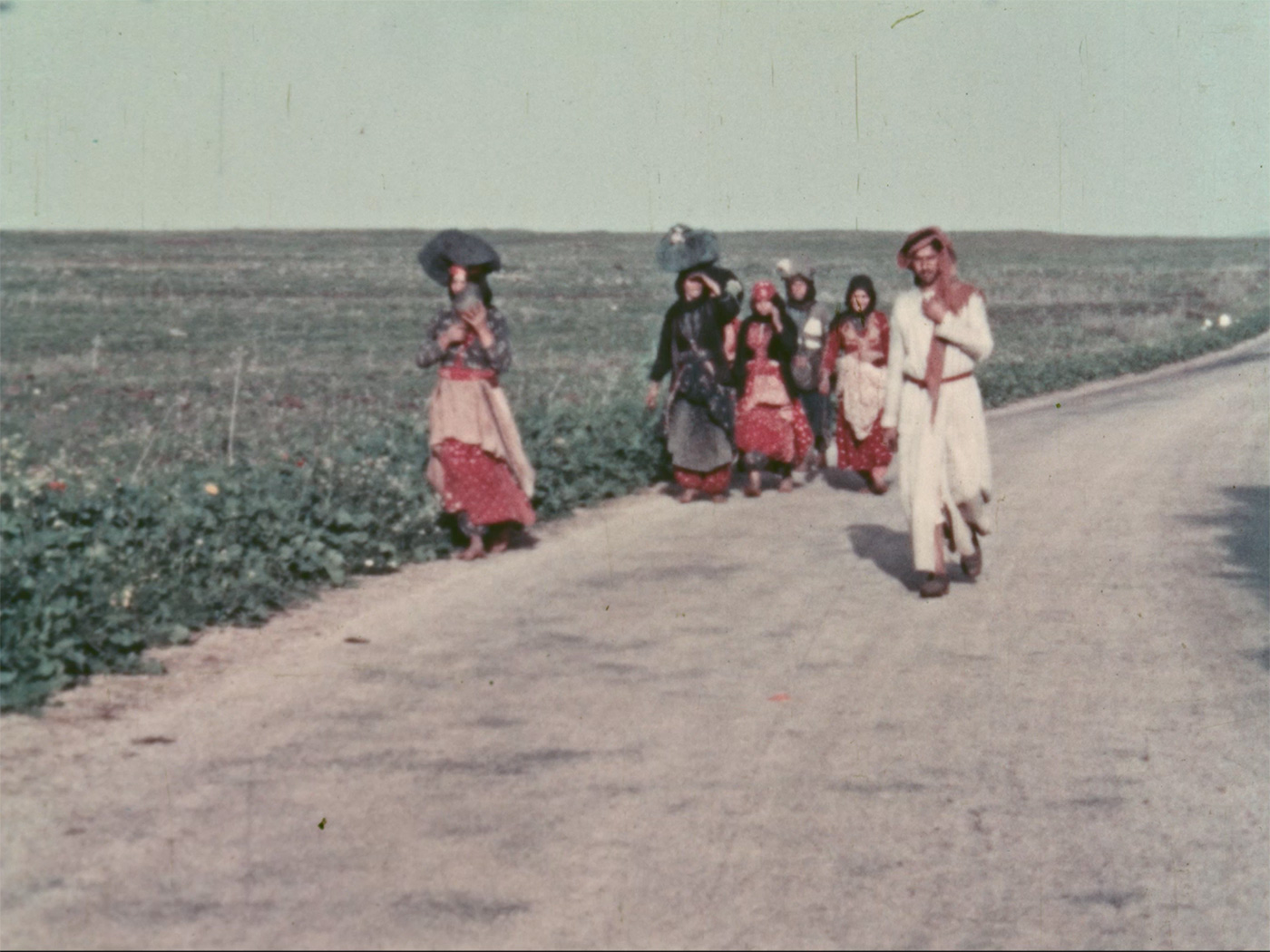
I see the Torrance collection as not only preserving and capturing the lost and erased world of Palestine in early modernity but also presenting that reality through a distorted colonial lens. The lens emerges as a Western point of view that reproduces images through the “biblification” of people and the land. The notion of “biblification” refers to an active reimaging of reality as to mirror symbols and imagery from the Bible. According to Palestinian historian Issam Nassar (2006), biblical imagery of the Holy Land re-emerged during English travel narratives to the Holy Land of the nineteenth century. Those narratives prioritised the selection and representation of noteworthy sites and destinations that relied on imagery of biblical scripture. Nassar shares that it was common practice in biblical travel expeditions for “events and places to which visitors failed to find any textual references [to be] viewed as worthy of dismissal” (75), while noting that for them “the real Palestine was the one described in the books rather than the one they saw” (73). Thus, biblical references had a strong impression on the conscience of the traveller of Palestine, shaping what they saw and how.
Figure 1: Wild Flowers of Palestine, Torrance collection. Courtesy of National Library of Scotland.
The archival films in the Torrance collection follow many of the tropes that had become the bedrock of missionary image-making which reproduced Palestine as “familiar site of European consciousness” and imagined Palestinians as the exotic “other” (Nassar 2006, 73). Through the Biblical lens, Palestinians were seen through the concept of the “immovable Orient” which presented a community “frozen” in time both in how the local population dressed and how they behaved. For Nassar, this framework of thinking and looking, not only created a theoretical and problematic understanding of a whole community of people to a Western audience but also created the “consensual” infrastructure which led to the colonisation of Palestine by England in 1917 and the eventual British and American support for the creation of the State of Israel in 1948 (68).
In the nineteenth and early twentieth centuries, colonial expansion brought European photographers and early filmmakers into the Eastern Mediterranean and Southwest Asia. In Palestine specifically, this process was driven by European interest in the “Holy Land”. The camera’s unique ability to capture the “truth” of Palestine and freeze it in time was of particular interest to those who sought to verify the timeless truth of the Bible. In his work Camera Orientalis (2016), Ali Behdad describes how the camera imbued Orientalism with scientific credibility and therefore functioned as a central pillar in the Orientalist framework. The camera had the power to “capture and ultimately re-present the monuments of the Orient… [and the] effacement of the native population” (Berg 2008, 11) by enhancing what is understood as an imperialist lens. Filmmakers of the time had the ability to treat images as “mirrored photographs” of the “imaginary or mental mould existing in the Westerner’s mind” (Perez 1988, 50) and thus “domesticate” ideas of people and lands that were considered “distant” in the imaginary of the Western world but as consumable and familiar. The camera acted as an extension of an Orientalist ideology that highlighted different power dynamics and hierarchies between colonial powers and colonised communities.
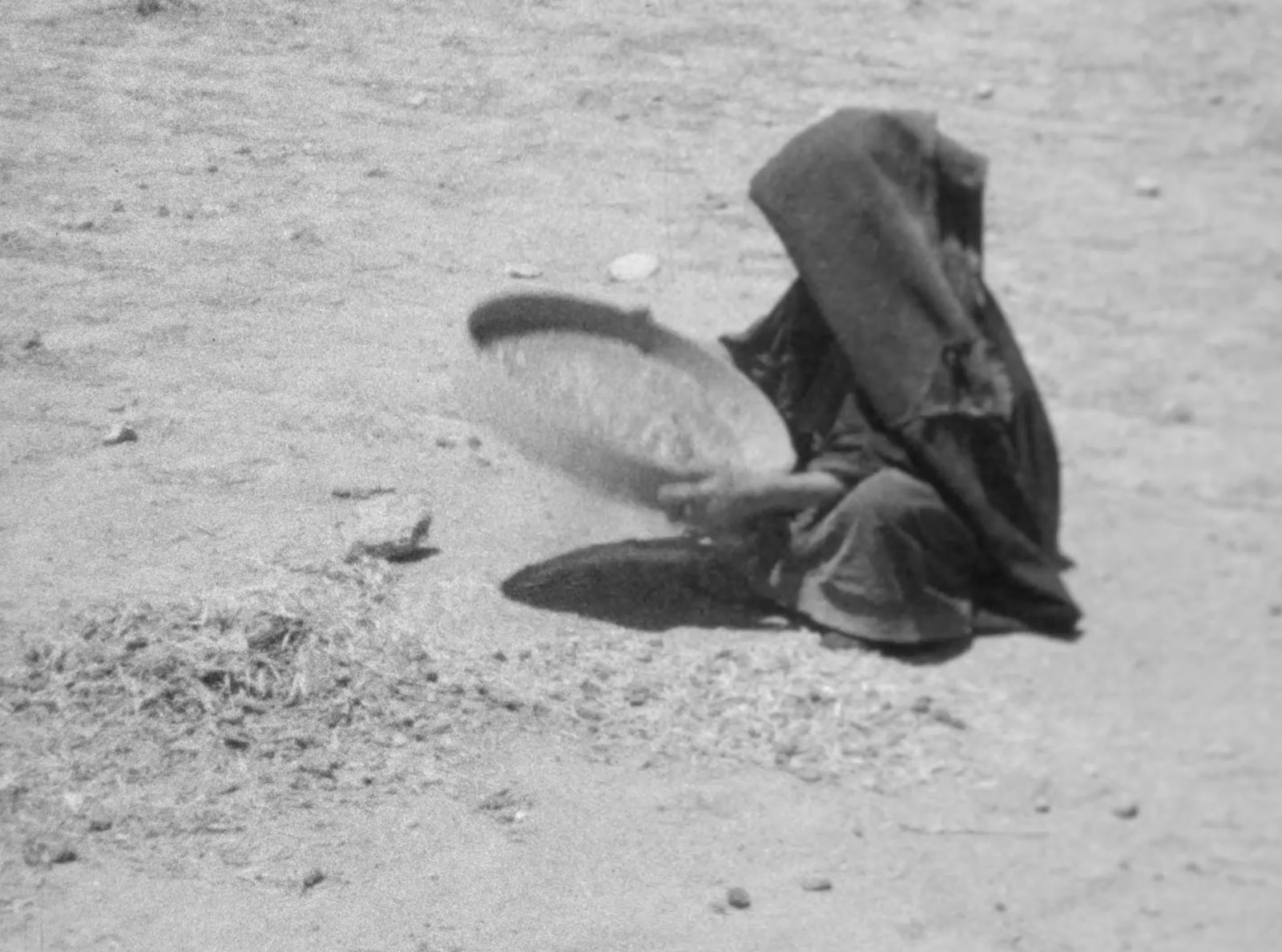
Figure 2: Arab Customs, Torrance collection. Courtesy of National Library of Scotland.
In this article I draw on the research of Sara Ahmed, and specifically her conceptualisation of “orientation” as an approach to understand Orientalism and subsequently the Orientalist gaze, not just as a critical and academic analysis but as a phenomenological and embodied reality. She expands Edward Said’s notion of Orientalism by exploring the term “orientation” to highlight the shared etymology with the word “Orient”. For Said ([1979] 2003), Orientalism refers to a discourse employed by the West for “dominating, restructuring, and having authority over the Orient” (25) and argues that “Orientalism is more particularly valuable as sign of European-Atlantic power over the Orient than it is as a veridic discourse about the Orient” (28). But while Said’s work focused on texts, Ahmed (2006) focuses on bodies arguing that the Orient “refers us not just to space or to directionality but also takes us in a specific direction” (112). For Ahmed, the Orient distils the idea of being “orientated” towards a specific location and thus it is an intentional form of facing something that is “other than me” and at the same time reasserts one’s own location as it “always reflects back or shows where one is located” (115). She offers the distinction between orientation towards and around to conceptualise the paradox of gazing at the other which is at once a form of consolidating the self, as well as signifying the importance of clarifying the here from which the orientation begins to unfold. Thus, “by being directed towards the orient, we are orientated “around” the Occident. Or, to be more precise, the Occident coheres at that which we are organised around through the very direction of our gaze towards the Orient” (116).
Ahmed’s conceptualisation of orientation becomes central to examining the colonial biblical and Orientalist gaze towards Palestinian bodies through an embodied and phenomenological understanding. It is vital to examine the different aspects through which the colonial gaze operates by investigating the spatial formations that hold Orientalist ideologies. That would include analysing the proximity of bodies from each other, the distance between the Scottish missionary’s camera in comparison to Palestinian bodies he is filming, as well as the ability to identify people’s faces which enhances their individuality and differences rather than creating a homogenous image of bodies and their environment. As Ahmed notes, the Orientalist gaze is highly dependent on “how bodies inhabit spaces through shared orientations” (118). By being in specific spaces, a body is able to extend its reach “by taking in that which is ‘not’ it, where the ‘not’ involves the acquisition of new capacities and directions” (115).
By using the earliest film in the collection named Tiberias 1935 as a case study, I decide to situate my research in relation to 1930s Mandatory Palestine. The specific archival film allows for examination of highly embodied representations of the colonial gaze towards Palestinians. According to its online listing, the film is considered by the Spielberg Jewish Foundation as one of the earliest films that present Palestine in colour (National Library of Scotland 2025). This rare find highlights the importance of the archival film as a rare documentation of the life in Palestine that also carries tension of hierarchies between white Scottish bodies and the indigenous Arab Palestinian bodies. I decide to frame Tiberias 1935 through Ahmed’s phenomenological lens as an analysis of image-making towards the relationship between bodies and the camera, which will then develop into a deeper understanding of the embodied performance as counternarrative discussed in the subsequent section.
In order to analyse how Ahmed’s ideas around orientation might be materialised in Torrance’s filmic compositions, I draw upon the coding categories developed by Catherine Lutz and Jane Collins (1993, 285) around notions of power, race, and history. These categories were created after their “close reading” of hundreds of photographs from National Geographic, which were examined images according to themes of colour, pose, framing and vantage point when investigating how non-Western peoples were represented. Using their “close-reading” methodology as an analytical framework, I examine how the Scottish missionary decided to look and film Arab Palestinian bodies by codifying the archival film frames in three categories.
The first category refers to footage that exclusively depict Arab Palestinian bodies. In examples such as the ones below, in instances presenting a woman wearing a traditional Palestinian embroidered dress or the fishermen in the lake of Galilee, the selection of what was filmed and what was not points to how the colonial, biblical, and Orientalist gaze can reveal itself. It is important to remember that the gaze does not reveal itself only when it decides to look, but also in what it decides to unsee or avert its gaze from.
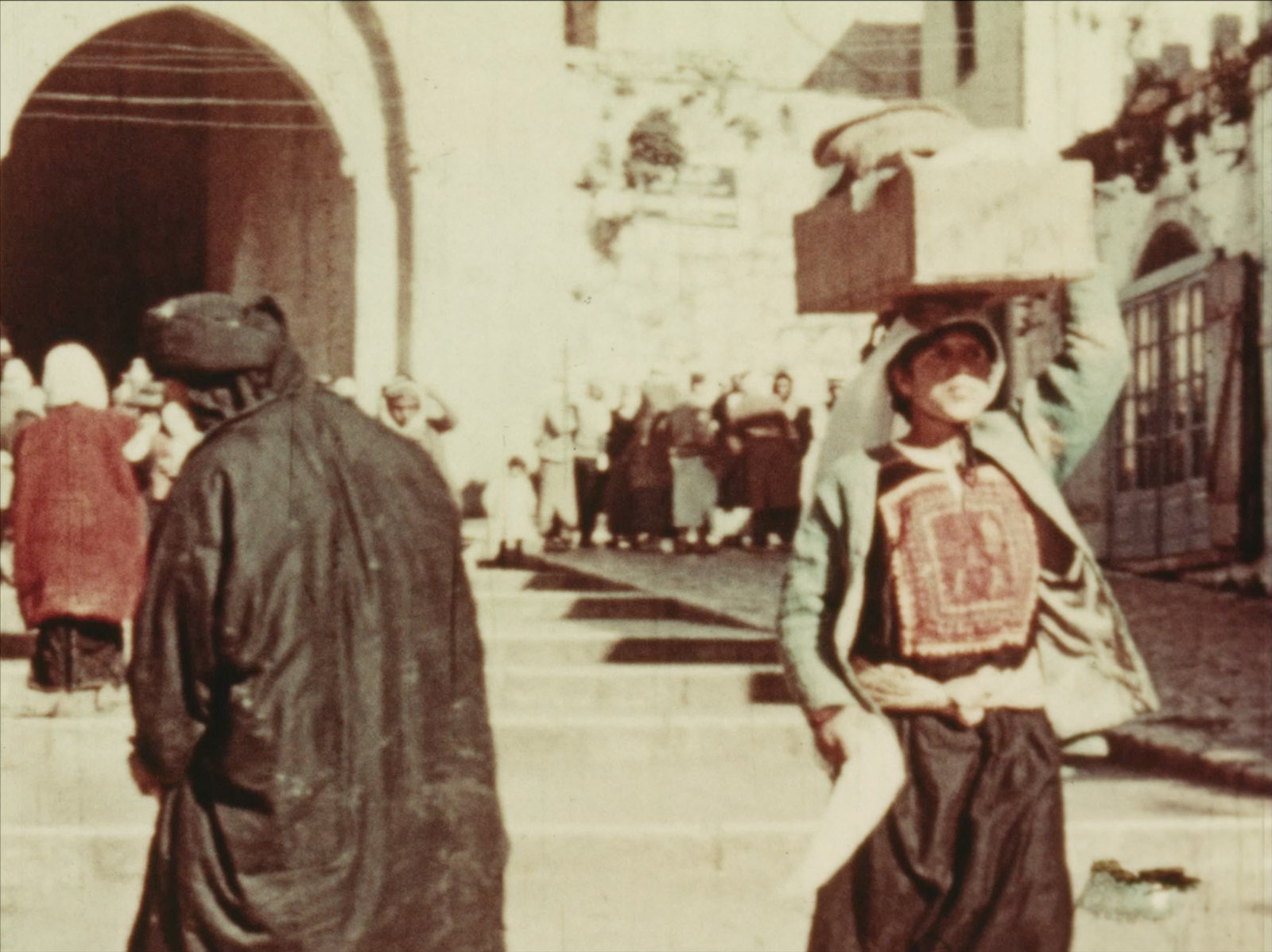
Figure 3: A woman carries a box on her head in a busy street, Tiberias 1935, Torrance collection. Courtesy of National Library of Scotland.
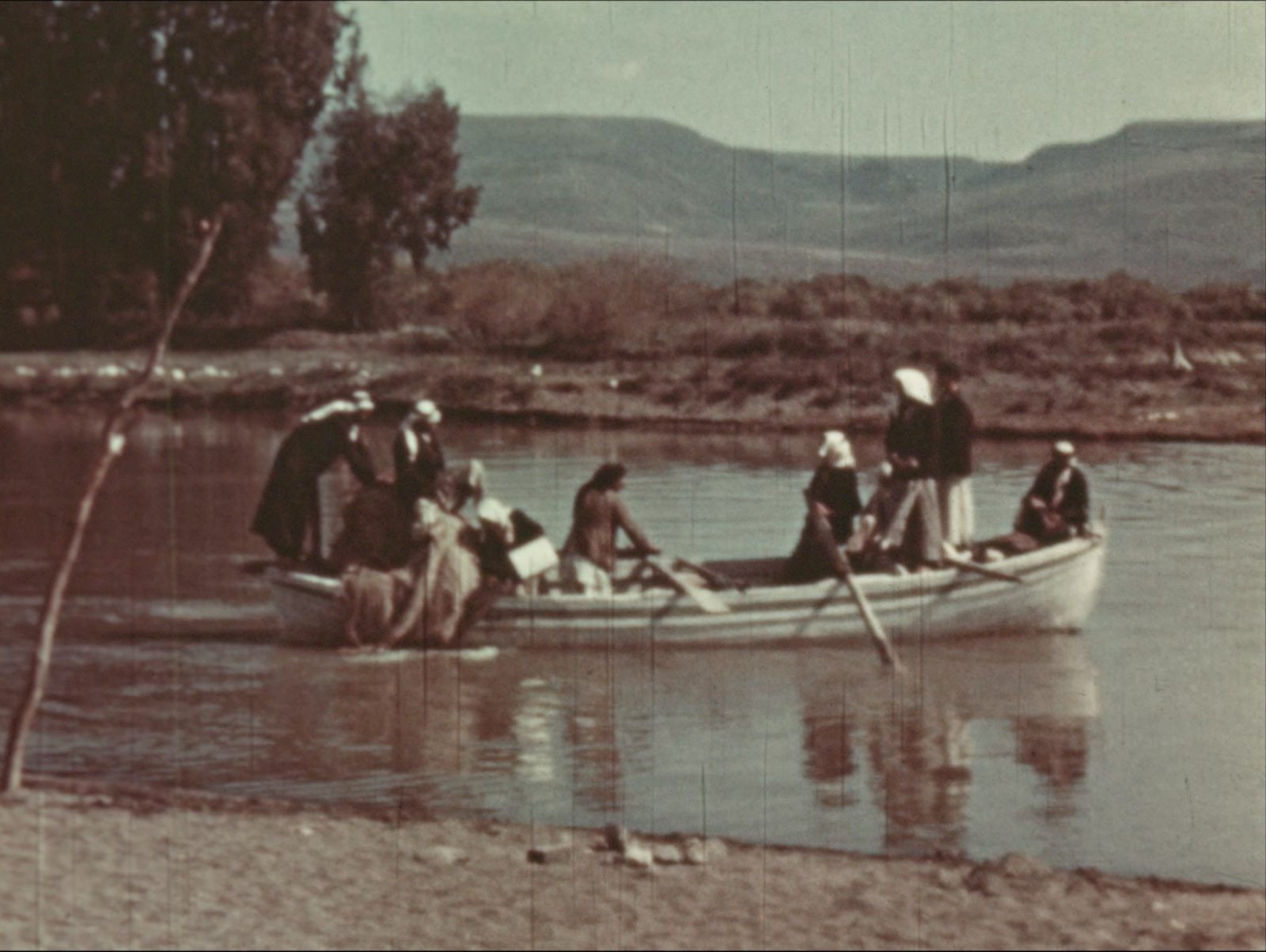
Figure 4: Fishermen at Lake Galilee, Tiberias 1935, Torrance collection. Courtesy of National Library of Scotland.
The Arab Palestinian people in the archive remain unnamed and their features mostly obscured. In each of the film frames, Palestinian bodies are positioned together, taking part in the same activity such as walking in the street, buying in the market, or fishing, making it hard to decipher their individual characteristics. As observed by Lutz and Collins in their own content analysis of colonial photography, non-Westerners are often seen as using so-called primitive technologies, for example being more spiritual, more in tune with their environment, and represented wearing fewer clothes. In the case of Mandatory Palestine, extensive research has described the community as one that has embraced modernity and had a plurality of experiences and cultures, as witnessed in the book Before Their Diaspora (Khalidi 1984). The filmic decision to prioritise highlighting Muslim and Jewish rituals over Christian ones confirm Lutz and Collins’ discovery, and further highlights how the Arab Palestinian bodies are selectively represented through the lens of the “exotic other”, conforming to expectations of primitivism and its biblical representation.
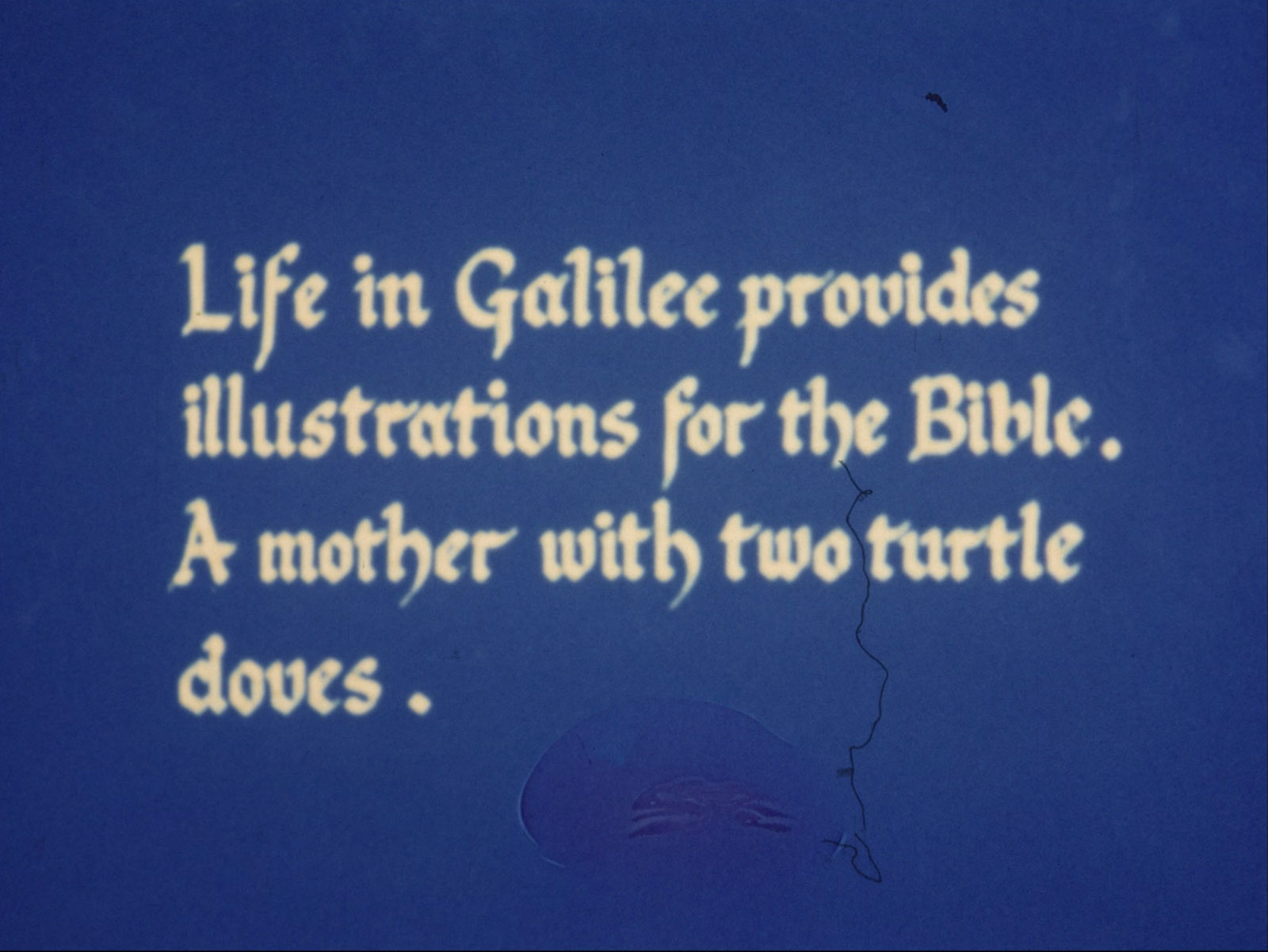
The separation between Scottish and Palestinian bodies becomes evident in the second category. The frames within this codification focus on how the Scottish missionary gaze looks at exclusively white Scottish bodies. In the example below, Scottish missionaries are presented with modern Western and formal clothes which contrast the traditional and “oriental” clothing that Palestinians have been solely portrayed wearing. Their bodily features are distinctive and clear, and the context of their activity, such as attending the language school, is purposeful and adequately described through an inter-title, as seen below.
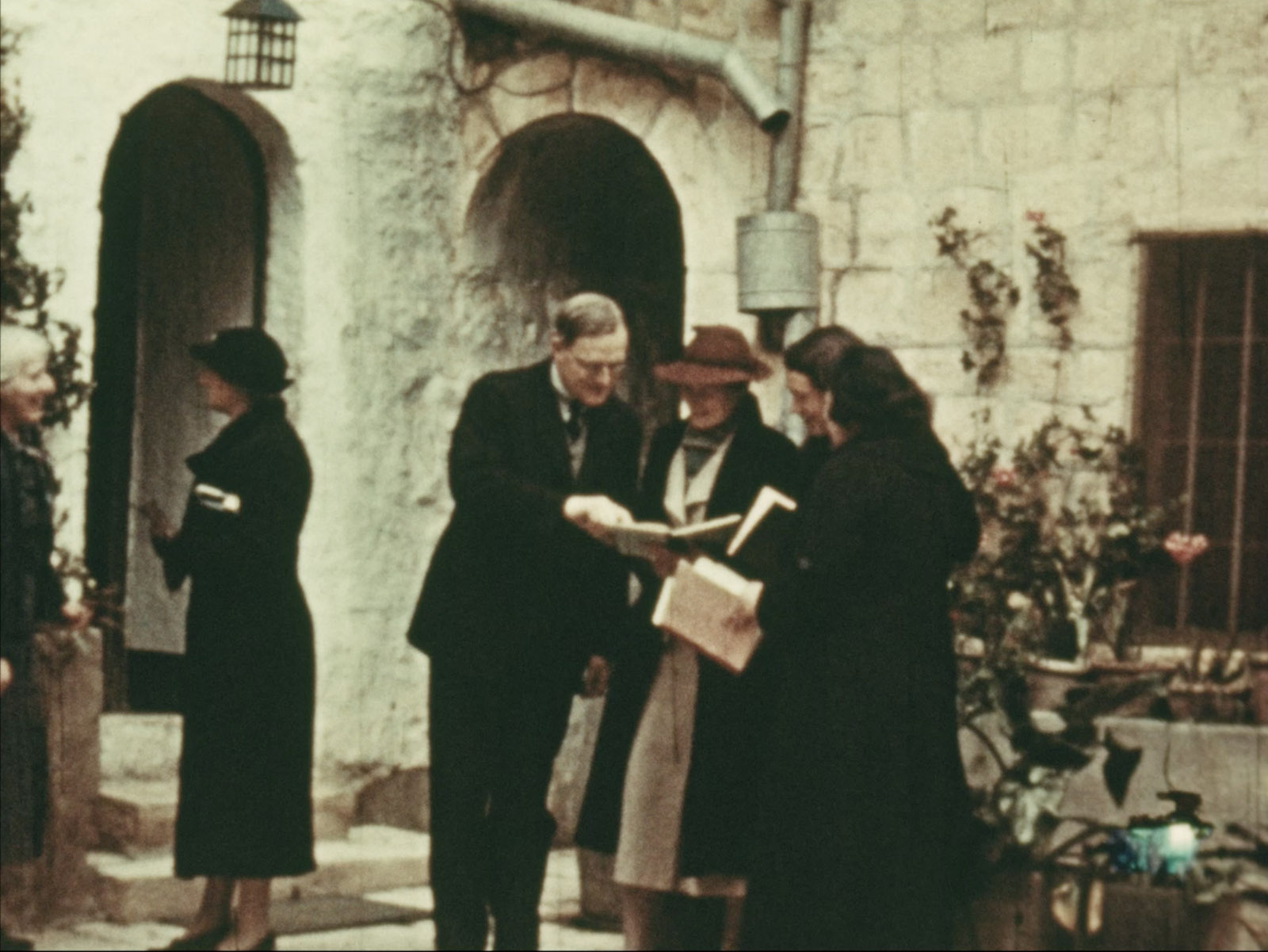
Figure 5: A group of Scottish people gathered in a language school, Tiberias 1935, Torrance collection. Courtesy of National Library of Scotland.
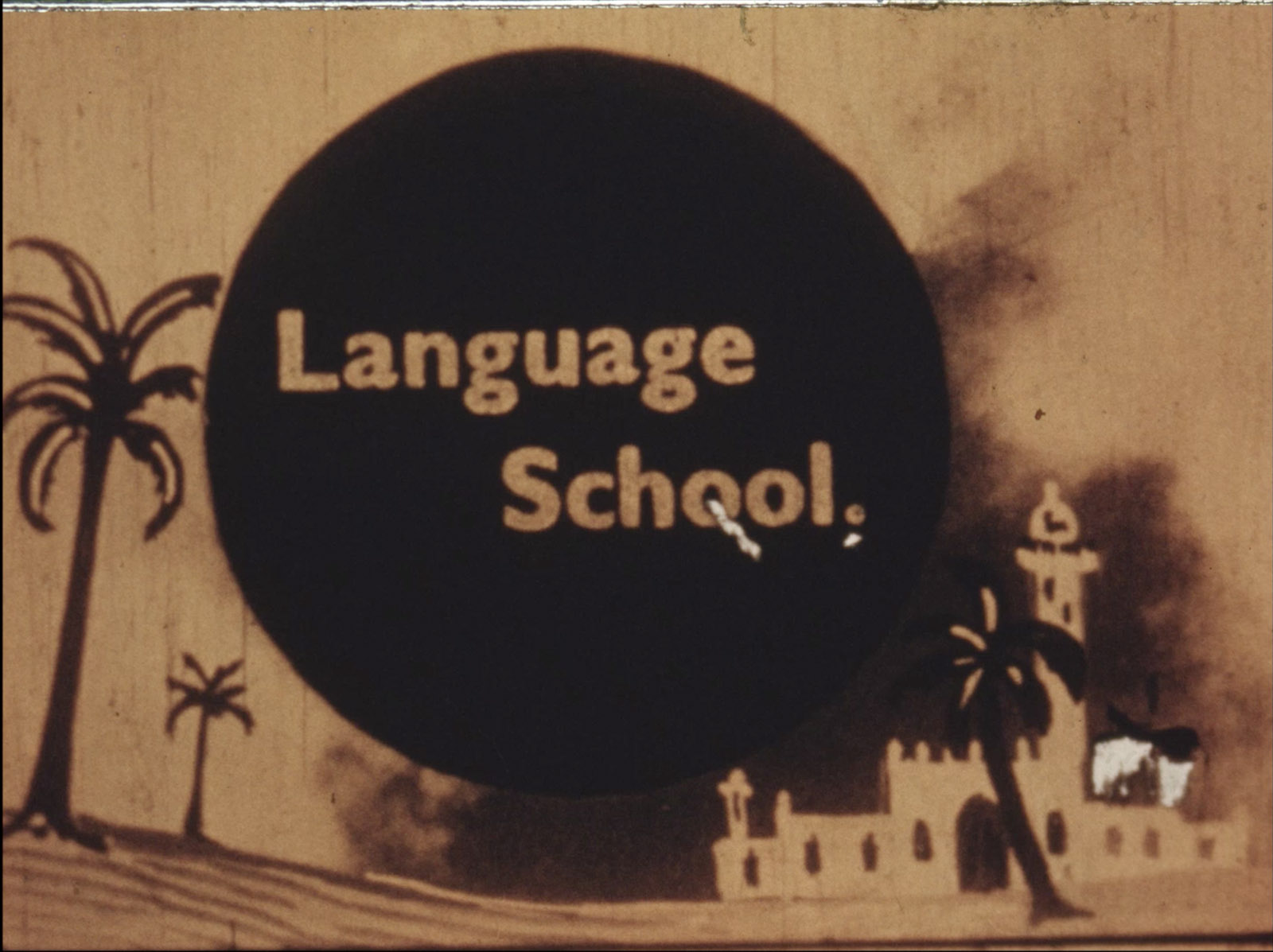
Figure 6: Language School title card, Tiberias 1935, Torrance collection. Courtesy of National Library of Scotland.
The binary between the two groups of people gets even clearer in the third and final categorisation. The third category focuses on moments when both Scottish and Arab Palestinians are situated within the same frame. While within Tiberias 1935 those moments are few and far between, they create a strong impression in how Scottish bodies are positioned hierarchically over Arab Palestinian bodies. In the case of the frame below, the Scottish filmmaker is filming and “capturing” the activity of Palestinian fisherman. He is positioned to appear above them, being in control of what and possibly how their activity is getting filmed. In another example that presents the spatiality of race, power, and colonialism, a Scottish missionary has positioned his body over the body of an Arab Palestinian body, gesturing as if “riding” a horse or a donkey. This positioning of the body evokes photography and film of British imperial occupations in which non-Western bodies were degraded to imagery of the savage and lower than human.
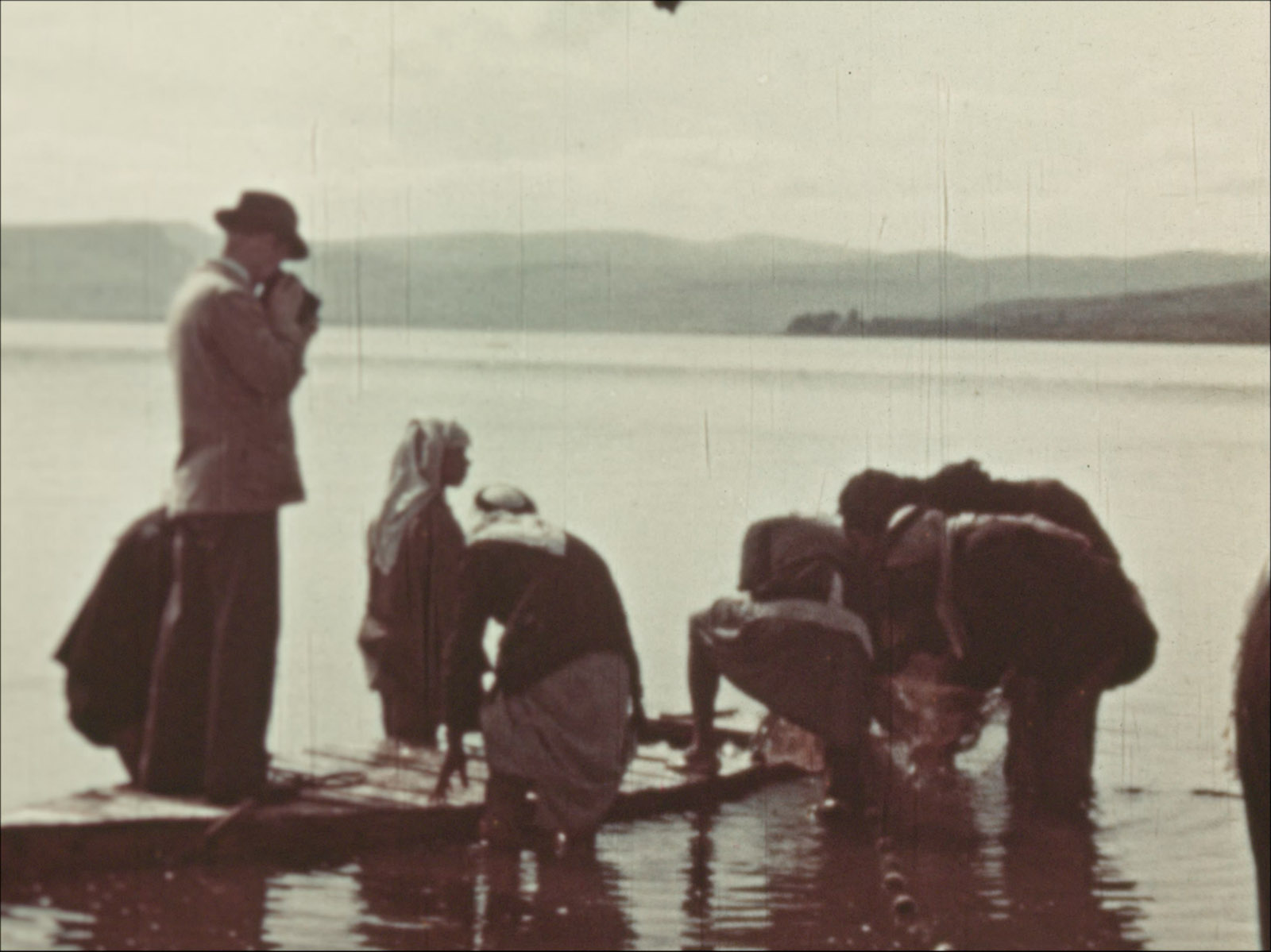
Figure 7: A Scottish man films fishermen in Lake Galilee, Tiberias 1935, Torrance collection. Courtesy of National Library of Scotland.
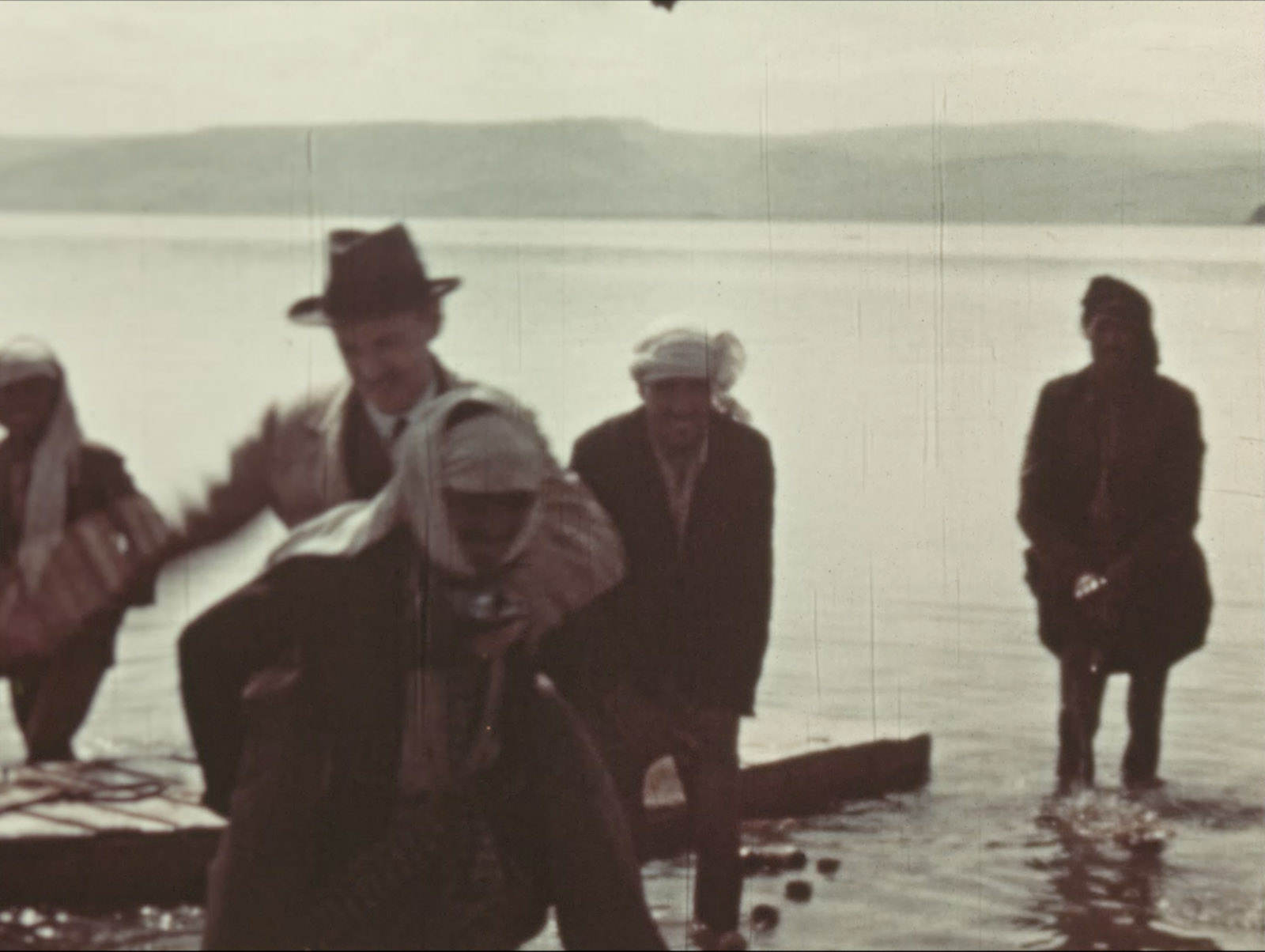
Figure 8: A Scottish man is carried by a fisherman in Lake Galilee, Tiberias 1935, Torrance collection. Courtesy of National Library of Scotland.
Given the way Lutz and Collins’ codes flow from a wider set of ideas about power and representation, their specificity in application to the Torrance archive and its biblical gaze has proved to be enlightening. They point out that non-Western people are represented as mostly relating to a Western point of view as an object of curiosity, either seen as primitive or embodying West’s mythology of a Biblical past.
By examining the archival images through Ahmed’s notion of orientation, I see Dr. Herbert Torrance’s camera as orientated around white Scottish bodies and towards Arab Palestinian bodies. While in the first category, the camera is used to highlight the superiority of whiteness in comparison to non-Western bodies, in this final category, Western bodies are seen superior both spatially and physically, highlighting the spatial formation of Orientalism beyond texts but through an embodied manifestation of power of white Scottish bodies over Arab Palestinian bodies. Therefore, we can articulate clearly and visually Palestinian life’s intensity of disposability through their unstable and precarious positioning within a “Holy Land” that is perceived as not theirs to be in. The colonial “making” and its aesthetic form thus unfolds in that context too.
The natives’ challenge to the colonial world is not a rational confrontation of points of view. It is not a treatise on the universal, but the untidy affirmation of an original idea propounded as an absolute. (Fanon 1963, 41)
In late 2024, I facilitated practice-as-research workshops alongside Palestinian diasporic participants as a process of co-creating Palestinian performances as “counternarratives” to the colonial “masternarrative” of Scottish archival films. My research consisted of two participatory performance projects, which saw me work with Palestinian diasporic individuals in Athens, Greece, and Glasgow, Scotland, which resulted in two final works. The first project, A Land with a People: A Palestinian Counternarrative, is a participatory film co-created over two days in September 2024 in Athens, and the second project, Ancestral Gestures to an Absent Sound, is a two-channel video installation documenting a participatory performance as gestural and sound re-enactment, which took place in November 2024 in Glasgow. Using the film archive Tiberias 1935 as a starting point, I invited them to co-create performances as archival “counternarratives”. The workshops’ methodology was thoughtfully designed to firstly deconstruct and deform the archival masternarrative and secondly reconstruct and transform the Palestinian counternarrative.
I frame the Palestinian diasporic participants’ engagement with the archive in two separate stages, by re-appropriating Bataille’s notion of “the informe”: the first stage is seen as deforming the colonial masternarrative by re-orienting the biblical film gaze; the second stage is seen as transforming the Palestinian counternarrative through voice and movement. From the one side, the act of deforming focuses on developing the content of the performance, shifting the colonial gaze as re-orientation around the Arab Palestinians in the archive and towards the Scottish missionary. On the side, the act of transforming hinges on shaping the form of performance.
In 1929, Georges Bataille coined the term “l’informe”, or formlessness in English, in the surrealist journal Documents, in order to investigate the idea of intrinsic worthlessness (Bois and Krauss 1996, 16). He conceptualised l’informe not as an object or an adjective but as a method, used in an abstract and philosophical manner (ibid, 16–18). Bataille directly challenged the perceived hierarchies of art which were seen as exemplifying themes of humanism, embodied by the surrealist artists of time. The term l’informe offers a satirical and critical perspective which highlights the need to dismantle conventional form and elitist categorisation by “bringing art down to the waste level”, to affirm that “the universe resembles nothing” (Bataille 1985, 31).
Considering how the examination of colonial ideology within archival films underlines the importance of form in shaping the consciousness around “othered” bodies and lands, the act of deforming becomes a powerful tool of rejecting elitist Western categorisation that undermines non-Western cultures and offers the consensual framework for domination and colonial expansion. While the term’s English translation as “formlessness” indicates a lack of form, Bataille’s interpretation posits the question of negotiation between what is formed and what remains formless. For that reason, like many scholars before me (Stoppani 2007; Van Raffe 2016), I decided to translate the French term l’informe into English as “the informe” to distinguish between this conceptual and linguistic confusion that the term “formlessness” might create.
Many artists have attempted to explore Bataille’s theorisation of “the informe” by experimenting with aesthetics and artistic form. Artists Rosalind Krauss and Yves-Alain Bois (1997) used Bataille’s concept in an exhibition at the Centre Pompidou in Paris called Formless: A User’s Guide where they discussed it as a valuable tool for free creative expression. While Bois and Kraus examined “the informe” through a radically materialist perspective and as a method of abjection against the rationality of high art, I believe that “the informe” as a method of rejecting categorisation feels very relevant in the context of rejecting the austere categorisation that colonial images construct of Palestinian bodies.
Sandra Ruiz and Hypatia Vourloumis (2021), in their book Formless Formations: Vignettes for the End of this World, employ Bataille’s “the informe” through an explicitly political angle. They frame their research as an “insurgent walking and flying side by side with planetary anticolonial organising and in direct solidarity with all indigenous, Black, Brown, feminist, queer, ecological, migrating and diasporic soldiers of love” (21). For them to be formless is to be in solidarity, by describing their term “formless formations” as a practice towards planetary “border breakage” (15). Within the Palestinian context, Abdaljawad Omar (2024) appropriates Bataille’s “the informe” when describing “formless operations” of Palestinian resistance that “deform” the colonial structure. By looking at resistance as an “anticoncept” (304), he claims that its aim is to resist conceptualisation as it “flows from the very structures that it ultimately seeks to decompose, degrade and destabilise” (309).
While Bataille’s theorisation does not involve reconstruction after absolute deconstruction, I posit that in the context of Palestinian narrativisation and lived experience, reclaiming and rebuilding what was lost becomes a radical act equal to Bataille’s nihilist sentiment in the 1930s. For Palestinians, when facing ongoing genocide, the act of reconstruction turns into a radical act of resistance and determination in the face of mass death and destruction. Bataille’s act of “the informe” brings a linguistic and intellectual radicality to an act of extreme perseverance by fundamentally disrupting the status quo that normalises violence, taking apart the existing rigid nature of the colonial form, and subsequently occupying the space of absence through their body; their grief, their pain, and their anger.
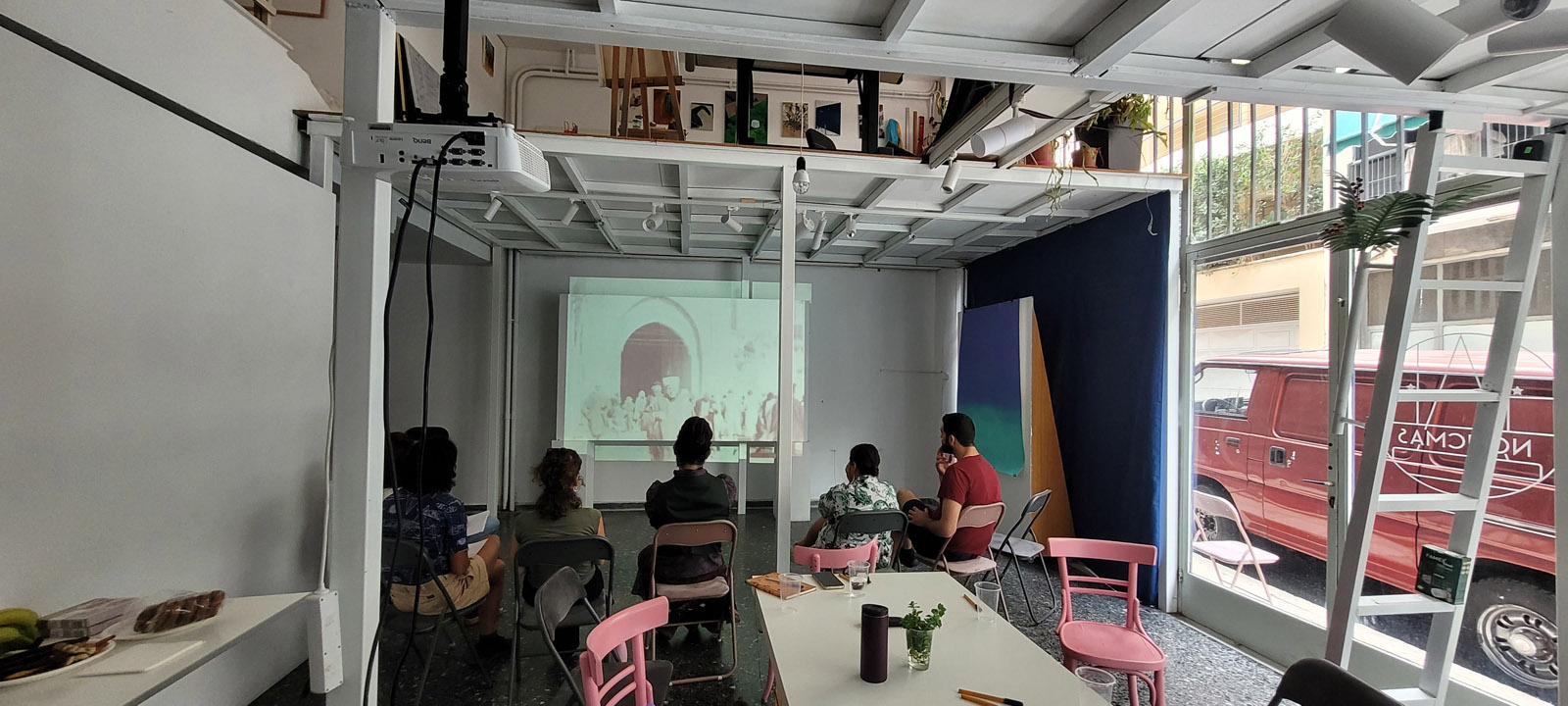
Figure 9: Palestinian workshop participants witnessing the archive for the first time, Athens, September 2024. Courtesy of Theo Panagopoulos.
The workshop was divided into two days with separate aims. Day one of the workshop involved the Palestinian participants meeting each other, introducing themselves, and learning more about the Scottish film archive as both an object of testimony as well as an ideological process of preserving but also constructing memory. Deforming the archive took multiple shapes and exercises, such as printed postcards of the archive, personal domestic objects, as well as writing prompts. The second day was designed as more of a loose and flexible day where the Palestinian participants were able to select a preferred performance approach when expressing, sharing, and transforming their counternarrative to the Scottish colonial gaze.
The participants in both cities came from diverse backgrounds, life experiences, and age groups, but also different connections to Palestine, either being mixed heritage, first or second generation Palestinian, and/or having been born or lived in the West Bank, Gaza, or as an Arab minority as part of the State of Israel. The workshop timings felt very heightened considering how connecting to each other during a period of collective grief and pain was very needed for all the participants, made even more significant due to taking place around the one-year anniversary since the genocide began. In Athens, I facilitated the workshop alongside Athens-based Palestinian poet Carol Sansour, while in Glasgow a portion of the workshop was supported by Emily Munro, one of the curators at the Moving Image Archive at the National Library of Scotland. The difference of experience and contribution created a fascinating contrast to notions of proximity, first geographically to Palestine but also culturally to the Scottish archive.
The workshops began with personal introductions and a clear overview of the process of the workshop. The participants in Athens began by introducing themselves and discussing their desires as part of embarking on this methodological process of archival intervention. The Glasgow-based participants were first treated to an intimate tour of the Moving Image Archives at the National Library of Scotland, getting access to private spaces and getting to understand the realities of preservation, archiving, and categorisation. The Torrance collection was thus situated within its own institution, as both a repository of memory but also as a physical space and a result of archival labour. Both approaches situated the participants within their respective environments and to each other as Palestinians, heightening the responsibility of witnessing the past during an urgent present. In both instances, participants discussed their own proximity to their Palestinian identity, either intergenerationally or spatially, while I also presented my research and the questions that brought me to the project. I discussed how my own Palestinian heritage as a mixed-heritage person combined with my embodied connections to Scotland as an immigrant, as well as to Greece through being half-Greek, led me to develop this methodology.
The film set the tone of the discussion that followed. The participants shared thoughts, discoveries, and memories that emerged after witnessing the footage. The discussion was free-form as an embodied orientation that unfolded from the “here” of a colonial archival film. They witnessed their ancestral past; an image of a land that rarely gets seen. However, they felt that the image was filtered through the eyes of a missionary and thus misrepresented what they knew to be true. Their intergenerational and embodied knowledge clashed with images and colonial re-interpretations. The discussion was followed by practical exercises that started the process of re-orienting the Orientalist gaze.
After the initial discussions, the participants were given the opportunity to choose one frame from the archival film in the form of a postcard. Three questions were provided along with the postcards:
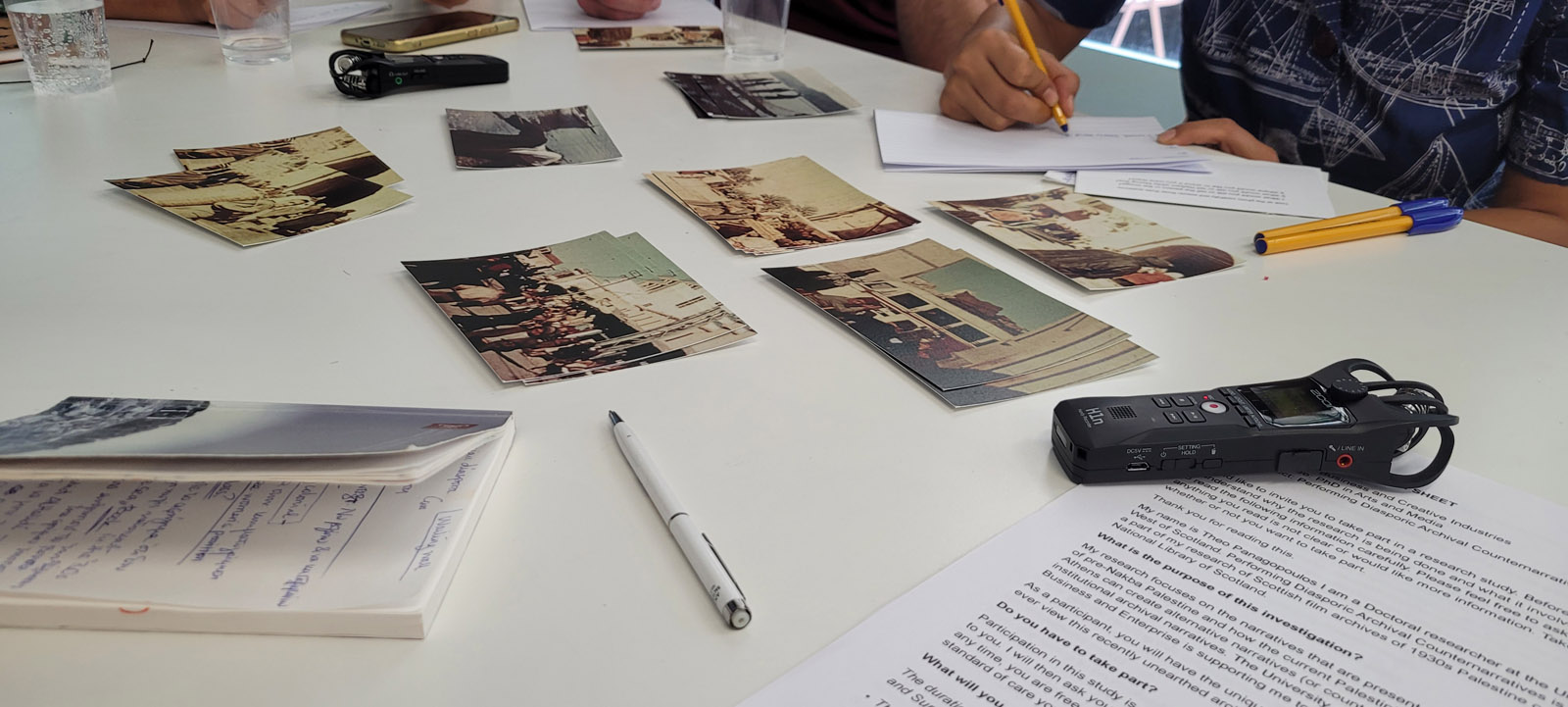
Figure 10: Postcard exercise, Athens, September 2024. Courtesy of Theo Panagopoulos.
Speaker 1: What would I ask these fishermen? What is the connection between them? If they are relatives, friends, how long they have been working together, where are the women, wives? If there are fisherwomen?
Speaker 2: What would I ask or tell the person in the image? One, I would ask them who they are. I would greet them, I would ask who they are, I would ask them where they are from. I want to ask them about the news. What are our people feeling.
Speaker 3: It reminds me of my grandmother. So, the first question is, “What would you ask or tell the person?” I would like first to greet her and ask her about her day and her name. I would also compliment her tatreez and I would tell her that she looks like my grandmother who was displaced from Tell-es-Safi village near Hebron. I would also ask her about what she is holding in her hands and around her waist.
This question highlights the start of the re-orientation process. The participants began by orienting themselves around the Palestinians in their selected postcards. Their answers signify the need to add a sense of humanity to their people and seek a point of connection to a skewed representation of their ancestral past. Most participants approached their response with caution but tenderness, attempting to learn about people’s specific experience, their genealogy and the social fabric that surrounds them. Some participants connected personally to some of the people in the archive, as they reminded them of their own family members.
The participants’ engagement with Arab Palestinians seen in the background of the frame directly connects to Bataille’s “the informe” as a method of deforming the archive as well as Ahmed’s conceptualisation of background. For Ahmed (2006), background could refer “to the ground or parts situated in the rear, or to the portions of the picture represented at a distance” (97). The participants’ contributions speak to what Ahmed describes as the “spatiality” of the background, which also gives shape to what is in the foreground. For the participants, the image’s background presents a plethora of possibilities for connection to those who have been rejected by colonial image-making, to the landscapes rejected by the missionary gaze, and to the ideas that could not be “absorbed” by the film camera.
Ahmed suggests that the notion of the background carries both a spatial and a temporal dimension. She used the example of “telling a story about someone” in order to offer the background or “what is behind” the person and the story (96). In that case, the notion of background refers to the past, to what happened in a previous time. Those two interpretations of background become essential in understanding how participants attempt to deform the archive, both spatially and temporally. The act of deforming as archival re-orientation is both about embodying the archive as an image and intervening in the narrative of the past. The participants deform a construction of the past seen through the eyes of Scottish missionary Herbert Torrance. Their engagement feels present despite their access to a “disposed” past.
Speaker 1: What would I ask Herbert? I don’t know if I would have anything to say to him. I don’t want to talk to him. But maybe I would ask him how they welcomed him. Did the fishermen welcome them? Did he ask for permission?
Speaker 2: I think I will tell Herbert that Palestinian women are strong and independent and are well-educated. I would also ask him about his perception and the reason why he is filming.
Speaker 3: In terms of what would I tell or ask Herbert…. It is interesting you call him Herbert. I find it weirdly personalised. I would want to understand his view in relation to his own positionality, his role, his underling ideology which we spoke about earlier, his politics. But mainly I want to know how he understood his power, his position, his privilege of being there and how he viewed himself in relation to other people in context.
This question focuses on how the workshop participants re-oriented towards the colonial gaze and the missionary’s role as a filmmaker. Most of the workshop participants held a hostile stance against Torrance by critically interrogating his role in creating a biblical narrative of Palestine that marginalises the indigenous Palestinian population. They questioned his positionality and ideological background but also his knowledge of the people he was filming. Through that hostility, the participants were able to reject his vision of their ancestral past and take the opportunity to expose his skewed colonial vision. Thus, their refusal to accept the archival vision as “objective truth” becomes central in constructing their own “counternarrative”.
Speaker 1: I would like to stand shoulder to shoulder with this man pulling this fishing net and eat fish together.
Speaker 2: To be honest, I would like to be in the sea. It would be a little bit difficult, so I would just be beside them looking from their own point of view.
Speaker 3: Where would I be standing in this picture? In fact, I think I would be standing with the women here in the back. Because I would be listening and trying to understand why they are all gathered there and what they are talking about. What are they discussing, what problem or occasion it is.
Speaker 4: I would stand in front of the camera with my back to the camera and block the camera. And then take over the view, own the perspective. The longer answer is I would just help; I would want to be part of it, I would want to help the men to fish, I would go home with them afterwards and visit their families. I would then ask them to help me figure out how to go visit my own family. That is the first answer I gave. But if I was just standing, I would stand with my back to the camera.
For this final question, I draw from Ahmed’s phenomenological notion of “worldfacing” in analysing the participants’ responses. Ahmed (2006) discusses “worldfacing” when describing the phenomenological outlook of Orientalism as a “way of gathering things around so they ‘face’ a certain direction” (118) and thus creating a worldview through its gaze. ‘Worldfacing’ refers to how a worldview gets reflected within a phenomenal space and how “bodies inhabit spaces through shared orientations” (ibid.). By physicalising the frame and imagining it through a spatial dimension, the participants embody their own collective re-orientation by choosing where to stand within the frame. All participants chose to position themselves around Palestinian bodies and making them central to their own way of looking. Responses such as “shoulder to shoulder” and “I would stand with my back to the camera” signify an embodied reclamation not only of the gaze but also of the space they are meant to occupy. By centring the position of the Palestinian bodies, they present their own positionality in how they view and experience the archival film.
Diasporic Palestinian communities began from a sense of “disorientation” as their starting point of their own orientation to Palestine is from a place of exile and displacement. The notion of diaspora as an identity centres “worldfacing” in connection with what has been disrupted, in this case Palestine as a land that the participants have been exiled or displaced from. How do Palestinian individuals of mixed heritage orientate themselves when connected to the Western colonial gaze? In some cases, participants wrestled with positioning themselves clearly as part of a binary of “us” and “other” due to their mixed heritage and/or their upbringing in the West.
Speaker 1: I carry my identity as jewel, it’s important to me, I’m proud of it but it’s also restraining, it carries a weight which is tying me somehow. To what I am, to what I’m going to be and to what is going on now and how I want to express all this struggle.
Speaker 2: When I was growing up in Canada, Palestinians only were represented as terrorists in the media. Exclusively […] it wasn’t till I left Canada that I began realising how conditioned I was to see ourselves in a particular way and there was so much of deconstruction of that case, it is still there, it is inevitable.
Ahmed discusses the notion of mixed orientation as a form of “reinvestigating alignments between bodies, nations and world” (112). Being of mixed heritage inherently “breaks” the strict binary categorisation of the colonial gaze, blending the idea of “other” with the notion of “us”. The idea of being in the diaspora and of mixed heritage adds to the sense of “disorientation” as it affects deeply the way one is looked at or seen on screen, always in contrast to other white bodies. According to Ahmed, he familiarity of what is considered a “white world” can “disorient” non-white bodies. The non-white gaze returns to the non-white body, following the line of the hostile white gaze. Colonialism makes the world “white” which is a world “ready” for certain kinds of bodies and not others (111). As she notes: “bodies remember such histories, even when we forget them. Such histories, we might say, surface on the body, or even shape how bodies surface. In a way, then, race does become a social as well as bodily given, or what we receive from others as an inheritance of this history” (ibid.). The notion of history and, in this case, colonialism living in the body became central how the Palestinian participants deformed the archive by devising their performance as counternarrative and as reclamation to the othering of the Arab Palestinian bodies.
During the workshop’s second day, the participants discussed and decided on the form that their intervention would take. While the first day followed a more rigid structure of multiple steps through which they deformed the colonial gaze, the second day was directed by the participants themselves through discussion and collective agreement on the content and form of their performance as counternarrative. The discussion took a critical approach around the notion of form that moulded itself into certain essential questions: what does our Palestinian counternarrative look like? What is the best way to attend to bodies and lived experiences without replicating historical patterns of oppression? Under what conditions should this archive be seen?
The Palestinian participants initially engaged first with the idea of what the counternarrative should not be by rejecting the colonial images of Palestinian embodied existences. For Eve Tuck and K. Wayne Yang (2014) bodily and “analytic practices of refusal involve an active resistance to trading in pain and humiliation and supply a rationale for blocking the settler colonial gaze that wants those stories” (812). For the participants, following their own agenda when creating their own narrative deeply resonated with them. Both groups in Athens and Glasgow, unbeknownst to each other’s choices, decided to intervene in the silent archives by developing their performance with the aim of “activating” auditory absence.
Bataille’s “the informe” feels apt when examining how the participants decided to transform their counternarrative by engaging with both what was formed (the visuals) and what was formless (the sound). As the negotiation between the formed and the formless, “the informe” becomes central when investigating the visual and audio interventions. It also contributes to a significant understanding when examining performance between physical “formed bodies” and digital “formless bodies”. Bataille’s theorisation offers a powerful conceptual outlook that allows the investigation of archival performance as a process of dismantling rigid categorisation by engaging with absence through the disposed, the erased, and the disappeared. The participants did not just create a form for what was formless, but rather, they exemplified the deep interconnectivity between was kept formed and what formless, enhancing notions of absence by bringing presence to the exact forced formlessness that Palestinian have been facing for more than a century, both narratively and physically. By developing their performance counternarrative out of absence, the diasporic Palestinian participants were able to implement their own agenda of unearthing intimate Palestinian stories. Many questions arose in the process of performing these interventions: who usually speaks and why? Could the emergence of a lost sound address the silences of history?
Speaker 1: Maybe we can write a voiceover on these 8 minutes.
Speaker 2: It could be more than one voiceover, could be one in Arabic, one in English, could be one telling one story and one telling another story.
Speaker 3: It will be nice to do one collective project as counternarrative. But each one of us can decide how we want to archive and respond to the archive.
In Athens, participants intervened through the sound by individually writing their own voiceovers. The voiceovers would be based on discussions that organically emerged as part of the two-day methodology and were either fictional, documentary, or hybrid in form and ascribed to the archive itself. The emerged counternarrative created a powerful mosaic of experiences for what it means to be a Palestinian in the 1930s and 2024; in the diaspora and on the land of historic Palestine; in the inner and embodied world and in the external social and political world. This assemblage of voices mirrored all the voices that could not be heard in the archive and all the memories that were intergenerationally passed down and were kept in the participants’ bodies.
Performance emerged as a collective tool of preserving lost collective memory and countering the hegemony of the missionary’s gaze. The voiceovers, while developed individually, were workshopped as a collective unit, with every workshop participant offering their own feedback on tone, cadence, and feeling. In many cases, the participants were encouraged by each other to write in Arabic, some being more fluent than others, and thus reclaim their own language as part of their counternarrative. Others were happy to perform in the language they felt most comfortable, in Greek or English, and thus offer the plurality of the diasporic Palestinian experience. All participants collectively agreed to use the existing archival footage of Tiberias 1935, to mould it, deform it, and transform it, so as to “fit” within their own gaze. The final work includes seven voiceovers ranging from the humorous, to the serious, from the autobiographical to the purely imaginative and fictional, from the 1930s to today.
Bataille’s philosophy became the framing through which the archival films were appropriated. The notion of the “accursed share” through the “wasted archives” and the notion of “the informe” through editing decisions of de-classifying meaning and de-aesthetisation of the image became central in how I decided to intervene through editing and creatively engage with the form of the archive. I approached the juxtaposition of a blurry versus clear image which signified the politics of visibility as well as notions of beauty. In French, Bataille’s l’informe does not only refer to the form as a mode of creative production but it also etymologically connects to the French word informe which has a double meaning and is very much reflected in Bataille’s use of the term. On the one hand it refers to something without a determined form as mentioned above, but on the other hand it refers to something imperfect, ugly, and flawed. Bataille’s understanding of “the informe” emphasises both aspects as a notion served to declassify and dismantle concrete systems of classification and hierarchisation.
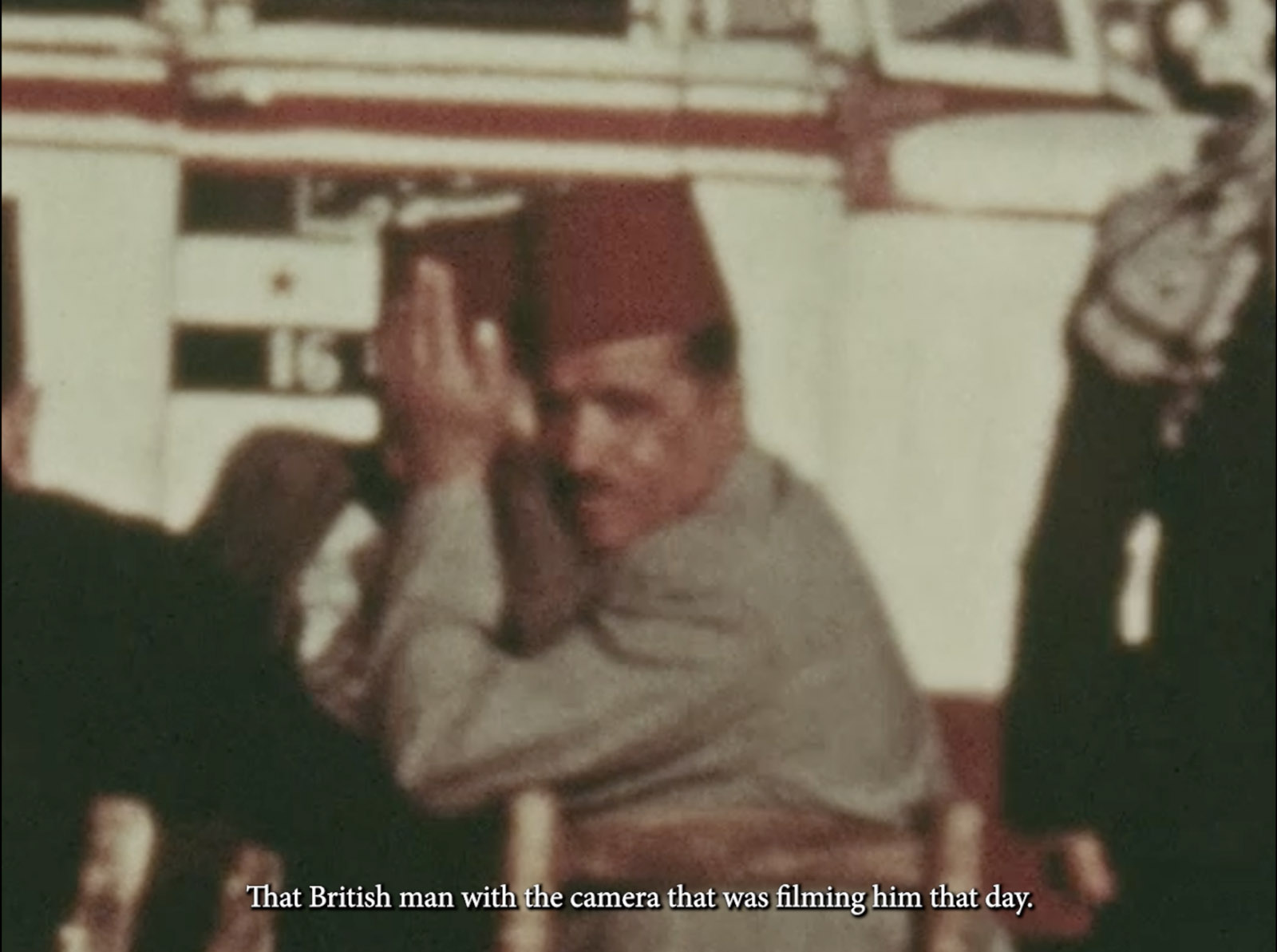
Figure 11: A love story between a Palestinian and a Syrian gets interrupted by the presence of the camera, A Land with a People: A Palestinian Counternarrative. Courtesy of Theo Panagopoulos.
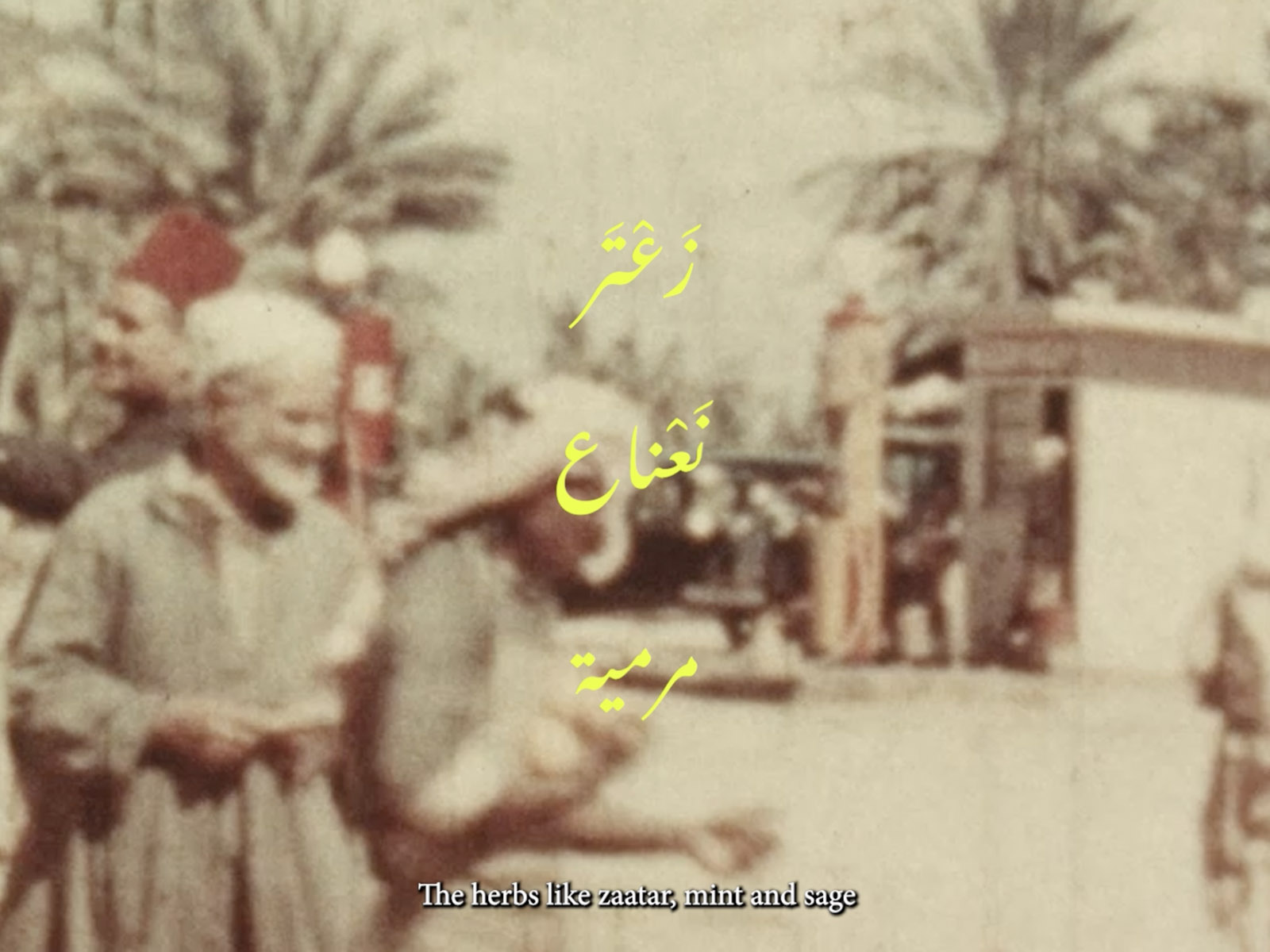
Figure 12: Text of herbs in Arabic are superimposed on the image, A Land with a People: A Palestinian Counternarrative. Courtesy of Theo Panagopoulos.
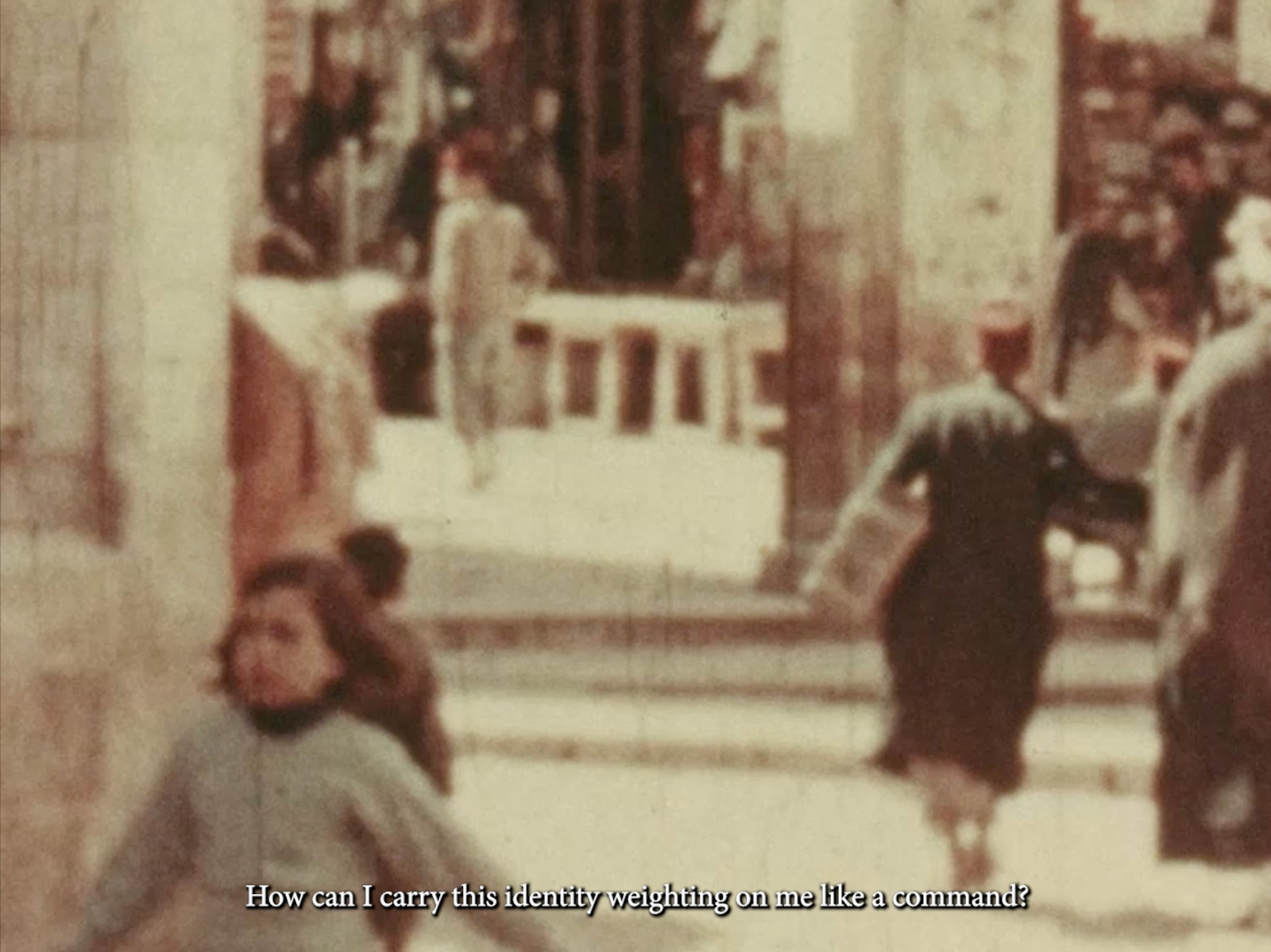
Figure 13: A participant’s emotional voiceover is reflected through footage moving in reverse, zoomed in and slowed down. A Land with a People: A Palestinian Counternarrative. Courtesy of Theo Panagopoulos.
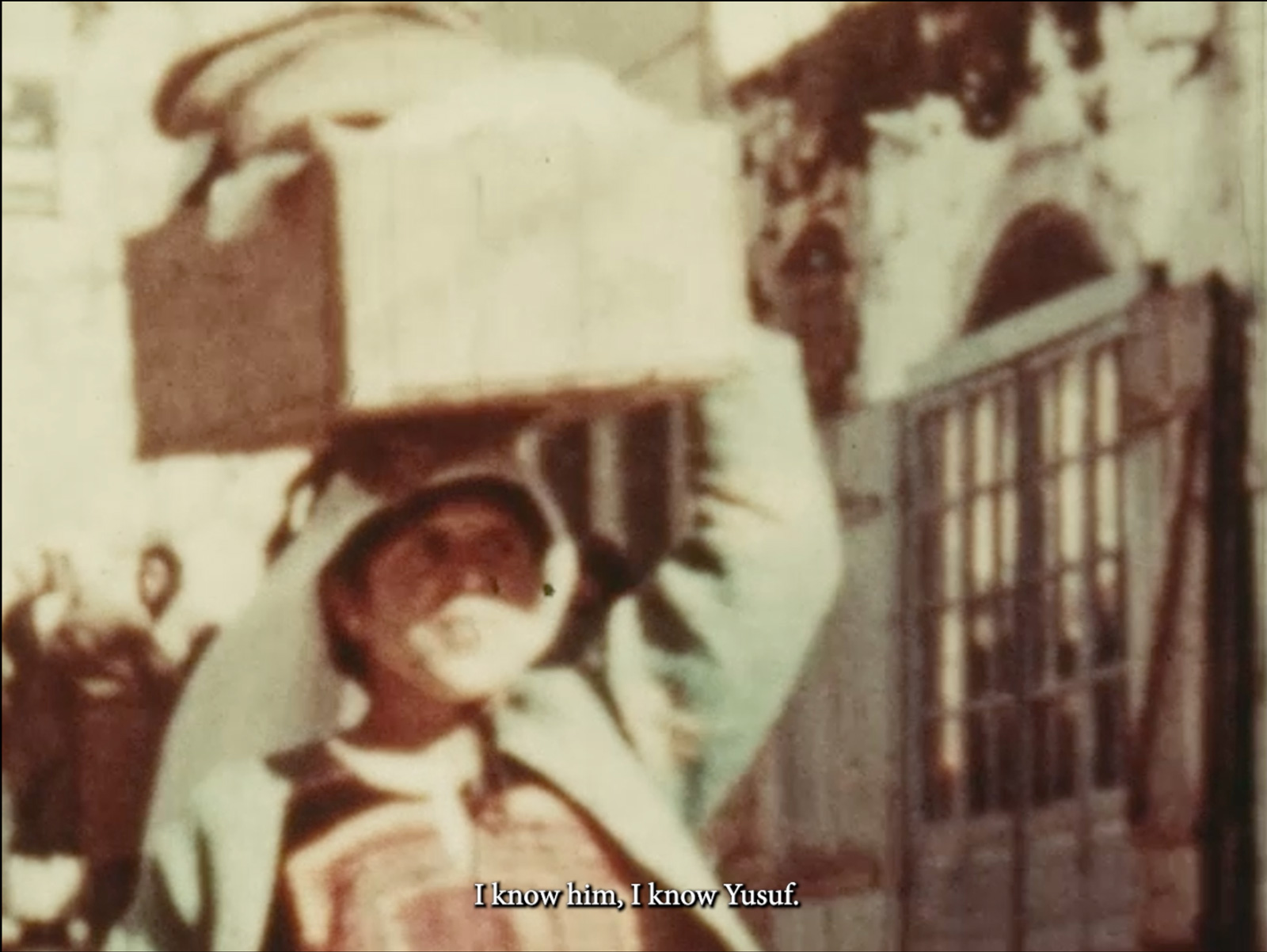
Figure 14: A woman holding a box becomes the vessel for an autobiographical interpretation. A Land with a People: A Palestinian Counternarrative. Courtesy of Theo Panagopoulos.
Intervening with the use of pixelated close-ups attempts to “uglify” the image and deform it. However, the contradiction is held in the fact that the footage itself renders Arab Palestinians as disposed not only from the film’s narrative but also their own land. To bring them to the forefront through archival re-appropriation brings their beauty to the centre of the frame, thus subverting notions of what is considered beautiful and what ugly. The counternarrative deforms the Orientalist gaze by deciding to look in the background, where the people are barely visible and their relationships with the land erased. Expanding the frame not only becomes a symbolic representation of re-claiming the narrative but allows for details within the image itself to emerge, which subsequently shifts the perception of the frame itself.
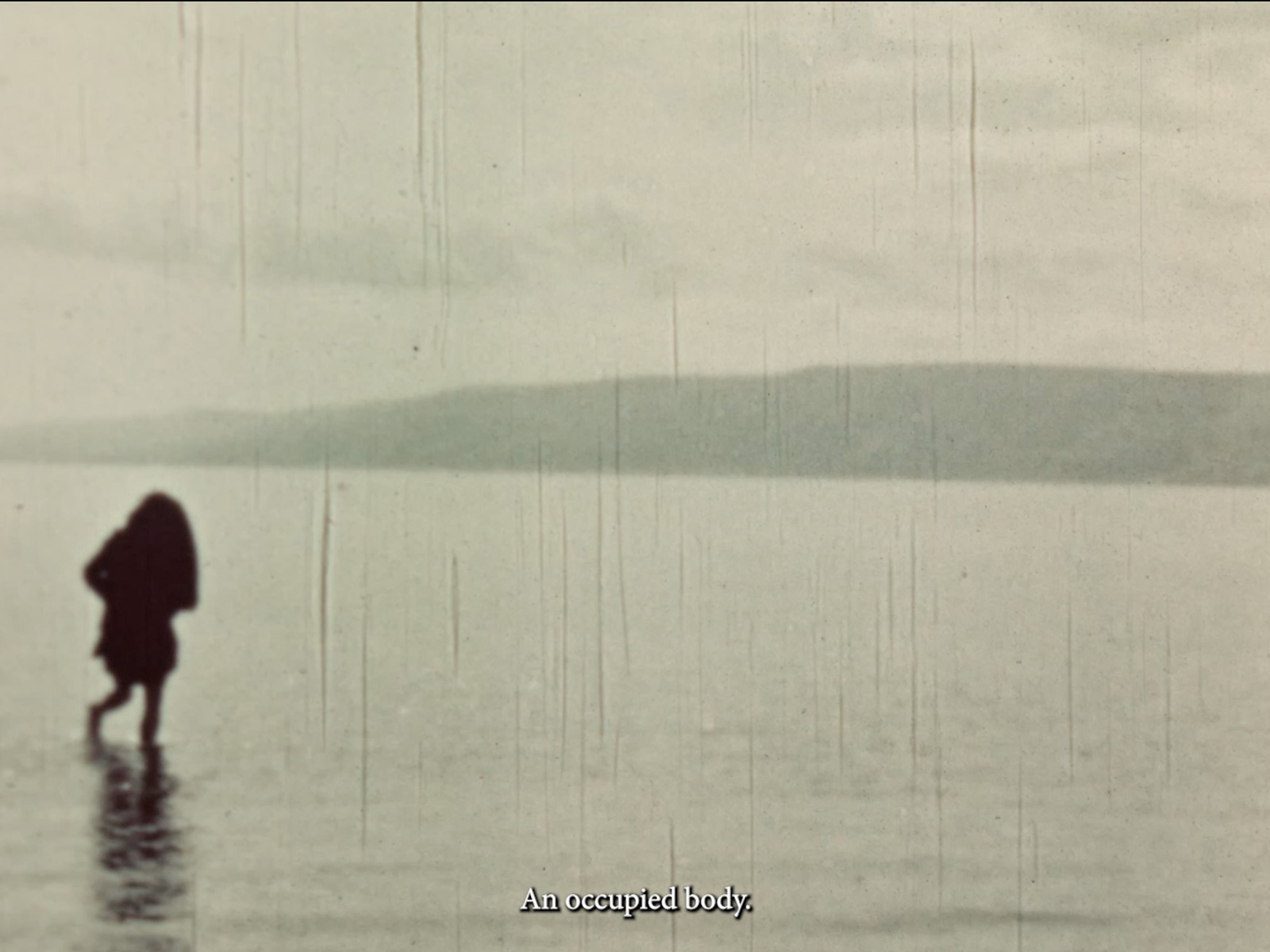
Figure 15: Voiceover-as-manifesto on dark Palestinian figures. A Land with a People: A Palestinian Counternarrative. Courtesy of Theo Panagopoulos.
The final work created as part of the Glasgow-based workshop, Ancestral Gestures to an Absent Sound: A Palestinian Counternarrative, reflects a similar critical performance approach in co-creating the Palestinian counternarrative as a response to the colonial hegemony seen and felt in the film Tiberias 1935. In this case, performance was used not only through the use of voice but also through movement and gestural work. While in the A Land with a People, the recording process was structured through specific sound recordings and a collective agreement on form and style, here the process is fluid, engaging directly with the archival footage. Specific gestures from the archive were collectively selected and projected on a multi-site screen installation that surrounded the participants. By being immersed in the footage, the participants were able to embody their own gaze and spatially position and re-position themselves. Their bodies became the central way of connecting with the archive, and while moving around the space, they began to explore the possibilities of re-orienting the gaze and co-creating out of the “formless”.
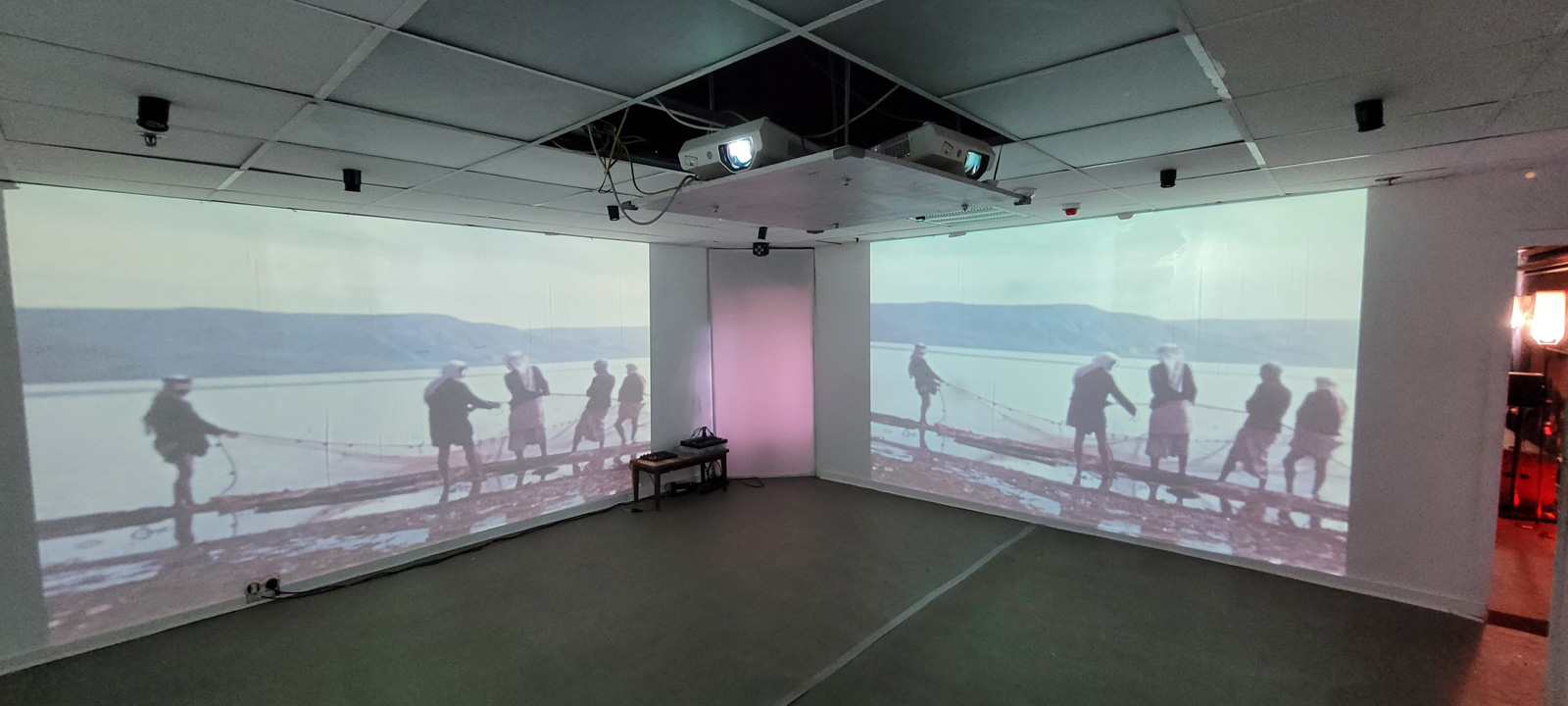
Figure 16: Tiberias 1935 is projected moments before participatory performance begins, Glasgow, November 2024. Courtesy of Theo Panagopoulos.
In this case, performance is used to connect to Palestinian ancestors who are only to be traced in the archive. Palestinians in the present and the past are the same size, moving together as if to invoke atemporal moments of connection. Gestures are seen closely; they are repeated, slowed down, and repeated again. The participants initially mirrored the gestures seen in the projections around them but slowly started exploring the possibilities of unearthing absent gestural sounds. The absence of sound as a sign of life motivated the participants to engage with a form of foley work, a sound design technique that re-creates sound out of scratch. Thus, performance emerges as a form of archiving the lost soundscape, mirroring the notion of re-discovering the lost world of 1930s Palestine, but understanding that world through reconstructing what people in the archive might be hearing and feeling. By documenting the performance, the colonial archive transforms into a medium through which embodied performative exploration can emerge and the erased past can be witnessed. The film camera not only acts as an observer of the performance but also plays an active role in it.
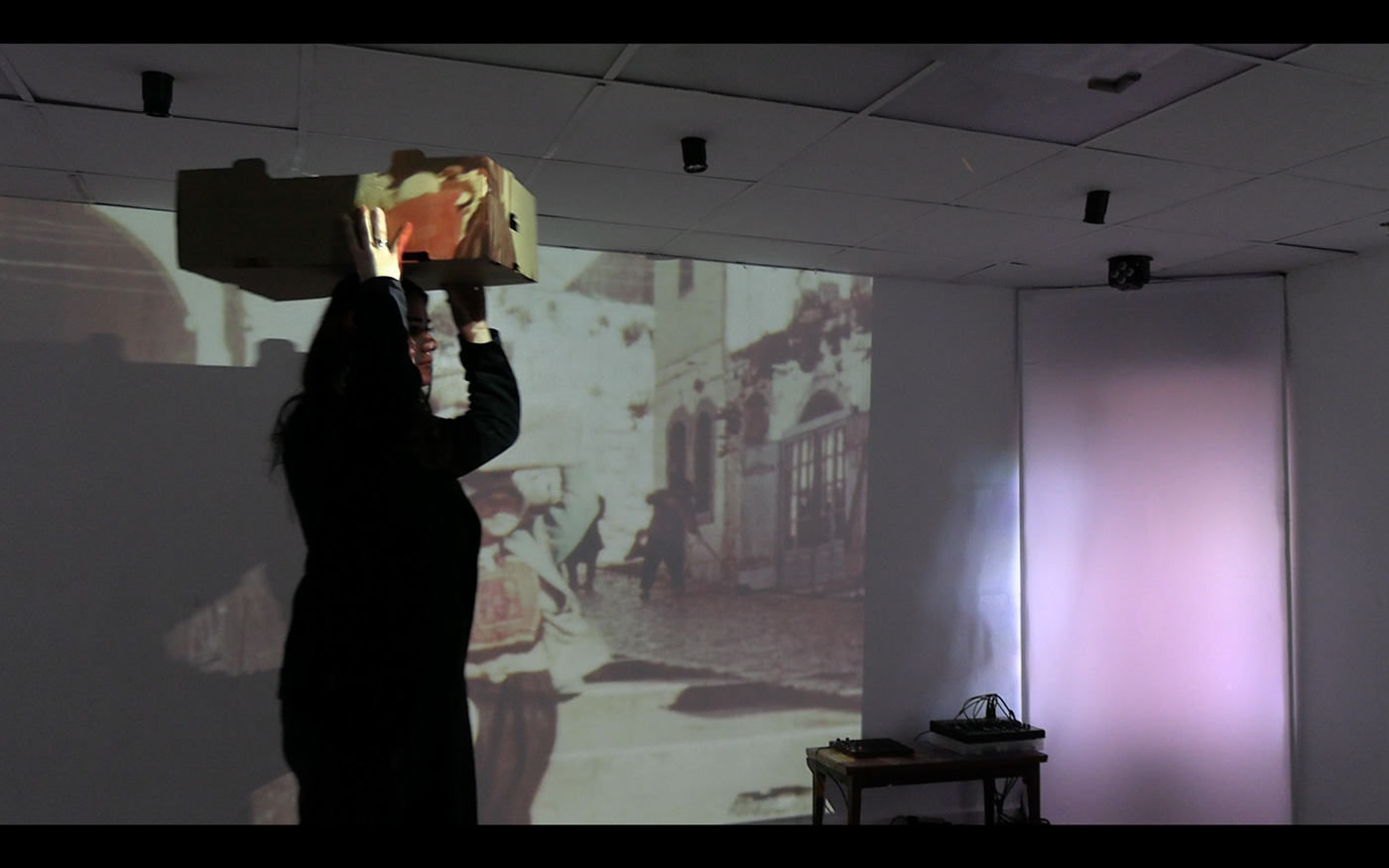
Figure 17: A workshop participant recreates the movement of a woman in the archive, Ancestral Gestures to an Absent Sound: A Palestinian Counternarrative. Courtesy of Theo Panagopoulos.
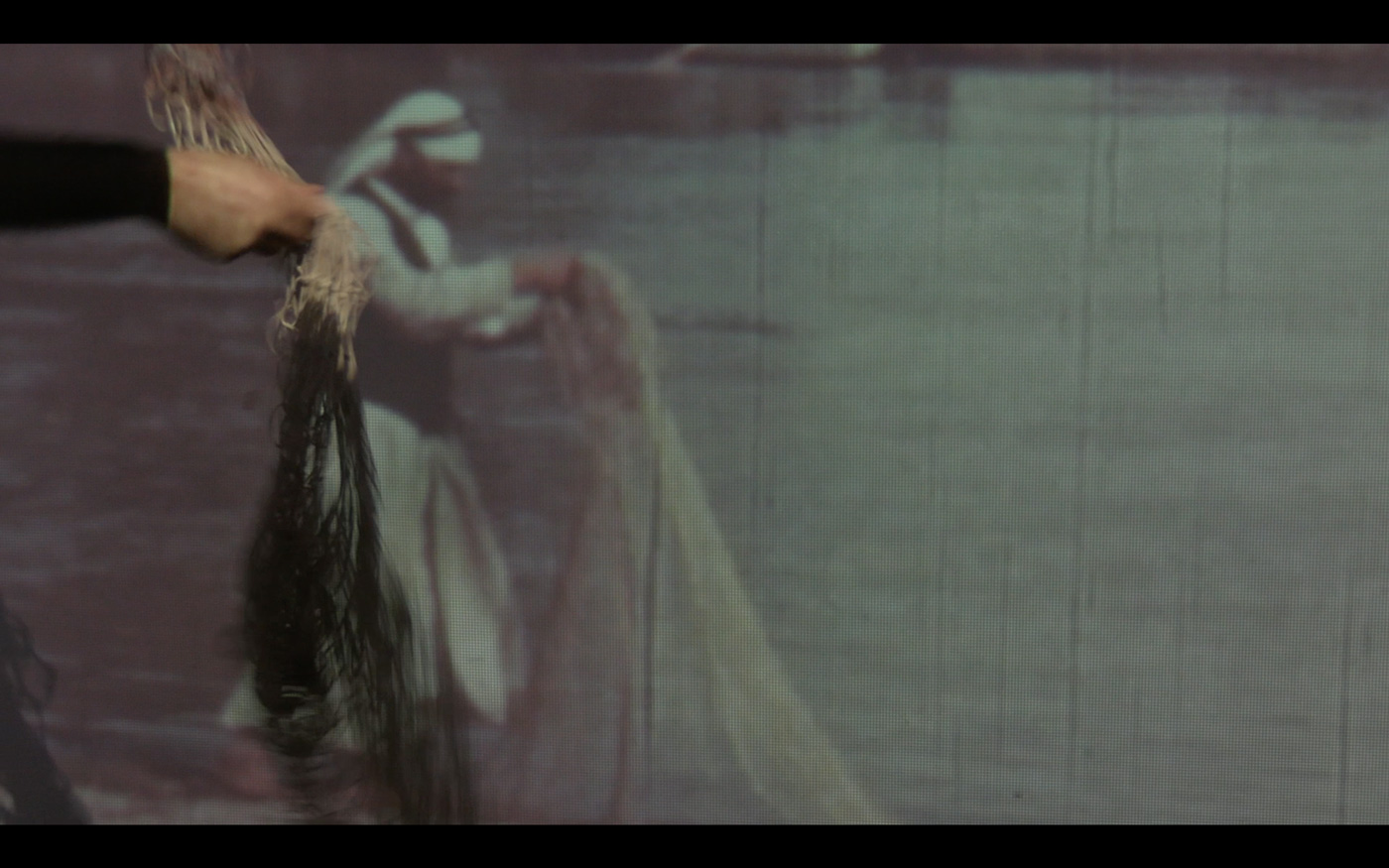
Figure 18: A workshop participant recreates a fisherman’s gesture, Ancestral Gestures to an Absent Sound: A Palestinian Counternarrative. Courtesy of Theo Panagopoulos.
In this performative act, there are multiple modes of mimesis being engaged. Whereas Plato dismissed mimesis as mere “imitation” that fails to capture the original, in the Poetics Aristotle argued that mimesis offers a poetic re-interpretation that can lead to an emotional catharsis (Gray 1987, 467). Here, deforming is rooted in discrediting the missionary as an authoritative and objective observer of Palestinian life, revealing his disrupting role in capturing images of Palestinians. The participants’ acts of mimesis to the gestures of the Arab Palestinians in Tiberias 1935 trouble notions of the authentic, the original, and the pure and become a powerful tool for the negotiation of Palestinian bodies through time; a temporal dance between past and present; between the indigenous and the diasporic; between the presence of the formed and the absence of the formless.
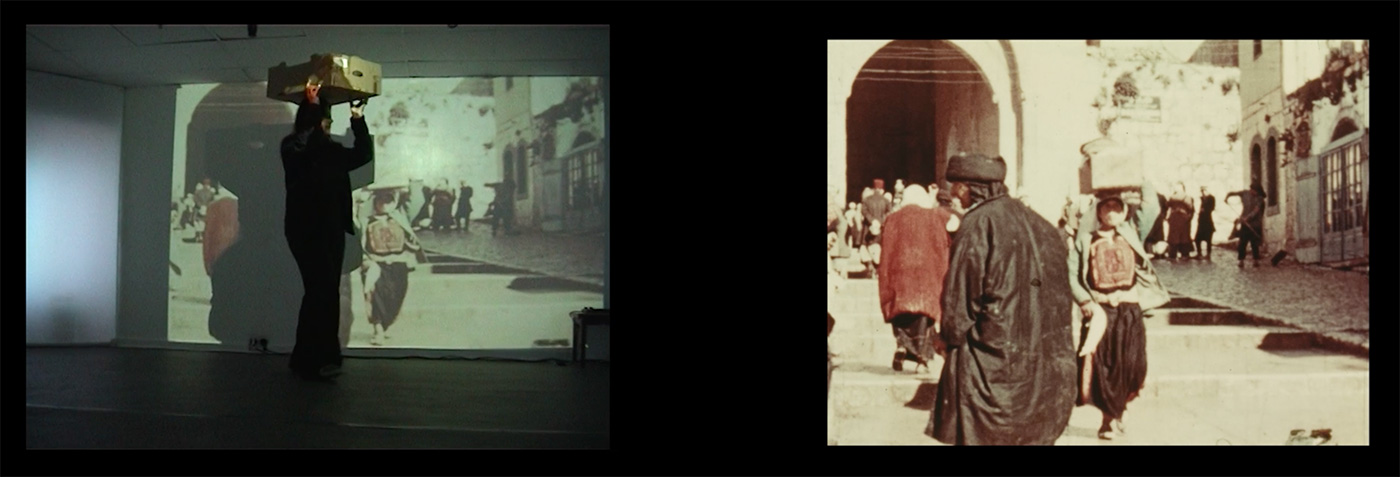
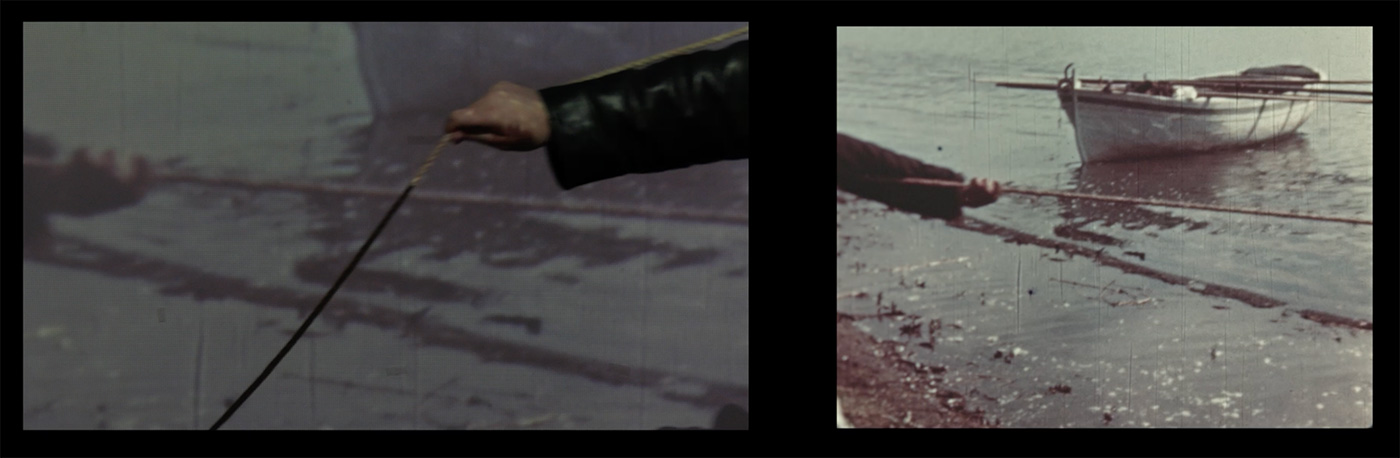
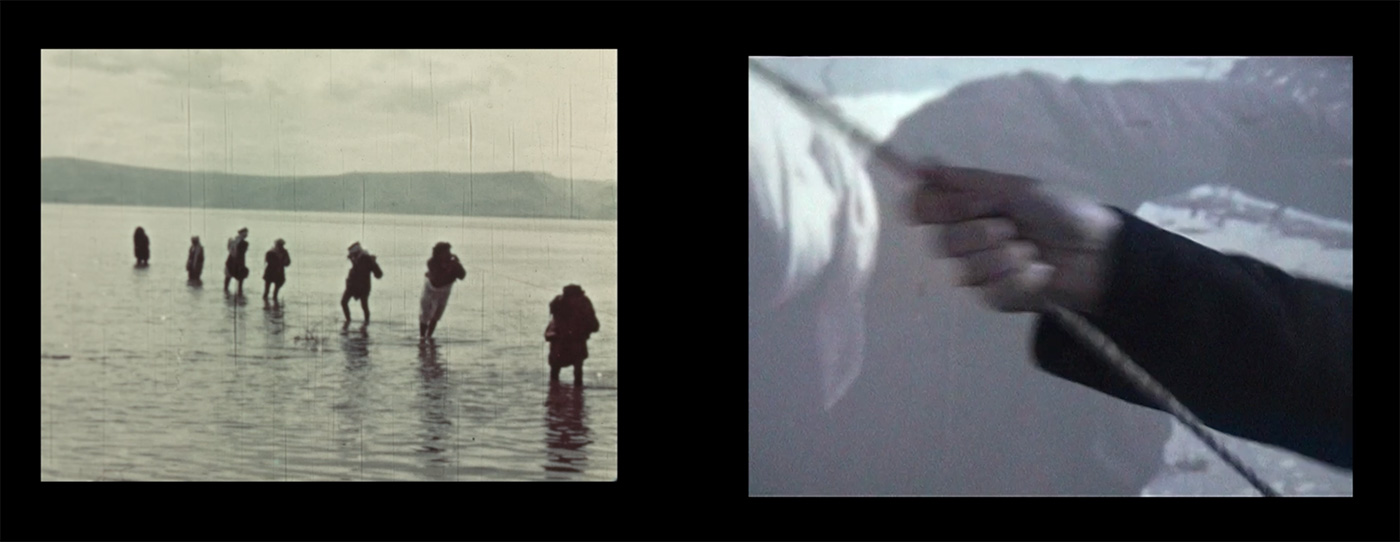
Figure 19: Ancestral Gestures to an Absent Sound: A Palestinian Counternarrative as a two-channel film. Courtesy of Theo Panagopoulos.
The participatory work conducted by both groups of participants reveals a larger form of narrative injustice that Palestinians face, not only from past representations but also in the present. Palestinian diasporic participants confronted the colonial gaze presented both in the archive as well as in current representations of Palestinian bodies in Western media. Performance became an avenue of expression that allowed participants to reshape colonial ideas of “othering” and “dehumanisation”, but also challenge Palestinian performativity that platforms an apolitical and decontextualised narrative of the Palestinian body as the suffering victim. Palestinian scholar Nadia Yaqub (2023) warns that the humanitarian narrative does not only depoliticise what it sees a Palestinian refugee “problem” but also commodifies it within an ideological framework where images of suffering circulate (13). Within this humanitarian “image-making economy”, Palestinians are forced to take the role of the decontextualised victim in order to have their narratives heard within such frameworks. Palestinian writer Mohammed El-Kurd (2025) claims that the “dehumanisation” of Palestinians throughout the decades have pushed them to narrate their existence as “perfectly” as possible. The Western gaze forces Palestinians to perform “perfect victims” and thus convince for their humanity and existence. Due to their “dehumanisation”, Palestinians are sought to speak for and represent the whole population, be verbally articulate and offer comprehensive political solutions. For El-Kurd, Palestinian narrative-making is synonymous with the “politics of appeal” which he defines as the:
practice that utilises a set of creative advocacy tactics designed to advance our cause, ceaselessly attempting to fulfil the aforementioned requirements [of the terrorist/victim dichotomy]. Once the criteria are conquered, magically, marvelously, the Palestinian can finally escape the circumscribed category of the terrorist and find refuge in the even narrower mode of victimhood. (22–23)
Thus, Palestinian diasporic participants went against the pressures of the Western colonial gaze that forces them to perform “only stories of victimhood and trauma in order to justify their presence in their countries of settlement” (Jeffers 2012, 42). Instead, through their bodies they express what is kept unspoken, unearth emotional worlds rejected, and resist their own erasure by engaging with their ancestral past and their diasporic present.
During the workshops, the genocide in Gaza becomes the central pillar through which the Palestinian diasporic participants engage with the world since 2023. It shapes their livelihoods in the West, not only through witnessing violence from a distance but also experiencing discrimination and “dehumanisation” through their experience as displaced bodies in the West. In this methodology, while I delved deeper in the context of Palestine through different temporalities, especially during the British Mandate (1917–1948) and the Nakba (1948), the genocide taking place in Gaza remained a cataclysmic event, affecting the participants in ways that sometimes remain unspoken during their observations, but always present and felt in their bodies.
During this moment of writing this article, the genocide continues despite attempts for ceasefire. According to Gazan journalist, Eman Abu Zayed (2026), the 2025 ceasefire “did was it was meant to do, make Gaza invisible.” The Palestinian performances become a counternarrative against what is kept invisible, what is rendered “dehumanised” and what is kept “decontextualised”. It forces all of us to bear witness, not only to destruction and violence, but also to Palestinian love, community, resistance, and grief. The Palestinian participants reclaim their images and reconstruct the representations of their bodies. They re-orient the archive’s colonial gaze, deform its violent but beautiful aesthetics, and transform them in a powerful testimony that break the temporalities between past and present; between absence and presence; between sound and image; between their performing body and their powerful words; between what remains formed and what is kept formless.
[1] In December 2024, an Amnesty International investigation concluded that ‘Israel is committing genocide against Palestinians in Gaza’ and demonstrated that ‘Israel has carried out acts prohibited under the Genocide Convention’ (Amnesty International 2024), a conclusion supported by Francesca Albanese, the United Nations Special Rapporteur on the situation of human rights in the Palestinian territory occupied since 1967. In March 2024, Albanese published her findings that ‘the overwhelming nature and scale of Israel’s assault on Gaza and the destructive conditions of life it has inflicted reveal an intent to physically destroy Palestinians as a group’ (Albanese 2024). Similar conclusions have since been reached by the International Association of Genocide Scholars and the UN Independent International Commission of Inquiry on the Occupied Palestinian Territory. While all the evidence is quite important in a world full of misinformation and so-called “fake news”, I first and foremost believe Palestinians on the ground who from day one have given vital testimonies of genocidal violence perpetrated against them just for being Palestinians.
Abu Zayed, Eman. 2026. “The ceasefire did what it was meant to do – make Gaza invisible.” Al Jazeera, 2 January. https://www.aljazeera.com/opinions/2026/1/2/the-ceasefire-did-what-it-was-meant-to-do-make-gaza-invisible.
Ahmed, Sara. 2006. Queer Phenomenology: Orientations, Objects, Others. Duke University Press. https://doi.org/10.1515/9780822388074.
Albanese Francesca. 2024. “Anatomy of a Genocide,” United Nations Human Rights Council, 25 March. https://www.un.org/unispal/document/anatomy-of-a-genocide-report-of-the-special-rapporteur-on-the-situation-of-human-rights-in-the-palestinian-territory-occupied-since-1967-to-human-rights-council-advance-unedited-version-a-hrc-55/.
Amnesty International. 2004. “Amnesty International Investigation Concludes Israel Is Committing Genocide against Palestinians in Gaza,” 5 December. https://www.amnesty.org/en/latest/news/2024/12/amnesty-international-concludes-israel-is-committing-genocide-against-palestinians-in-gaza/.
Bataille, Georges. 1985. “Formless.” In Visions of Excess: Selected Writings 1927–1939, edited and translated by Allan Stoekl, with Carl R. Lovitt and Donald M. Leslie, Jr. University of Minnesota Press.
Behdad, Ali. 2016. Camera Orientalis: Reflections on Photography in the Middle East. University of Chicago Press. https://doi.org/10.7208/chicago/9780226356549.001.0001.
Berg, Keri A. 2008. “The Imperialist Lens: Du Camp, Salzmann and Early French Photography.” Early Popular Visual Culture 6: 1–17. https://doi.org/10.1080/17460650801947838.
Bois, Yve-Alain, and Rosalind E. Krauss. 1997. Formless: A User’s Guide. Zone Books.
Delgado, Richard, and Jean Stefancic. 2001. Critical Race Theory: An Introduction. NYU Press.
Derrida, Jacques. 1996. Archive Fever: A Freudian Impression. Translated by Eric Prenowitz. University of Chicago Press. https://doi.org/10.2307/465144.
El-Kurd, Mohammed. 2025. Perfect Victims and the Politics of Appeal. Haymarket Books.
Fanon, Frantz. 1963. The Wretched of the Earth. Grove Press.
Giroux, Henry. 1993. “Postmodernism as Border Pedagogy: Redefining the boundaries of race and ethnicity.” In A Postmodern Reader, edited by Joseph P. Natoli and Linda Hutcheon. Albany State University of New York Press.
Gray, Vivienne. 1987. “Mimesis in Greek Historical Theory.” The American Journal of Philology 108 (3): 467–486. https://doi.org/10.2307/294672.
Jeffers, Alison. 2012. Refugees, Theatre and Crisis: Performing Global Identities. Palgrave Macmillan. https://doi.org/10.1057/9780230354821.
Khalidi, Walid. 1984. Before Their Diaspora: A Photographic History of the Palestinians, 1876–1948. Institute for Palestine Studies.
Lutz, Catherine, and Jane Lou Collins. 1993. Reading National Geographic. University of Chicago Press.
Masalha, Nur. 2012. The Palestine Nakba: Decolonising History, Narrating the Subaltern, Reclaiming Memory. Zed Books.
Milner, H. Richard, and Tyrone C. Howard. 2013. “Counter-Narrative as Method: Race, Policy and Research for Teacher Education.” Race Ethnicity and Education 16 (4): 536–61. https://doi.org/10.1080/13613324.2013.817772.
Mirzoeff, Nicholas. 2011. The Right to Look: A Counterhistory of Visuality. Duke University Press. https://doi.org/10.2307/j.ctv11vc8rg.
Nassar, Issam. 2006. “‘Biblification’ in the Service of Colonialism: Jerusalem in Nineteenth‐century Photography.” Third Text 20 (3–4): 317–326. https://doi.org/10.1080/09528820600853589.
Omar, Abdaljawad. 2024. “Bleeding Forms: Beyond the Intifada.” Critical Times 7 (2): 304-317. https://doi.org/10.1215/2641047 8-11216928/.
Ruiz, Sandra, and Hypatia Vourloumis. 2021. Formless Formations: Vignettes for the End of the World. Minor Compositions.
Said, Edward W. (1979) 2003. Orientalism. Penguin Modern Classics.
Sela, Rona. 2017. “The Genealogy of Colonial Plunder and Erasure – Israel’s Control over Palestinian Archives.” Social Semiotics 28 (2): 201–229. https://doi.org/10.1080/10350330.2017.1291140.
Stoler, Ann Laura. 2002. “Colonial Archives and the Arts of Governance.” Archival Science 2 (1–2): 87–109. https://doi.org/10.1007/BF02435632.
Stoler, Ann Laura. 2009. Along the Archival Grain: Epistemic Anxieties and Colonial Common Sense. Princeton University Press. https://doi.org/10.1515/9781400835478.
Stoler, Ann Laura. 2022. “Archiving Praxis: for Palestine and beyond.” Critical Inquiry 48 (3): 570–593. http://doi.org/10.1086/718625.
Stoppani, Teresa. 2007. “Dust Revolutions. Dust, Informe, Architecture (Notes for a Reading of Dust in Bataille).” The Journal of Architecture 12 (4): 437–47. https://doi.org/10.1080/13602360701614714.
Tuck, Eve, and K. Wayne Yang. 2014. “Unbecoming Claims: Pedagogies of Refusal in Qualitative Research.” Qualitative Inquiry 20 (6): 811–818. https://doi.org/10.1177/1077800414530265.
Van Raffe, Robert. 2016. “Bataille’s Informe in the Work of Francis Bacon.” https://www.academia.edu/62291086/Batailles_informe_in_the_work_of_Francis_Bacon.
Vatulescu, Cristina, and Ann Laura Stoler. 2025. “‘The Archive is Dormant, Never Dead’: An Interview with Ann Laura Stoler.” Comparative Literature Studies 62 (3): 44 2–453. https://doi.org/10.5325/complitstudies.62.3.0442.
Yaqub, Nadia, ed. 2023. Gaza on Screen. Duke University Press. https://doi.org/10.1515/9781478093602.
Theo Panagopoulos is a doctoral researcher in performance at the University of the West of Scotland of Greek, Lebanese, and Palestinian descent. His practice-as-research PhD engages with participatory performance as counternarrative to colonial film archives he unearthed at the National Library of Scotland that present rare footage of 1930s Palestine. He is also a working filmmaker in both documentary and fiction. His most recent film is an archive documentary essay called The flowers stand silently, witnessing which delves into the complicated more-than-human entanglements between people and flowers and has been awarded at prestigious festivals such as Sundance, International Documentary Festival Amsterdam (IDFA) and in early 2025 was nominated for an EE BAFTA award.
© 2025 Theo Panagopoulos
Except where otherwise noted, this work is licensed under a Creative Commons Attribution-NonCommercial-ShareAlike 4.0 International License.