Eleni Kolliopoulou, Independent scholar and artist
Ankoku Butoh, or “dance of darkness,” emerged in Tokyo in late 1950s through the work of Tatsumi Hijikata in dialogue with Kazuo Ohno. Often framed as a response to both the codified traditions of Noh and Kabuki and the influx of Western modern dance, Butoh cannot be reduced to a reactionary postwar form. While shaped by the social and aesthetic tensions of its time—drawing on avant-garde currents such as surrealism—it has continued to evolve as an open-ended and heterogeneous practice.
In this context, Butoh resists stable definition. Rather than functioning as a fixed dance technique, it operates as a mode of inquiry into embodiment and experience, foregrounding the body as a site where imagination, memory, sensation, and environment converge. Central to this orientation is the dissolution of distinctions between art and life. As articulated in the archives of Kazuo Ohno and Yoshito Ohno—“Life is my dance teacher” and “My Butoh is a prayer” (Dance Archive Network 2020)—Butoh emerges as a practice in which lived experience and performance become inseparable.
This understanding positions Butoh not simply as a historical performance genre, but as an evolving epistemology of the body: one that seeks to engage the latent and often inarticulable dimensions of human experience. Within this framework, the present article approaches Butoh-fu not primarily as a notation system for choreographic reproduction, but as a non-representational practice that reconfigures embodied perception and temporality.
This research emerges through an ongoing dialogue between philosophical inquiry and practice-based experimentation. While grounded in performance practice, the present article focuses primarily on the philosophical and spatiotemporal dimensions of Butoh-fu as a system of embodied transformation and perceptual transition. The aim of this postdoctoral research is to advance understandings of temporality and performativity in hybrid performance practices through the lens of qualia as articulated in Butoh-fu. Here, the term qualia is adopted, as used by Subbody Butoh practitioner Lee Rhizome, to denote the qualitative dimensions of lived experience—what it feels like to undergo a particular sensory or mental state (Kolliopoulou 2025, 18).
Within this framework, Butoh-fu emerges not simply as a choreographic notation system, but as an articulation of paradoxical, image-based qualia-worlds capable of reorganising embodied perception and temporality. Developed by Tatsumi Hijikata through poetic language and visual collage, and preserved in his scrapbooks, Butoh-fu operates as a system of evocative prompts that mobilise embodied imagination. Rather than prescribing movement, it generates experiential states, enabling performers to navigate shifting temporalities and intensities of presence.
Butoh-fu is partially accessible through Butoh Kaden, an online archive developed by Yukio Waguri (2020), while original materials are preserved at the Hijikata Tatsumi Archive (TTA) at Keio University in Tokyo. Founded by Takashi Morishita, who worked closely with Hijikata, the archive constitutes a key site for the preservation and ongoing interpretation of Butoh-fu. Research conducted at the TTA in April 2023 enabled direct engagement with archival materials and Butoh-related literature. Practice-based exchanges with second-generation and contemporary practitioners, including Kayo Mikami, Natsu Nakajima, and the duo Yuri & Seisaku, shed further light to Butoh embodiment. The visit was facilitated by Kae Ishimoto, whose guidance situated this research within the broader Butoh ecology of Tokyo. These encounters underscore the extent to which Butoh-fu operates not only as an archival artefact but as a living, embodied practice transmitted through relational and pedagogical lineages.
Among the theoretical sources consulted, The Body as a Vessel (1986) by Kayo Mikami is particularly significant. Drawing on her experience while working with Hijikata, Mikami (1986) emphasises that Butoh exceeds the studio context: “life also contains the qualities of Butoh, and the dancer’s life becomes a site of training” (24). This understanding foregrounds lived experience as integral to the emergence of Butoh-fu, thinking of it here as a generative framework for embodied and temporal transformation. Therefore, this article argues that Butoh-fu operates less as a codified notation than as an embodied score for perceptual transformation.
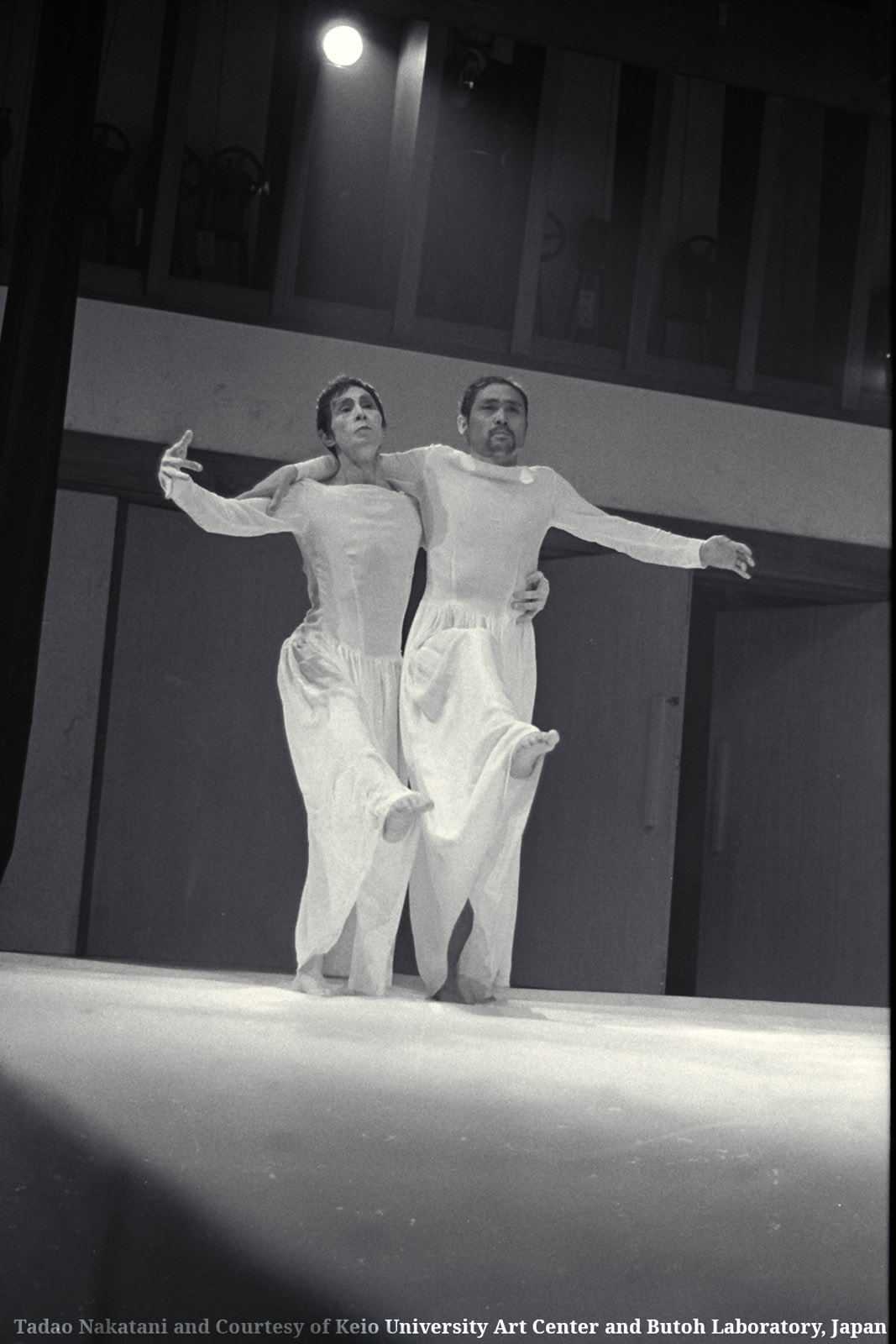
Fig.1: Kazuo Ohno and Tatsumi Hijikata performing together. © Tadao Nakatami. Courtesy of Keio University Art Center and Butoh Laboratory, Japan.
Tatsumi Hijikata drew inspiration from modern painting, particularly the visceral and unsettling imagery of Francis Bacon, as well as from avant-garde French literature, including the writings of Jean Genet. Yet, beyond these artistic influences, Hijikata remained an acute observer of the natural world. He was captivated by the movement of animals, atmospheric and climatic phenomena, landscapes, but above all, by the gestures and behavioural textures of everyday human life. Through sustained observation, he sought to internalise such movements and reconfigure them within the studio through the bodies of his dancers.
Hijikata’s choreographic practice approached nature not as a stable form to be imitated, but as a perpetually shifting process situated between life and death, emergence and decay. In this sense, Butoh does not reproduce natural patterns so much as it seeks to distort and destabilise them. Movement becomes an ongoing play of transition, contradiction, and metamorphosis. This orientation resonates with the Japanese concept of aida (“in-between-ness”). Rein Raud, Professor of Asian and Cultural Studies at Tallinn University, observes that aida describes a spatiotemporal logic in which transitions occur gradually across multiple thresholds and zones of indeterminacy (Raud 2004, 32). From this perspective, Butoh may be understood as an embodied practice of aida: a continual negotiation of liminal states in which fixed distinctions between human and non-human, life and death, stillness and movement remain unresolved.
The concept of aida becomes particularly significant in relation to the philosophy of Nishida Kitarō. This article suggests that Nishida’s reflections on time, space, and embodied experience offer an important framework for approaching Butoh-fu. Often regarded as a bridge between Eastern and Western philosophical traditions, Nishida articulates a conception of reality grounded in dynamic relationality rather than stable subject-object divisions.
Mikami (1986) notes that Hijikata’s early practice sought to interrogate “the body’s essential truths through the denial of accepted views on the body or movement” (54). His methodology did not operate through fixed choreographic vocabularies, but through continual processes of transformation and destabilisation. As Mikami further observes, Hijikata was driven by an avant-garde impulse “to create and destroy in continuum” (69). This destabilising logic extended beyond aesthetics into perception itself. Rather than producing coherent representational images, Butoh often cultivates states of ambiguity, contradiction, and disorientation that unsettled habitual modes of spectatorship. Such strategies foreground transition, indeterminacy, and the coexistence of multiple states within the dancing body.
From this perspective, Butoh may be thought of less as a codified dance technique than as a psychophysical practice oriented toward states of “non-objectification,” a term explored by Toshiharu Kasai (1999). For Kasai, the diminution of self-consciousness enables performers to shift attention away from externally controlled movement toward inner sensation and embodied presence. This process becomes central in understanding how Butoh-fu functions not as representational notation, but rather as a generative framework for altered states of perception and temporality.
At the same time, such altered states may also be understood as forms of ritualised attention. Rather than reproducing ritual in a traditional or symbolic sense, Butoh suspends habitual temporal structures and invites intensified modes of presence. In this regard, Byung-Chul Han’s (2020) reflections on ‘the disappearance of rituals’ become relevant not as a direct framework for interpreting Butoh historically, but as a means of understanding how practices of durational attention and embodied repetition might resist and reappear in the accelerated temporality of contemporary life.
Let us now turn to Tatsumi Hijikata’s methodology through the testimonies collected in Yukio Waguri’s “Private Butoh Notation” (Morishita 2018). Hijikata’s Butoh-fu functioned as a means of accessing specific psychological, emotional, physiological, and nervous states from which movement could emerge. Rather than prescribing a choreographic form, Butoh-fu activated embodied conditions capable of generating movement from within sensation and perception.
Takaaki Yoshimoto suggests that “Hijikata’s Butoh didn’t begin from form but treated the body as the letter with which he could write metaphors” (quoted in Morishita 2018). In this sense, the dancing body becomes not a vehicle for representation, but a site through which metaphor is physically enacted and transformed into lived experience. Similarly, Takashi Morishita (2018) argues that “Butoh notation can be extended or universalised beyond the bounds of Butoh. It offers a language that has the potential to be relevant outside of periodisation, location, or culture.” Butoh-fu thus opens a field of imagistic and sensory associations rooted in lived experience while simultaneously resisting fixed interpretation. The present study focuses on the structural and dramaturgical principles through which these imagistic constellations generate embodied and temporal transformation.
Butoh-fu is structured through seven distinct “worlds.” each associated with particular states of transformation, materiality, and becoming (fig. 2). Drawing on the classifications documented by Yukio Waguri in Butoh Kaden, these worlds function less as fixed symbolic categories than as dynamic spatiotemporal fields through which the performer navigates shifting modes of embodiment.
|
Butoh-fu Worlds |
Forms |
Qualities |
|
World of Abyss |
Decomposed |
Dissolving, Nothingness |
|
World of the Neurology Ward |
Decomposed |
Multiplying and extending |
|
World of Flowers |
Decomposed |
Spreading, particles |
|
World of Birds and Beasts |
Fixed |
Varying development |
|
World of Wall |
Fixed |
Condensation, textures |
|
World of Anatomy |
Irregular |
Shapeless, magmatic |
|
World of Burnt Bridges |
Irregular |
Human form emerging |
Fig. 2 Waguri’s Seven Worlds of Butoh-fu.
Taken together, the seven worlds suggest a dramaturgy of transformation structured through successive states of dissolution, mutation, condensation, and emergence. Rather than depicting stable identities or forms, they articulate transitional processes through which matter, sensation, and embodiment continuously reorganise themselves. In this sense, each world may be understood as composed of multiple states of aida: zones of passage, indeterminacy, and becoming.
The sequential arrangement of the worlds evokes a movement from amorphous and decomposed states toward increasingly differentiated forms of embodiment. This trajectory can be read as a conceptual inversion of the “arrow of time” described by physicist Arthur Eddington in 1927, in which entropy signals the irreversible movement from order toward disorder. By contrast, the progression of Butoh-fu stages an experiential movement from fragmentation and formlessness toward the emergence of form and presence. What is at stake here is not a scientific model of temporality, but a dramaturgical reorientation of time as embodied transformation.
According to Michael Lazarin (2007), “if the present of one moment is different from the present of another moment, then this would seem to argue that the present is not a substance” but rather a shifting quality or attribute (3). He further distinguishes between two understandings of motion: as the “filling-in” between fixed points or as a “stretching-out” from one point toward another. This distinction is significant in relation to Butoh, where movement often resists linear progression and instead unfolds through durational transitions and states of becoming.
If transitions are understood as embodiments of temporal passage, then Butoh offers a particularly fertile framework for investigating temporality through lived experience rather than abstract measurement. In this context, motion may be approached as a form of aida: a relational interval that simultaneously connects and separates states, bodies, and moments in time. Lazarin ultimately observes that “time is easy to know but difficult to explain” (13). This paradox becomes especially resonant in Butoh practice, where temporality is not merely represented but sensorially enacted. Such an understanding opens the possibility of approaching time not as a singular linear progression, but as a multidirectional and relational process. This perspective will be further explored through Nishida’s concept of basho.
According to Rein Raud (2004, 34), Nishida conceptualises reality not as a singular homogeneous field but as an assemblage of overlapping “worlds” structured through different modes of experience. Within this framework, Nishida distinguishes between spatial and temporal perception. Spatial perception is associated with measurable extension and objective relations between things, whereas temporal experience unfolds through the irreversible succession of lived experience.
For Nishida, however, these dimensions do not remain separate. Their convergence becomes possible through basho (“place” or “field”), a mode of relational experience associated with acting intuition and developed through Zen-inflected modes of awareness (Kolliopoulou 2020, 22). In basho, distinctions between subject and object cease to operate as fixed oppositions. Experience emerges instead through relational co-presence, where self, environment, and world continuously constitute one another.
This understanding of acting intuition is particularly significant in relation to Butoh-fu. Rather than organising movement through external form, Butoh-fu generates embodied states in which performers enter dynamic relations with images, sensations, environments, and temporal intensities. The dancing body no longer functions as an isolated subject expressing pre-existing meaning, but as a site of continual relational transformation. Nishida articulates this relational ontology through the notion of “contradictory self-identity”:
Self-realization occurs only when our self transcends itself and faces the Other. At the moment of self-realization, our self has already transcended itself. Therefore, I always say: become things and you think, become things and you happen. I and things are relative to each other in contradictory self-identity. (Nishida 1979, 381; quoted in Raud 2004, 45)
Here, the “Other” does not refer solely to another human subject, but to the broader field of relational existence encompassing environment, matter, atmosphere, and non-human entities. Such a perspective resonates strongly with Butoh-fu, where performers are frequently invited to embody states of metamorphosis, becoming animal, landscape, object, memory, or atmospheric condition. In this sense, Butoh-fu may be understood as a performative practice of basho: a relational field in which embodiment unfolds through processes of transition, interpenetration and becoming.
Nishida frequently employs the notion of paradox to describe reality as relational, contradictory, and multi-layered. For Nishida, different modes of existence correspond to different modes of temporality and consciousness:
I think that in the material world, time is reversible. When we come to the life-world, time becomes irreversible. This is because life is singular, and the dead do not return to life…. Acting entities create forms. This world is the world of purposes. […] in this world [of Basho] action proceeds from the created to the creator, in balance between the inside and the outside. (Nishida 1979, 375; quoted in Raud 2004, 35)
As Raud (2004, 46) explains, Nishida’s account may be understood through three interrelated modes of reality and consciousness. The first concerns the material world of objects and processes, governed by cyclical and reversible transformations. The second refers to the life-world of intentional beings acting toward purposes and survival. The third, associated with historical consciousness and basho, involves reflexive and creative self-awareness, through which human beings shape and are shaped by the world relationally.
These three dimensions should not be understood as strictly separate ontological categories, but as overlapping modes of experience and temporality that continuously interpenetrate one another. Such a framework becomes particularly productive when approaching the seven worlds of Butoh-fu. Rather than interpreting Butoh-fu as a fixed symbolic system, I propose reading its seven worlds through Nishida’s relational ontology of time-space. The worlds of Butoh-fu may then be understood as spatiotemporal fields in which different modes of embodiment, perception, and becoming emerge and overlap. Processes of dissolution, animality, material condensation, fragmentation, and human formation do not unfold linearly, but coexist through shifting intensities and transitional states.
From this perspective, Butoh-fu operates as a multi-layered map of embodied temporality. It allows performers to navigate between human and non-human modes of perception, between material and historical time, and between states of formation and disintegration. The significance of Butoh-fu therefore lies not in the representation of movement itself, but in its capacity to generate relational experiences of time-space through embodied transformation.
The present research emerged through practice-based experimentation with Butoh-fu in mixed-media performance contexts. Earlier publications have addressed the practical dimensions of this research, including performer training methodologies and dramaturgical applications (Kolliopoulou 2023; Kolliopoulou 2026). The focus of the present article, however, remains on the philosophical implications of Butoh-fu as a non-representational system of embodied temporality.
This section brings Butoh-fu into dialogue with contemporary performance theory in order to situate embodiment as a temporal and perceptual practice rather than merely a choreographic one. In this context, André Lepecki argues that dance operates through continual processes of bodily reinvention grounded in memory and lived experience:
Only by daily reinventing for oneself a body-for-living—a reinvention that is about activating memory (cellular memory, affective memory, muscular memory) for the present and not about repeating information for the already archived future—can the dancer create for him- or herself other modes of dancing and thus foster other modes of understanding dance perceptively and theoretically. Such reinventions impact not only the choreographic but also the ontological. (Lepecki 2007, 122)
Lepecki’s understanding of embodiment resonates strongly with Butoh-fu’s non-representational logic. Rather than reproducing codified movement vocabularies, Butoh-fu mobilises memory, sensation, and imagination as processes through which bodily perception is continuously reorganised. Movement emerges not through the execution of predetermined forms, but through the activation of experiential states unfolding across multiple temporalities.
From this perspective, Butoh may be understood as a practice of temporal embodiment in which memories, sensations, and affective traces are transformed into movement. Such processes destabilise habitual perceptions of the body as a fixed entity and instead foreground embodiment as relational, processual, and continually becoming. The dancing body does not simply move through time; it becomes a site through which time is sensorially enacted and reconfigured. This understanding also clarifies why Butoh often cultivates slowness, suspension, and durational intensity. These qualities interrupt normative temporal rhythms and invite altered modes of attention and presence. In this sense, Butoh’s temporal logic may also be understood as ritualised: not through the reproduction of symbolic ritual forms, but also through the cultivation of embodied attentiveness capable to resist accelerated and instrumentalised experiences of time.
Rebecca Schneider (2014) observes that “theater, like history, is an art of time. […] Time is the stuffing of the stage—it’s what actors, directors, and designers manipulate together” (7). Performing arts therefore constitute a fertile site for investigating temporality not simply as representation, but as lived and embodied experience. Within this context, Anne Bogart distinguishes between “horizontal” and “vertical” time:
When busy, when trying to get from where I am to where I want to be, I am generally living in horizontal time. Horizontal time is linear and has a part that is remembered and a future that is imagined. […] Vertical time, in contrast, may contain horizontal time but it also intersects and disrupts the experience of linear time. […] In vertical time, nowness is real and non-divisible. (Bogart 2019, 4)
Bogart’s notion of vertical time resonates strongly with Butoh’s durational and non-linear temporalities. Butoh frequently suspends narrative progression and conventional rhythm in favour of intensified states of presence, slowness, and perceptual expansion. In this sense, the performer does not merely execute movement in time but inhabits time as an embodied and continuously unfolding field of sensation. Schneider further suggests that performance practices actively sculpt the audience’s experience of time through the embodied presence of performers. Such an understanding aligns with Butoh-fu’s capacity to generate altered temporal states grounded in attention, sensation, and transitional embodiment. The performer’s engagement with embodied temporality may therefore invite spectators into an intensified awareness of duration, suspension, and relational presence.
As Bogart (2019) notes, art “creates the experience of vertical time for the perceiver by plunging a stake or by dropping an anchor into the endless flow of time, thereby creating a sense of eternity in the human body” (3). This formulation becomes particularly relevant to Butoh-fu, where image, sensation, and psychophysical transformation operate as means of interrupting habitual temporal perception and cultivating embodied states of temporal depth.
Masaki Iwana (2011), dancer, filmmaker, and choreographer, describes Butoh as “a dance that is connected to our original experience and inner landscape (nikutai) as a state that is dormant within our bodies” (27). His reflections on Butoh emphasise the relation between embodiment, memory, and temporality, proposing that performance emerges not through the execution of external form but through the activation of latent experiential states.
In his writings and visual diagram on time-space perception (fig. 3), Iwana contrasts dominant temporal structures in Western theatrical and dance practices (often related to traditional forms) with the durational and internally generated temporality cultivated in Butoh. Rather than prioritising externally organised movement or compositional precision, Butoh training seeks to cultivate heightened states of embodied attention through which performers engage shifting relations between sensation, environment, memory, and presence.
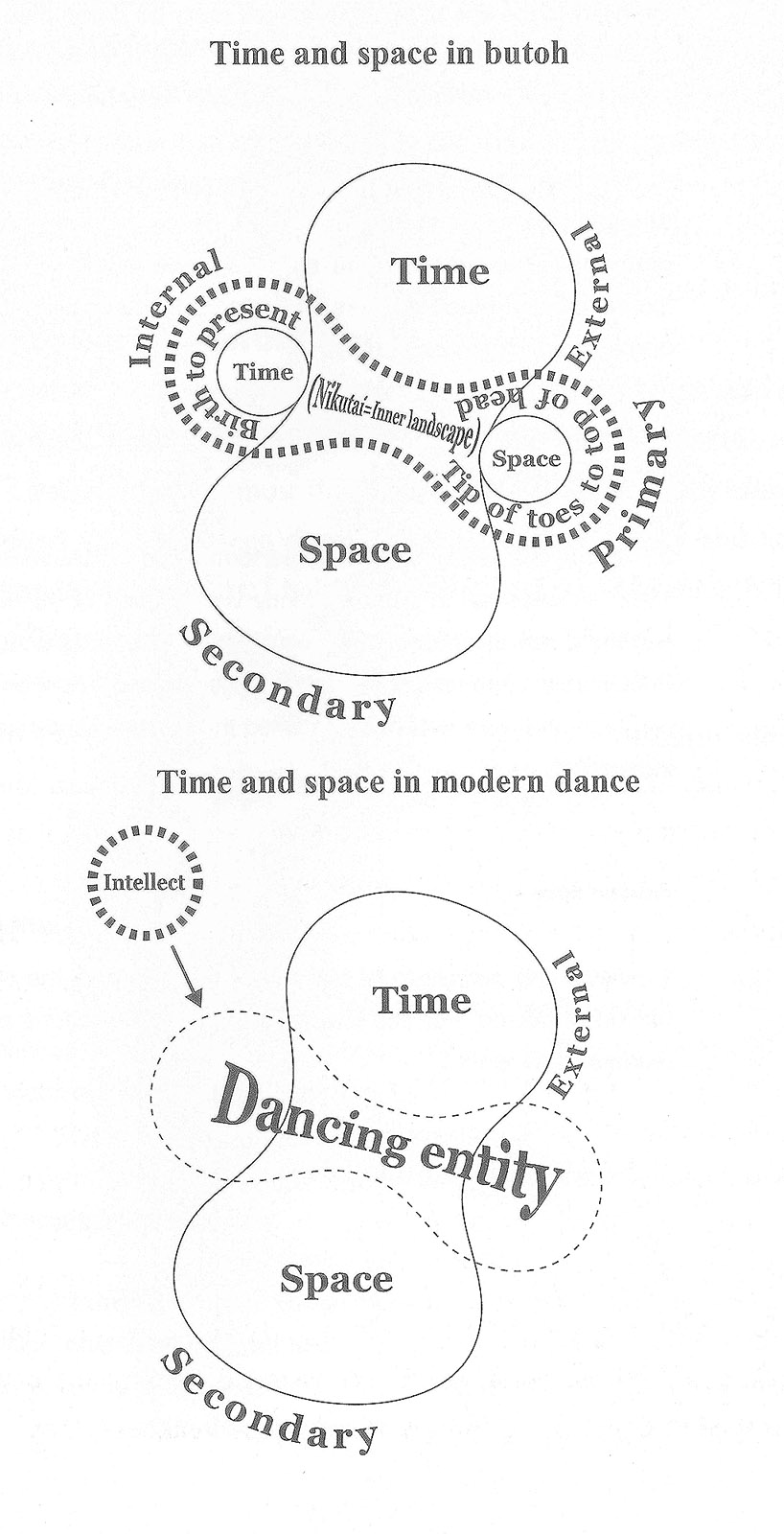
Fig 3: A visual comparative map of time embodiment in Butoh and in modern dance (Iwana 2011, 20).
From this perspective, the performer’s body functions not merely as a vehicle for movement but as a dynamic field of temporal and perceptual transformation. Iwana suggests that performers carry within themselves an “inner landscape” capable of affecting the surrounding time-space of performance. Such a conception resonates with Nishida’s relational perception of basho, in which self and environment continuously constitute one another through embodied interaction. Importantly, this perception does not imply a rejection of compositional structure or choreographic intentionality. Rather, it is pointing toward a different mode of embodiment in which movement emerges through sustained psychophysical attention and relational presence instead of solely through externally imposed form. In this sense, Butoh-fu may be understood as facilitating access to transitional states in which inner and outer temporalities become increasingly entangled.
The present research explores how Butoh-informed training practices grounded in such time-space principles might affect not only performers’ embodied experience, but also spectators’ perception of duration, attention, and presence within mixed-media performance contexts. Masaki Iwana’s practice spans on choreography and film. His work therefore extends Butoh aesthetics across multiple media, thereby articulating embodiment not only as stage-based performance but also as a cinematic exploration of duration, perception, and inner landscape.
Iwana offers a definition of the Butoh body (nikutai) as a living entity that may further clarify its distinction from the codified dancing body in modern dance:
- It contains both physiological and emotional dimensions while retaining an individual character.
- It functions as a repository of nature.
- It contains the entirety of lived time from birth.
- It encapsulates all dimensions of the soul, including intuition and spirituality. (Iwana 2011, 8)
Rather than understanding these statements as essentialist definitions, they may be read as articulations of embodiment in a temporally stratified field. Thus, the body in Butoh is not limited to present movement, but is constituted through accumulated layers of lived time, affect, and perceptual memory.
In this sense, Butoh can be understood as a practice that activates embodied temporality—where movement emerges through the integration of physiological, emotional, and experiential strata rather than through the execution of external form. This resonates with Maxine Sheets-Johnstone’s formulation of “thinking in movement,” where:
Thinking in movement is obviously a bodily phenomenon. The body inhabits movement in the literal sense of living in it…. (Sheets-Johnstone 1981, 402)
From this perspective, movement is not an expression of pre-formed thought, but a mode of embodied cognition through which the body continuously articulates its relation to the world, memory, and environment. In Butoh practice, this relational field extends to spatial conditions, site-specific contexts, and the presence of other bodies, producing a distributed and intersubjective field of perception. Within this framework, Butoh-fu may be understood as a device that intensifies such embodied cognition by generating image-based conditions for perceptual and temporal transformation, rather than prescribing fixed choreographic outcomes.
Sondra Fraleigh describes Butoh as a “metamorphic dance,” in which:
the dancer and the audience transform through the experience of the event… these experiences are presented as ‘metamorphic explorations’ because they pass from one state to another in transformational modes characteristic of Butoh. (Fraleigh and Nakamura 2006, 101)
Importantly, this transformative dimension should not be understood as symbolic ritual transformation in a fixed cultural sense, but as a processual reorganisation of embodied temporality—where perception, sensation, and presence are continuously reconfigured.
Fraleigh describes Butoh as a “metamorphic dance” on the basis of two interrelated dimensions. First, Butoh is grounded in the performer’s somatic experience, which functions as the primary material through which movement emerges rather than being externally imposed. This somatic grounding reconfigures spectatorship, fostering a mode of attention that is less representational than affective and psychophysical. Second, the very object of Butoh may be understood as transformation itself. In this sense, Butoh-fu does not prescribe fixed choreographic forms, but rather generates sequences of shifting states of presence. Movement emerges through processes of becoming, in which transitions and thresholds (aida) are not secondary moments but integral components of performance composition. Dancers are therefore trained not only to embody states, but also to inhabit the transitions between them, foregrounding temporality as continuous modulation rather than linear progression.
This intertwining of embodiment and temporality resonates with Lepecki’s account of dance as a critical intervention in time. Lepecki argues:
This challenge might be said to constitute dance’s unique relation to temporality and to the manifestation of the body and of presence as interventions in temporality. This body, visceral matter as well as sociopolitical agent, discontinuous with itself, moving in the folds of time, dissident of time, manifests its agency through the many ways it eventually smuggles its materiality into a charged presence that defies subjection. (Lepecki 2004, 6)
In this formulation, the dancing body is not understood as a stable entity moving through time, but as a discontinuous and relational field of temporal emergence. Butoh-fu can be situated within this logic as a practice that intensifies such temporal dislocation by structuring embodiment through image-based, non-representational transitions. Within this framework, the transformation of perception and bodily awareness that may occur in Butoh practice can be understood not as transcendence or emancipation in a teleological sense. Instead, it could be seen as a reconfiguration of embodied temporality through altered relations between attention, sensation, and movement. While such processes have sometimes been associated with ritual structures, here they are approached primarily as temporal and perceptual modulations rather than as culturally fixed ritual forms.
Anthropological discussions of liminality offer a productive framework for approaching the temporal and perceptual operations of Butoh-fu. For Victor Turner (1974), liminality designates a threshold condition in which normative social structures and fixed identities become temporarily suspended, allowing subjects to enter states of transformation and indeterminacy. Such anti-structural conditions are characterised by ambiguity, instability, and altered relations to time and embodiment. Approached through this lens, Butoh-fu may be understood not merely as a choreographic system, but as a perceptual technology that guides performers into transitional states where habitual distinctions between self and environment, interior and exterior, representation and sensation become destabilised.
Why should rituals matter in contemporary performance practices? According to Byung-Chul Han, rituals function as stabilising symbolic structures that organise communal life and provide forms of orientation within the accelerated temporality of contemporary society. Far from being reducible to repetition or convention, rituals generate temporal thresholds that interrupt the continuous flow of productivity and consumption. As Han (2020) argues, rituals as well as art operate through forms, gestures, and symbolic actions rather than discursive meaning: “art is not a discourse. It produces its effects through forms and signifiers, and not through the signified” (25). This understanding becomes particularly resonant in relation to Butoh, which adopts a non-representational and image-based logic, thus emphatically privileging embodied sensation over fixed interpretation.
The connection between ritual and Butoh may be approached through the notion of paradoxical self-transcendence. Han suggests that ritual practices produce a temporary distancing from the self, enabling forms of transformation that exceed ordinary modes of subjectivity. A comparable process can be identified in Toshiharu Kasai’s (1999; 2000) notion of “non-objectification” referenced earlier in this article: a psychophysical state cultivated within Butoh practice in which dancers suspend excessive self-consciousness and relinquish the impulse to control movement externally. Rather than focusing on the body as an object to be represented or mastered, performers enter an intensified state of embodied attention shaped by sensation, memory, and affective responsiveness. In this respect, Butoh-fu operates not as a representational score but as a perceptual framework that facilitates altered relations between self, body, and environment.
From this perspective, it is here argued that Butoh may be understood as generating a liminal and anti-structural time-space. In this context, fixed distinctions between subject and object, interior and exterior, become temporarily destabilised. While rituals traditionally function at the level of collective symbolic order, Butoh redirects this transformational dynamic toward embodied perception itself. It is precisely through this destabilisation that Butoh-fu enables shifts in temporal awareness and modes of presence that resist the accelerated linearity of contemporary life. Therefore, rather than restoring ritual in a traditional sense, Butoh reconfigures performers’ and spectators’ attention as an embodied practice of perceptual transition.
A further point of convergence between Butoh and ritual lies in their shared engagement with transition. As discussed earlier, Butoh may be understood as a choreography of becoming structured through continuous states of passage and transformation. Similarly, Han argues that:
Rituals give form to the essential transitions of life […] Thresholds, as transitions, give a rhythm to, articulate, and even narrate space and time. Thresholds are temporally intense transitions. […] Thresholds transform. (Han 2020, 35)
Ritual thresholds interrupt ordinary temporality, producing intensified states of attention and perceptual reorientation. This understanding resonates strongly with Butoh-fu, whose imagistic structures guide performers through unstable and often contradictory states of embodiment.
Within Butoh, themes of emergence, decay, grief, and transformation frequently situate the body within an ambiguous zone between life and death, presence and disappearance. Such states are not staged as fixed representations but enacted as transitional processes unfolding through the performer’s embodied temporality. In this sense, Butoh does not reproduce ritual forms directly; rather, it reactivates ritual-like modes of attention through anti-structural and liminal experiences of perception. The body becomes a threshold site through which contradictory temporalities coexist and continuously transform one another.
This perspective also reframes Butoh-fu as more than a choreographic device. Its paradoxical image-worlds function as embodied scores that destabilise habitual perception and open relational states between self and environment, interiority and exteriority, human and non-human presence. Such processes resonate with Nishida’s concept of basho, understood as a relational field in which subject and world emerge through mutual co-constitution rather than separation. From this perspective, Butoh-fu operates as a perceptual and temporal practice through which performers—and potentially spectators—experience embodiment as a continuously shifting field of transition and relational becoming.
Bogart, Anne. 2019. “Foreword: Embodied Time.” In Time and Performer Training, edited by Mark Evans, Konstantinos Thomaidis, and Libby Worth. Routledge. https://doi.org/10.4324/9781351180368-2.
Dance Archive Network. 2020. “About the Kazuo Ohno / Yoshito Ohno Digital Archive.” https://dance-archive.net/en/features/featrues_50.html
Fraleigh, Sondra. 2010. Butoh: Metamorphic Dance and Global Alchemy. University of Illinois Press.
Fraleigh, Sondra, and Tamah Nakamura. 2006. Hijikata Tatsumi and Ohno Kazuo. Routledge. https://doi.org/10.4324/9780203001035.
Han, Byung-Chul. 2020. The Disappearance of Rituals: A Topology of the Present. Translated by Daniel Steuer. Polity.
Iwana, Masaki. 2011. The Intensity of Nothingness: The Dance and Thoughts of Masaki Iwana. Maison du Butoh Blanc.
Kasai, Toshiharu. 1999. “A Butoh Dance Method for Psychosomatic Exploration.” Memoirs of the Hokkaido Institute of Technology 27: 309–316.
Kasai, Toshiharu. 2000. “A Note on Butoh Body.” Memoirs of the Hokkaido Institute of Technology 28: 353–360.
Kasulis, Thomas P. 2026. “Japanese Philosophy.” The Stanford Encyclopedia of Philosophy (Winter 2022 edition), edited by Edward N. Zalta and Uri Nodelman. https://plato.stanford.edu/entries/japanese-philosophy/.
Kolliopoulou, Eleni. 2019. The body of the relationship: A practice-based exploration of the relationship between the body and its environment informed by the notion of Butoh-body: Three case studies in time-based art. Doctoral dissertation, University of Ulster. https://pure.ulster.ac.uk/en/studentTheses/the-body-of-the-relationship-a-practice-based-exploration-of-the-/.
Kolliopoulou, Eleni. 2023. “Enacting Peripeteia in Möbius Strip: Adapting Butoh Principles in Mixed-media Performance.” Choreographic Practices 14 (1): 27–49. https://doi.org/10.1386/chor_00056_1.
Kolliopoulou, Eleni. 2023. Αιμοπετάλια (Platelets). http://www.elenivisualart.eu/poetics-politics-of-everyday-life/encounters-in-public-space/αιμοπετάλια-platelets-2024/.
Kolliopoulou, Eleni. 2024. “Defining Peripeteia: The Theoretical Disentanglement of Möbius Strip.” Nordicum Mediteranneum 19 (2). https://doi.org/10.33112/nm.19.2.3.
Kolliopoulou, Eleni. 2026. “Butoh-fu as a Devising Tool in Mixed-media Performance Making.” Critical Stages 33. https://www.critical-stages.org/33/butoh-fu-as-a-devising-tool-in-mixed-media-performance-making/.
Lazarin, Michael, ed. 2007. Time and Nothingness. Institute of Buddhist Cultural Studies, Ryukoku University.
Lepecki, André, ed. 2004. Of the Presence of the Body: Essays on Dance and Performance Theory. Wesleyan University Press.
Lepecki, André. 2007. “Choreography as Apparatus of Capture.” TDR/The Drama Review 51 (2): 120–23. https://doi.org/10.1162/dram.2007.51.2.119.
Mikami, Kayo. 1986. The Body as a Vessel: Approaching the Methodology of Hijikata Tatsumi’s Ankoku Butoh. Ōzaru Books.
Morishita, Takashi. 2018. “Yukio Waguri’s ‘Butoh Notation’.” https://butoh-kaden.com/en/appendix/waguri-butoh-fu/.
Nishida Kitarō. 1979. “Bashoteki ronri to shokyoteki sekaikan.” In Nishida Kitarō Zenshū, vol. 11, edited by A. Takeda, K. Riesenhueber, K. Kosaka & M. Fujita, vol. 11. Iwanami Shoten
Ohno, Kazuo, and Yoshito Ohno. 2004. Kazuo Ohno's World: From Without & Within. Translated by John Barrett. Wesleyan University Press.
Raud, Rein. 2004. “‘Place’ and ‘Being-Time’: Spatiotemporal Concepts in the Thought of Nishida Kitarō and Dōgen Kigen.” Philosophy East and West 54 (1): 29–51. https://doi.org/10.1353/pew.2003.0057.
Sheets-Johnstone, Maxine. 1981. “Thinking in Movement.” The Journal of Aesthetics and Art Criticism 39 (4): 399–407. https://doi.org/10.2307/430239.
Tatsumi, Hijikata, and Eikoh Hosoe (1960) Navel and A-Bomb (Heso to genbaku). https://www.youtube.com/watch?v=DlgAqjzT3JE.
Turner, Victor. 1974. “Liminal to Liminoid, in Play, Flow, and Ritual: An Essay in Comparative Symbology.” Rice University Studies 60 (3): 53–92.
Waguri, Yukio. 2020. Butoh Kaden. https://butoh-kaden.com/en/.
Eleni Kolliopoulou (Athens) is a mixed-media visual/performance artist and researcher particularly interested in the intersection between performance and philosophy. She studied at the University Kapodistriaka of Athens in the Department of Methodology, History, and Theory of Science (1998–2003, BA). She moved to Italy in September 2007 to attend the Philip Radice School of Physical Theater. Between 2008 and 2013 she accomplished her BA and MA degree by the Academy of Fine Arts of Turin. She was in Germany (Hochscuele Burg Gibiechestein Halle an der Saale) as an Erasmus student for the academic year 2011–2012. Eleni was awarded the degree of Doctor of Philosophy for her practice-based PhD research at Ulster University (Northern Ireland, UK) in March 2020. Her research concerned the use of Butoh body notion in immersive performative installations. Eleni pursued an HFRI funded post-doctoral research project hosted by Ionian University, Department of Audio-visual Arts, 2022–2024 (GR). She has been an adjunct lecturer at University of the Peloponnese, Department of Performing and Digital Arts during 2021–2022, 2024–2025 and 2025–2026.
© 2025 Eleni Kolliopoulou
Except where otherwise noted, this work is licensed under a Creative Commons Attribution-NonCommercial-ShareAlike 4.0 International License.