
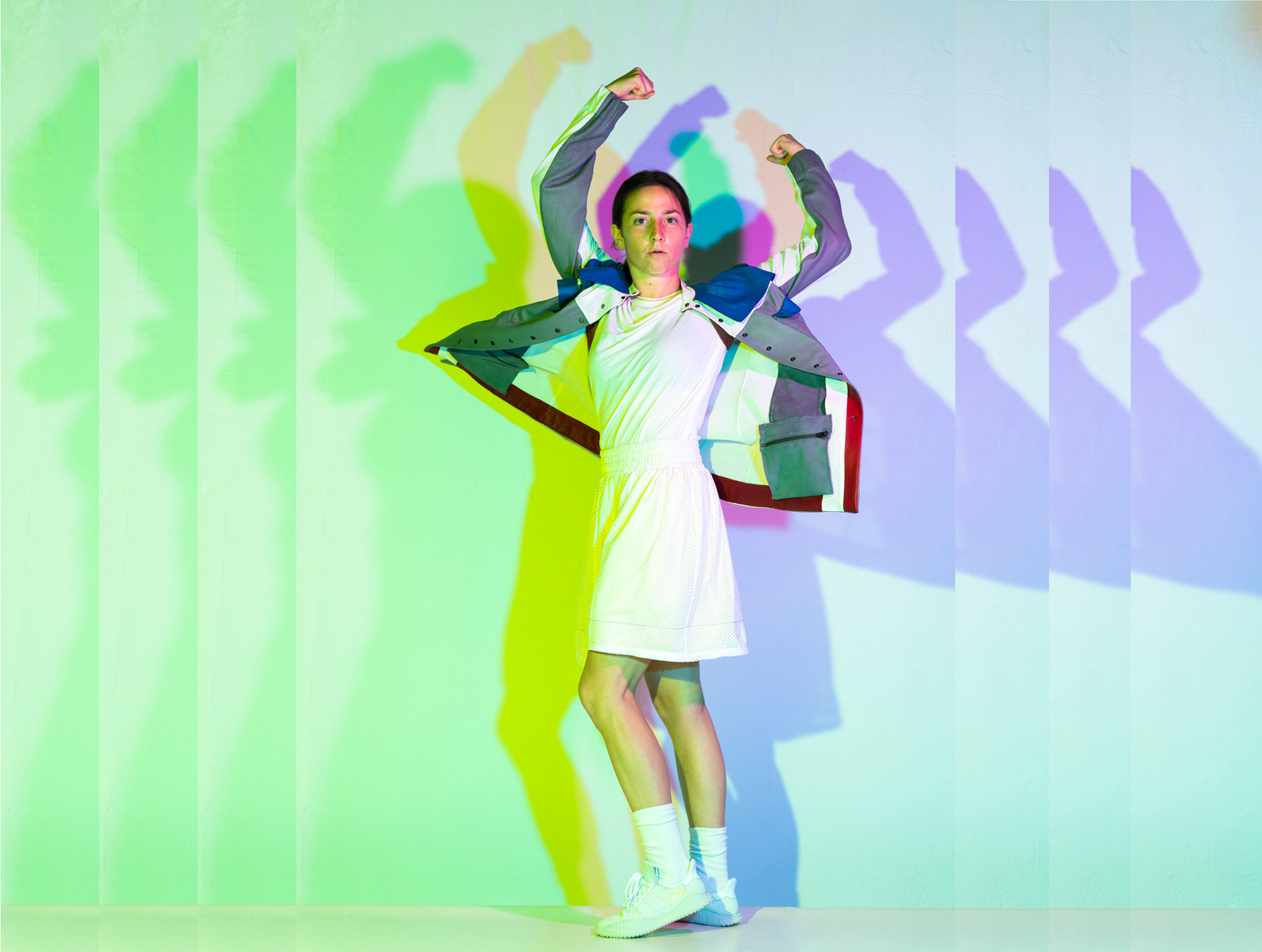
Margherita Elliott in Igor and Moreno, Beat (2019). Photo by Alicia Clarke.
Daniela Perazzo, Kingston University London
Let me begin elsewhere. A few years ago, maybe five or six, I became obsessed with Elena Ferrante’s writing, especially her four Neapolitan novels (2011–2015),[1] which tell the story of Elena (also called Lenù), the first-person narrator, and Lina (or Lila), her closest friend, from their childhood in 1950s Naples to old age. I would read them every evening into the night (in the Italian original), unable to let go of Ferrante’s depiction of these two ordinary yet elusive characters, whose lives are entangled with the local history of poverty, violence, and organised crime. Ferrante’s language captures the transient, provisional, and marginal states of these identities, through words that convey the inherent uncertainty of their affective and material lives. One such word is the term she uses to describe a body-and/as-mind phenomenon Lila experiences a number of times in her life, a sort of emotional state she contends with or even an existential condition she suffers from, whereby the boundaries around people and things (including the outlines of her own identity) appear to her as if they were dissolving, which leads her to a state of both overwhelming emotions and infinite possibilities. The Italian word used in the novels to designate this phenomenon is smarginatura—a term employed “neologistically” by Ferrante, derived from the technical vocabulary of printmaking to describe the process of cutting off the margins of a page, or to spill outside its edges (Carvalho 2018, 95).
In this article, I engage po(i)etically with the image of a subject spilling outside the margins of its own identity to articulate an understanding of the potential of smarginatura as an antidote to or a strategy against the individuality of the neoliberal capitalist subject, which flattens, silences, and fixes the beautifully fragile multiplicity of every being and, in reducing this complexity and reaffirming solid boundaries, also denies the interconnectedness of life. I frame this potential as a political capacity to acknowledge and embrace the intrinsic multiplicity of every subject, which in turn becomes the ground for a politics of plurality and interdependence.
An early moment of smarginatura happens in the first novel of Ferrante’s quartet, entitled My Brilliant Friend, when thirteen-year-old Lila is seen dancing wildly to the new dance of the time, rock and roll. In the description of an evening of partying at a friend’s house, the dancing becomes entangled with local politics and Lila ends up partnering with Marcello, one of the two sons of the local Camorra boss—someone she despises more than anything in the world. Lenù narrates:
I was sure she would say no, I knew how she detested him. But that wasn’t what happened. The music started, and she, with the desire to dance in every muscle, first looked for Pasquale, then, not seeing him, grasped Marcello’s hand as if it were merely a hand, as if beyond it there were not an arm, his whole body, and, all sweaty, began again to do what at that moment counted the most for her: dance. (Ferrante 2012, 151)
Soon things start becoming tense, old threats make their way into the party, and Lenù tells Lila they must go. Lila laughs at the suggestion: “‘Even if there’s an earthquake coming, I’m going to have another dance’, and she looked at Enzo, who was leaning against a wall. But meanwhile Marcello asked and she let him draw her again into a dance” (Ferrante 2012, 152). Yet, only a few minutes later, as they are leaving the party, Lila doesn’t remember dancing with Marcello and, when he grabs her by the hand and asks her to dance again, she is horrified and says to Lenù: “He touched me, did you see: me, that shit. If he does it again, he’s dead” (Ferrante 2012, 152). In her moment of smarginatura, when her boundaries are dissolved, Lila is both alone and together, being both the glue of the party and the person who has everyone’s eyes glued on her. Her partnered dancing is experienced as dancing solo; she is simultaneously one and more than one. The spilling out of her ‘self’ through dancing reads equally as a profoundly personal experience and a radically political gesture: a form of impulsiveness and bodily abandon that signals the blurring of the categories of singular and plural.
Further episodes of smarginatura occur throughout the tetralogy, but readers have to wait until book four, The Story of the Lost Child, for a fuller discussion of the phenomenon, here labelled smarginatura for the first time by Lila herself. Now almost twenty-five years older, pregnant for the third time, Lila engages in an emotionally-charged exchange with Lenù following an earthquake that shook the city of Naples—a real one this time (at least in the book), not simply invoked as a metaphorical apocalypse, as she had done when younger. Lenù recounts:
She used that term: dissolving boundaries [smarginatura]. It was on that occasion that she resorted to it for the first time; she struggled to elucidate the meaning, she wanted me to understand what the dissolution of boundaries meant and how much it frightened her. She was still holding my hand tight, breathing hard. She said that the outlines of things and people were delicate, that they broke like cotton thread. She whispered that for her it had always been that way, an object lost its edges and poured into another, into a solution of heterogeneous materials, a merging and mixing. She exclaimed that she had always had to struggle to believe that life had firm boundaries, for she had known since she was a child that it was not like that—it was absolutely not like that—and so she couldn’t trust in their resistance to being banged and bumped. (Ferrante 2015, 175–176)
My reason for opening this article somewhere other than its canonical beginning, with a story within a story, is that I was reminded of Ferrante’s smarginatura when I saw Igor and Moreno’s choreographic work, Beat, in November 2019 at The Place, London. In this piece, a solo performer, Margherita Elliot, dances relentlessly to electronic music and, in doing so, continuously reinvents herself, “morphing through moves, moods, dance styles, gestures […] driven by DJ Martha’s music” (Leask 2019). In the fifty minutes of the performance, Elliot materialises on stage many slippery yet picturable selves, which reach out to the audience’s imagination in a tangible, material way. The connection I drew between the overlapping of singular and plural in Lila’s dancing and Elliot’s embodiment of multiple selves when dancing solo prompted me to consider the potential of the choreographic format of solo dancing to become, paradoxically, a site for the exploration of multiple subjective states.
The potential of solo performance to portray and convey multiplicity has been explored in performance and dance studies works that have challenged the idea that this form might be the expression of a singular, individual voice. Rebecca Schneider (2005) has argued that “so much late-century ‘solo’ performance work appears as a critique of singularity—as if to show up the cracks in the face paint we call unitary subjectivity” (36). Referencing, for instance, how jazz solos are in dialogue with each other through an intricate web of relations—they “cite each other, bleed into each other, react to each other, re-enact each other” (37) —she argues that every performed action is always “a palimpsest of other actions” and as such contains “multitudes” (41). Attending to the relational nature of movement and perception, Erin Manning (2009) writes of how movement doesn’t begin in the body as an isolated unit, but always in the encounter, always as a “moving-with”, which implies plurality: “We perceive-with objects, catching the edges of their contours, participating in the relations they call forth. […] This quality of relation is what gives an object-event its potential infinitude” (81). Other dance writing examines specific solos across dance history, often complicating assumptions about solitary authorship and autonomy. For instance, Janice Ross’s contribution to Claudia Gitelman and Barbara Palfy’s edited collection On Stage Alone: Soloists and the Modern Dance Canon (2012) analyses Ann Carlson’s Animal Series solos from the late 1980s and 1990s to argue that they stage interspecies encounters, redistributing agency and undoing the myth of a single controlling author.
In this article, I investigate the potential of solo dancing to explore and expose plurality through Ferrante’s image of a self whose boundaries have been dissolved. While Ferrante uses the word smarginatura “neologistically”,[2] and the phenomenon itself can be read in relation to notions of the unconscious and through psychoanalytical frameworks (Carvalho 2018), here I propose to use the term po(i)etically to shape an understanding of how the dissolution of boundaries and the spilling outside the margins of a frame—which I see enacted both by Lila in Ferrante’s novels and by Elliot in Beat—can perform a critical and creative response to the conformist “one-dimensionality” of the individual under capitalism. In advanced industrial societies, as Herbert Marcuse already argued in One-Dimensional Man, published in 1964, very efficient forms of control that serve technological progress and consumer culture stifle critical thinking and genuine opposition, leading to a conservative environment in which individuals are fully immersed in the logic of the system. This challenges the notion of the modern individual as free and exposes the power of the consumerist system to neutralise dissent and create conformist individuals committed to pursuing material goals to satisfy false needs produced by the system itself. In this context “individual thought [is] absorbed by mass communication and indoctrination” (Marcuse 2002, 6), producing one-dimensional people who passively accept the status quo and are incapable of imagining alternatives.
Thinking through conceptualisations of the plurality and differentiation of existence—from Rosi Braidotti’s (1994) theory of nomadic subjectivity, to Roberto Esposito’s (2012) rethinking of the notion of personhood, to Jack Halberstam’s (2011) generative idea of failure and losing one’s self—I attend to the performative and affective modalities through which solo dancing can reveal a commitment, both aesthetic and political, to the articulation of the subject as multiple. In doing so, I also wish to pursue a reflection on the zones of contiguity between solo choreography and first-person writing. While the juxtaposition is inspired by Ferrante’s first-person writing via the narrator Elena, through her retelling of her life-long friendship with Lina and her depiction of her friend’s states of smarginatura, I am especially interested in extending my reflections to include ‘autotheoretical’ writing, the genre-defying more-than-memoirs that engage with the dialogue between personal narrative and critical discourse “in ways that are direct, performative, or self-aware” (Fournier 2021, 6). Perhaps controversially, due to performance criticism’s disavowal of textual approaches for nearly half a century now, I consider the extent to which solo dancing, like (a certain articulation of) personal narrative in contemporary literature from the early 2000s, can become “the form of a pure multiplicity” (Esposito 2012, 134), “a site of multiple others” (Braidotti 2014, 164), a field of intensity in which the place of the subject is both excavated and made available to different voices. Similarly to how Beat evokes practices of performing the self that contemporary audiences are exposed to through media platforms, autotheory is also in dialogue with “the shifting place of the personal in relation to social media technologies and the more widespread cultural tendencies to overshare” (Fournier 2021, 16). Moreover, if autotheory is characterised by “an invoking of one’s self as an integral part of theorizing” (Fournier 2021, 15), the self of many examples of autotheoretical writing is presented and performed as multiple: “an endless collection of oneself that is impossible to gather” (Singh 2018, 18).
When I look, when I imagine, there is a scattering, a diffusion of perspectives. A recalibration of my centre of gravity.
Sometimes I am just a mouth. Sometimes just a hand. Now I am that tongue; now I am that fold. Sometimes, I am just a feeling. Sometimes just skin. (Angel 2012, 132)
Besides, as Lauren Fournier (2021) writes, “autotheory has an interesting relationship with margins, and writers and artists who work autotheoretically often extend the conceit of writing, annotating, and scribbling in the margins in conceptual ways” (138). This can take the form of placing theoretical references or quotations in the margins, thus transforming both the page layout and the readers’ experience of reading thorough an unconventional engagement with the spatial and temporal dimensions of writing/reading the self. This seems pertinent in relation to Ferrante’s smarginatura, as the practice of working creatively with typesetting formats and assigning a different role to the margins of the page signals an interest in exploring the range of possibilities they invite or invoke.
In the writing that follows I explore how solo dancing and performative personal narrative can engage with the dissolution of identity boundaries, by curating adjacencies between performances of the self that attend to its processes of becoming and unbecoming—either through dancing or through writing, where either “mode of doing” contributes to the shaping of the self/selves they perform (Fournier 2021, 16). In particular, I invite into the conversation autotheoretical writings by Katherine Angel (2012), Ann Cvetkovich (2012), Maggie Nelson (2015), and Julietta Singh (2018) as examples of feminist and queer writing that “shuttles between self and theory” (Fournier 2021, 35) to give voice to and perform a self that emerges in dialogue with a multiplicity of contexts and ideas and as such can only be portrayed through plurality.
Margherita Elliott in Igor and Moreno, Beat (2019). Photo by Alicia Clarke.
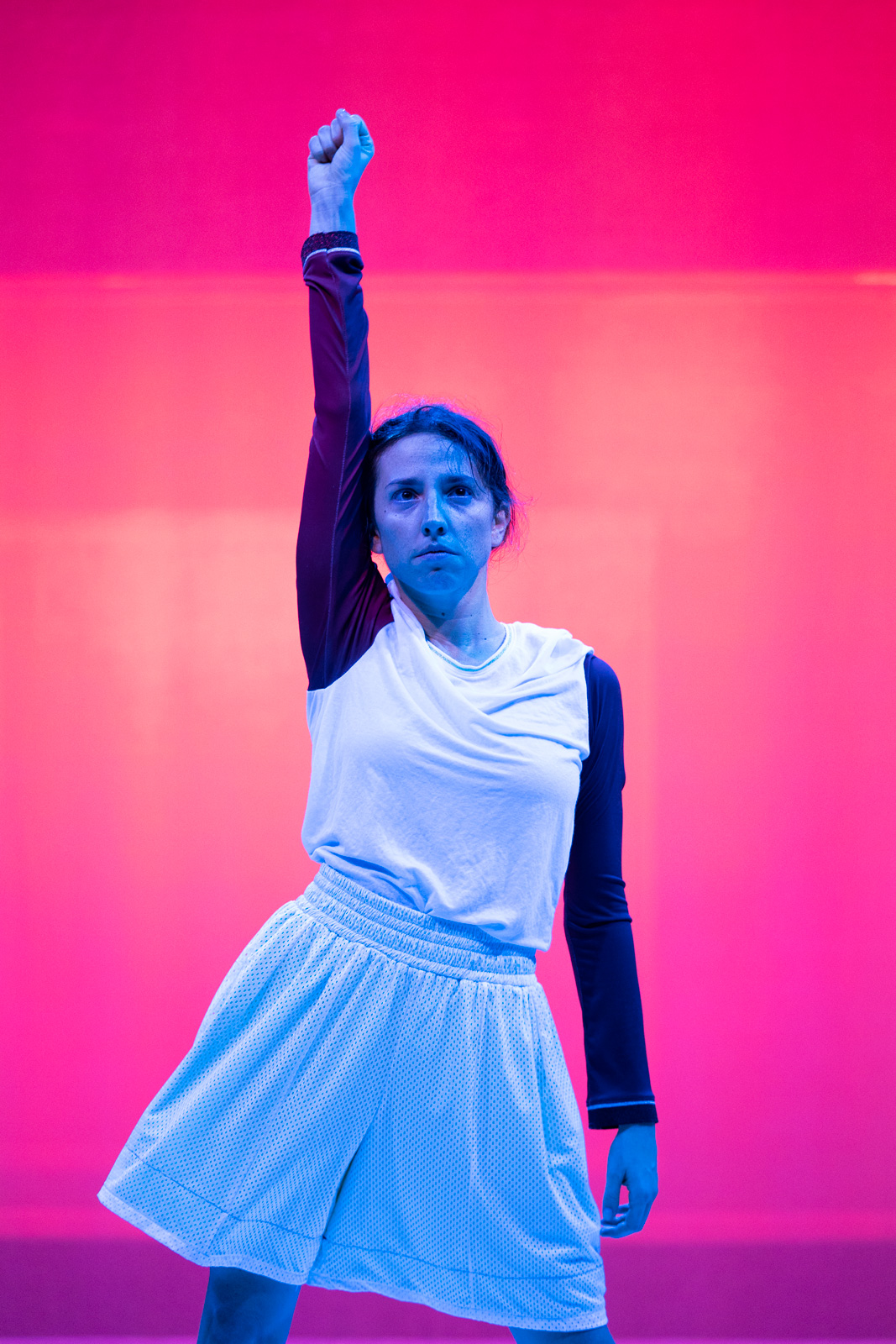
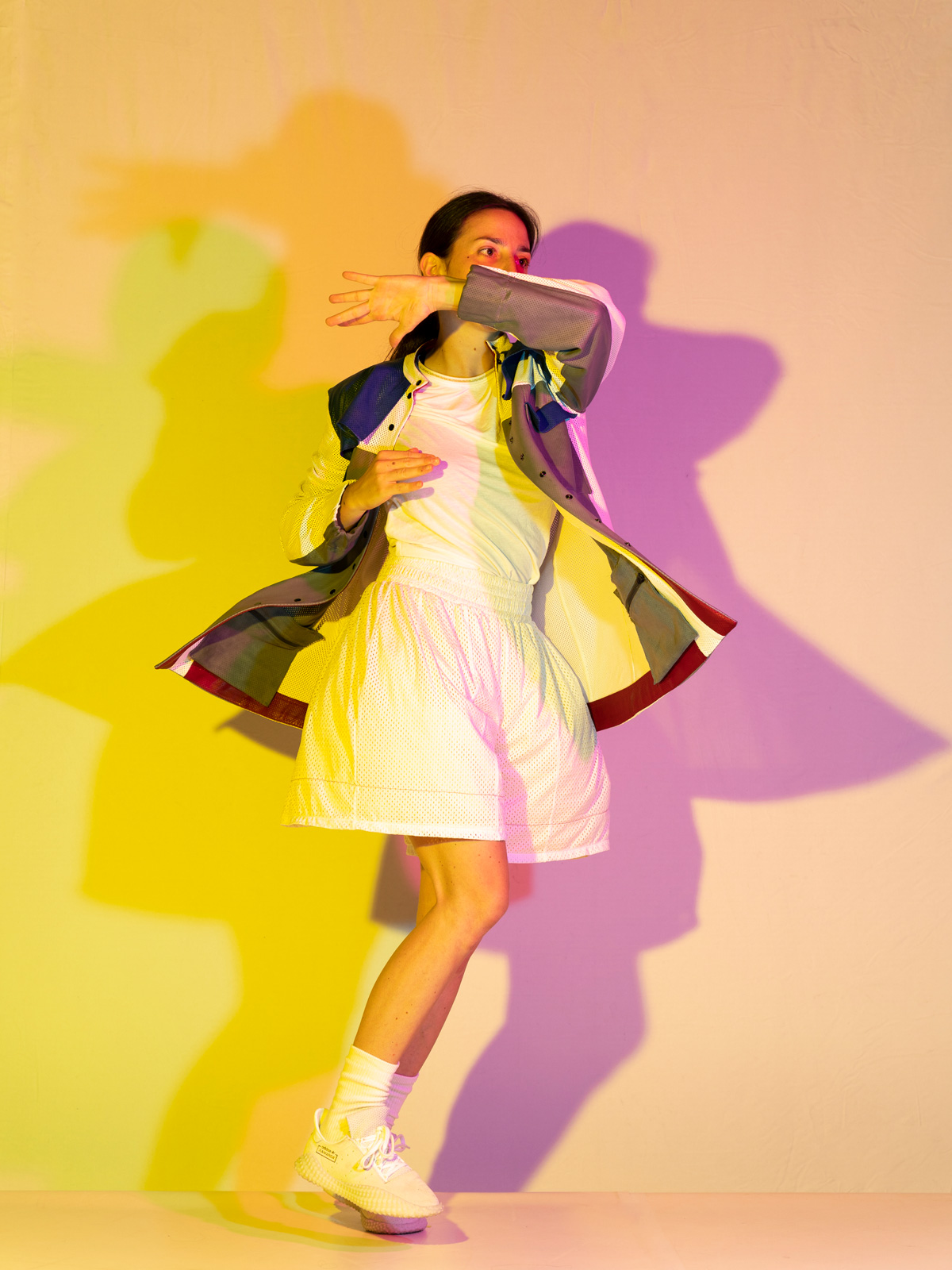
Allow me now to start from the beginning. The stage of Beat is a white raised dance floor backed by three white screens of decreasing sizes hung one behind the other, pulsating with the continuous beat of an electronic track. The auditorium is nearly full on the night of the show’s London premiere at The Place theatre in 2019. As Margherita Elliot enters the performance space, she quietly cuts through this white canvas, a space-time of possibilities, and comes to stand in the middle, full front, her presence both unassuming and self-assured. Scanning the audience left to right and then back again, she pauses to exchange silent moments with individual spectators, looking intently, coyly smiling at specific people, imperceptibly straining her eyes to see better, to recognise a certain person. Naively, I find myself wondering: does she know them—all of them, so many? She comes across as young and “girlish” (Leask 2019), in her casual, sporty clothes, white trainers, and ankle socks. Without breaking eye contact with the audience, she slowly begins to move, still loosely rooted on the spot. Her first moves are soft, tentative, as if to explore the possibilities not only of the body but also of the self that is being performed on stage: her right foot and hand slide a little to the side and then relax, her head bends forward and her shoulders sag, her hips drift an inch to the left and her chin follows, her knees slowly begin to bend while her shoulders lift to reach her ears, her head drops to the left and her chest pushes forward. Throughout this slow sequence, Elliot never breaks eye contact with the audience, her gaze attentive and inquisitive, as if in the eyes of the spectators she could see a reflection of the self/selves she is performing. A vocal sound rising to a crescendo marks a transition, signalling a readiness to engage with a wider vocabulary of movement. A string of gestural sequences begins: they are fast but not frantic, each movement morphing into the next before it can be fully completed, grasped, identified. Expertly, seamlessly, her body moves as if to bang on a door with a fist, handle cooking pans, pour liquid into a glass, throw a stone, slice bread, skip with a rope, wash her face, aim an arrow, pray, wave a fan, chuck water on the floor from a bucket, step on a cigarette butt—all of these actions and many more, but also none of them at all, as the movements disappear just as I am beginning to locate them, to read them as figurative.
The daily routines of self-care and moving the body—swimming, yoga, dinner with friends, visits to the dentist, or just getting out of bed in the morning—are modest forms of transformation, but my experience, and writing about it, taught me that they are nonetheless meaningful. In its sometimes banal attention to detail, my writing chronicles a relation to self and to the world that is established through the physicality of both body and home as forms of sensory environment. (Cvetkovich 2012, 79–80)
In June 2020 I spoke to the choreographers, Moreno Solinas and Igor Urzelai, on Zoom to hear from them about the creative process that led to Beat. The duo, based between London and Sardinia (Italy), have been collaborating since 2007, creating choreographic work that explores individuality and difference in human behaviour through stylistic and dramaturgical approaches that escape categorisations.[3] In conversation, one of the key approaches they identified in Beat is the work they did with the dancer to navigate the fine line between the figurative nature of gestural movement and the refusal to settle into a readable narrative and characterisation. Attending carefully to the potential for gesture to mediate meaning, they challenged the ability of movement to communicate an idea by focusing on physical actions and unsettling, suspending, and shifting their habitual frames and therefore undermining their knowability. The ways in which Igor and Moreno’s choreography works with gesture in this piece points to Giorgio Agamben’s (2000) idea of gesture as “communication of a communicability” (59)—a third way that hovers in between conceiving of gesture as movement with a specific finality and classifying it as movement with an end in itself. Agamben’s notion of gesture as “endless mediality” (59) further illuminates how Elliot’s dance resists closure: it does not seek to transmit a fixed meaning but rather both lays bare and challenges the very possibility of meaning-making. In this sense, the choreography does not merely use gesture as a tool but foregrounds gesture as a site of potential, where the act of communication is suspended, exposed, and continually deferred. The ambiguous relationship Elliot’s dance entertains with the ends of gestures (both in the sense of their purposes and in the sense of their edges) aligns with Agamben’s view that gesture is not about what is communicated, but about the fact that communication is possible, making the dance a living enactment of communicability itself.
By practising ways of interrupting movement, the creative process appears to rely on principles that stop a gesture or an action from being completed, deliberately introducing an “impasse”—a condition which, according to Cvetkovich (2012), is as much linked with stuckness as it is with movement, “even if that movement sometimes seems backward or like a form of retreat” (21). So, in this sense, an impasse, an interruption becomes generative and creative and produces “different ways of being able to move” (ibid.). Nevertheless, despite its generative potential, this breakage intervenes in the presentation, or even in the essence, of the thing it blocks, fragments, or queers. This makes me ponder: is a gesture still that gesture if its beginning and end have been interrupted (cut off the page, smarginati, to use Ferrante’s term) and its intention has been frustrated, obfuscated? Something about this question is reminiscent of the Theseus paradox, the thought problem concerning the identity of the mythological ship of Theseus after all its parts were replaced: was it still the same ship?[4]
Elliot’s appearance on stage yo-yos between what comes across as her open, accessible being there and a fragmented presence composed of sections of movements operating on the margins of recognisable frames. In her review of the performance, Josephine Leask (2019) writes:
Margherita Elliott in Igor and Moreno, Beat (2019). Photo by Alicia Clarke.
Is she a show-off gymnast, a serious ballerina, a macho weight lifter, a comedienne, an ordinary person, a cheer leader, an actress, a folk dancer, a monged-out [sic] clubber; a cheeky child, a wise old woman; gay, straight, gender fluid; happy, depressed, grotesque, aggressive. As she confidently and seamlessly passes through these different transformations, she interacts with us—rarely removing her gaze, questioning us, reflecting on what we give her back as an audience. How will we react to her continuously shifting states? I marvel at how her behaviour and appearance can change from one beat to the next—how she can look so different through subtle gestures, a raised eyebrow, a glance, a stare.
As Igor put it during our virtual conversation, “it’s that sense of feeling that we know who she is and not having a clue”, which Moreno further explained as a “not being able to grasp who Margherita is” (Solinas and Urzelai 2020). The dance then raises questions about the identity of the dancer herself: when is Margherita really Margherita? Is Margherita still Margherita when she gives herself to the audience through shredded, reshuffled, and disfigured forms? I am interested in exploring this contradiction between a unitary framing of identity and its multiple projections alongside the ways in which this (productive) inconsistency is articulated in examples of autotheoretical writing. Specifically, the paradox of identity, of the plurality of its composition versus the singularity of the name that designates it, is also what underpins Nelson’s memoir The Argonauts (2015). Here Nelson revisits the thought problem of the ship of Theseus via the version that Roland Barthes gives of it in his autobiography, Roland Barthes by Roland Barthes (1977), where he attributes the same paradoxical question of the ship of Theseus to Argo, the ship of the Argonauts, the Greek heroes who accompanied Jason in his quest for the Golden Fleece.[5]
In The Argonauts, Nelson’s writing mixes personal memory with theory and philosophy, in a mode of autobiographical, reflective, and critical writing that is indebted to feminist, queer, and activist practices. The self that emerges from her pages is as plural and changeable as the parts of the ship that continues to be known by the same name. The singularity of the name we go by charges us with “the task of performing a self for others”, while “we develop, even in utero, in response to a flow of projections and reflections ricocheting us off. Eventually, we call that snowball a self (Argo)” (Nelson 2015, 118). What I’m trying to get to here is that both Elliot’s dancing and Nelson’s writing renew the Theseus paradox by drawing attention to the plurality and changeability of the forms that go by a certain name that persists in time—whether explicitly (as in Nelson’s book) or not (as in Igor and Moreno’s choreography), their works “reclaim” a term (Argo) or an idea (solo dancing) “to designate molten or shifting parts, a means of asserting while also giving the slip […]—they retain, they insist on retaining, a sense of the fugitive” (Nelson 2015, 35–6).
Margherita Elliott in Igor and Moreno, Beat (2019). Photo by Alicia Clarke.
Here smarginatura becomes both an epistemic lens and a compositional device, which simultaneously explains and enacts the multiple, scattered, overlapping, overspilling qualities of the person known by a singular name. It concomitantly validates a subjective state that accepts changeability and inconsistency, and produces the political possibility of existing outside normative expectations of a singular, one-dimensional subject. This makes it possible for such a subject to escape its own instrumentalisation, embracing the critical and creative project of becoming multi-dimensional in the face of dominant paradigms that reward the flattening of subjectivity.
Rosi Braidotti (2014) argues that writing itself can be a way of enacting “nomadic becoming”: her notion of nomadic subjectivity, which conceptualises a self that is always in becoming and “resists settling into socially coded modes of thought and behaviour”, is “both an analytic tool and a creative project”—one which can be attempted through “critique and creativity” (182). When writing is a form of both ethical commitment and affective engagement, it “enacts the destitution of unitary visions of the subject as an autonomous entity” by embracing the other “within and all around the self” (165). When Braidotti states that “imagination”, “myth-making”, and “fiction” are key ingredients of writing practices that have the potential to create “adequate figurations” of the present, more so than what can be accomplished by “theoretical systems” (182), Nelson’s Argonauts comes to mind as a project that, through a creative rewriting of philosophy, can give voice to the nomadic subjectivity Braidotti conceptualises. I posit here that Igor and Moreno’s Beat is adjacent to Nelson’s writing in its ability to imagine, visualise, and perform the plurality of the self and its constant renewal.
My writing is riddled with such ticks of uncertainty. I have no excuse or solution, save to allow myself the tremblings, then go back in later and slash them out. In this way I edit myself into a boldness that is neither native nor foreign to me. (Nelson 2015, 122)
Yet, while Nelson’s writing stems from a personal place, Elliot’s dancing is not a self-portrait: the self that emerges from the dance is formed in the eyes and the experience of the spectators, for whom Margherita is not an “I” but a “she”—a third person. Rather than being at the root of the choreographic investigation, the problem of Margherita’s identity emerges through spectating, as a question the work aims to engender in the viewers. It is a question in the third person (who is she?), rather than a self-searching of the subject (who am I?) or a self-invention of the neoliberal individual (who would you like me to be?). Roberto Esposito (2012) writes that the third person is “the only true plural” because, by not being an “I” or a “you”, it can contain any subject, multiple subjects—or no subject (108). While “I” and “you” respectively occupy and complement the subject position, “mutually imply[ing] each other” and conceiving of each other through “distance” (105), the third person escapes this logic of dependence, differentiation, and mirroring and troubles the ability of the subject to be the source of the enunciation—to be the measure of identity. The third person then offers the scope for a different idea of identity (what Esposito calls the impersonal, or non-person), one that “is situated precisely at the point of intersection between no one and anyone” (107) and that embraces “a logic that privileges multiplicity and contamination over identity and discrimination” (145).
We assemble – on bricole – our beliefs from myriad elements, stones we pick up on a beach, as we grow into our lives.
(Angel 2012, 148)
Where Nelson uses other voices (quotes and ideas from other writers and theorists) to pluralise the “I” she writes from, Igor and Moreno work with the formal and stylistic possibilities of gesture and theatre to create a solo that stages a plural subject. I argue that, paradoxically, there is no “I” in this solo dance: Beat is the performance of a she/her—or rather, more appropriately, of a they/them. Moving beyond (self) reflection, it makes it possible for the self to diffract[6] into multiple possible selves. In times of multimediality and digitally ubiquitous performances of the self, I suggest that Beat, although imbricated in such practices, can fulfil a function that both overlaps with and exceeds stylistic gestures of self-presentation and visceral gestures of self-expression. While inhabiting a similar frame of presentation to the Instagram selfies and TikTok videos (minus the digital mediation), in avoiding capture as an “I”, the solo dancer in Beat escapes the logic of self-projection and “self-investment” of the neoliberal individual, whose pursuit of practices of self-promotion and self-betterment is ultimately “related to enhancing the self’s future value” (Brown, 2015, 34).
Margherita Elliott in Igor and Moreno, Beat (2019). Photo by Alicia Clarke.
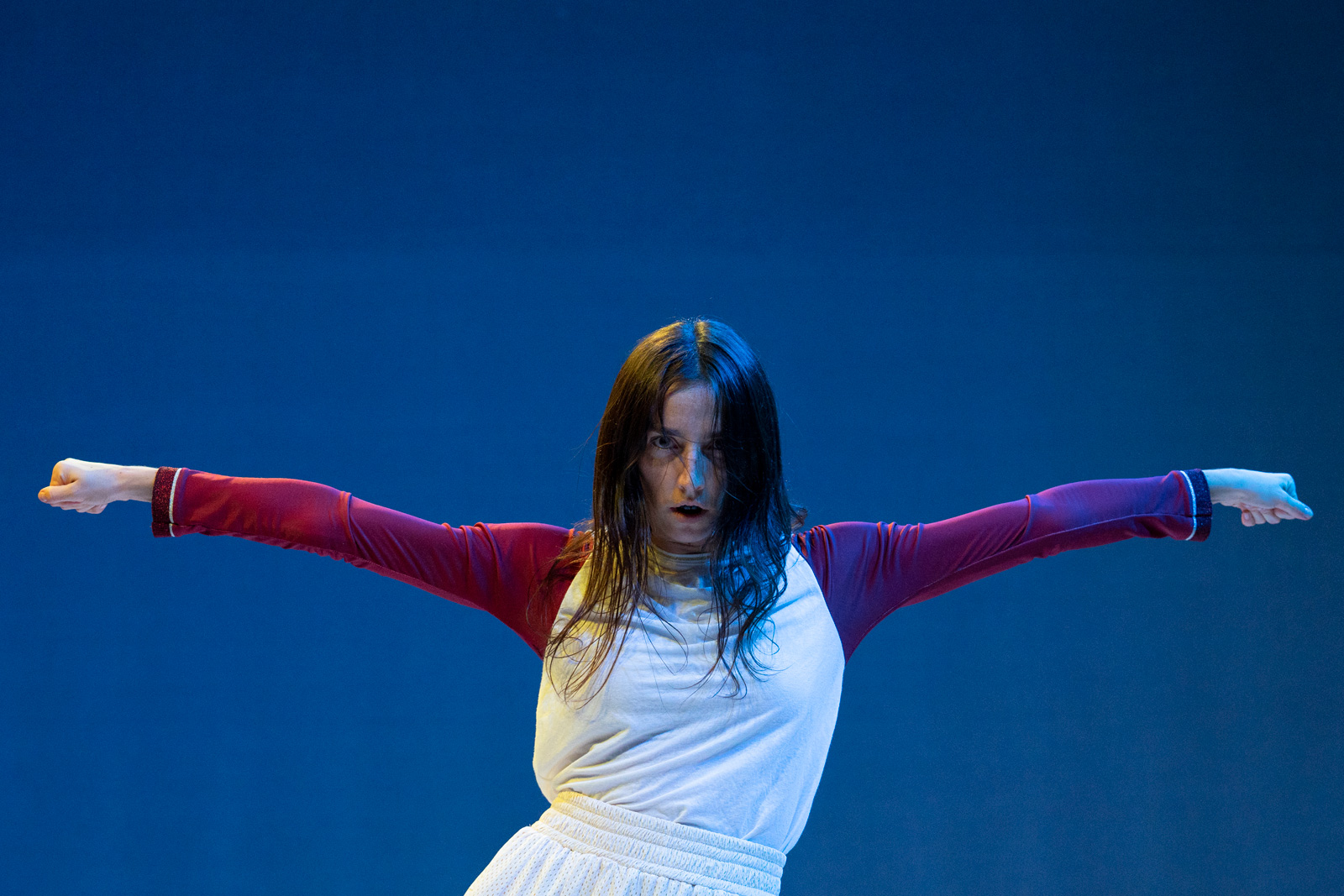
As the performance progresses, the dancer becomes more and more undone—and, in doing so, reveals herself as her plural self. Her relationship with the audience becomes more playful, her moves increasingly unpredictable, her shapes possibly more bizarre, her facial expressions more exaggerated. The grotesque effect is magnified by Elliot’s ‘empty’ mouth, fashioned with a black layer covering her teeth: while her mouth assumes a variety of shapes, any reading of them is distorted by the absence of visible teeth. Her gesture fragments suggest more intimate actions, from removing contact lenses to pushing the fingers of both her hands into her mouth. Her moves loosely reference dance styles from ballet to ‘flossing’ and contexts from social dancing to clubbing. Varying her speed as she interprets the predictable beat of the music, she restyles her clothes by turning her jacket inside out and pulling down her top into a dress—provocatively exposing her stomach almost up to her breasts as she does so. Her ponytail becomes undone as she spins her head around; then she gives us the finger, then two fingers, and then takes a break, while the electronic track pauses too. In the silence of the pause, she drinks water and teases the audience, walking close to the front row with her mouth full of liquid, which she defiantly spits out by the spectators’ feet.
Margherita Elliott in Igor and Moreno, Beat (2019). Photo by Alicia Clarke.
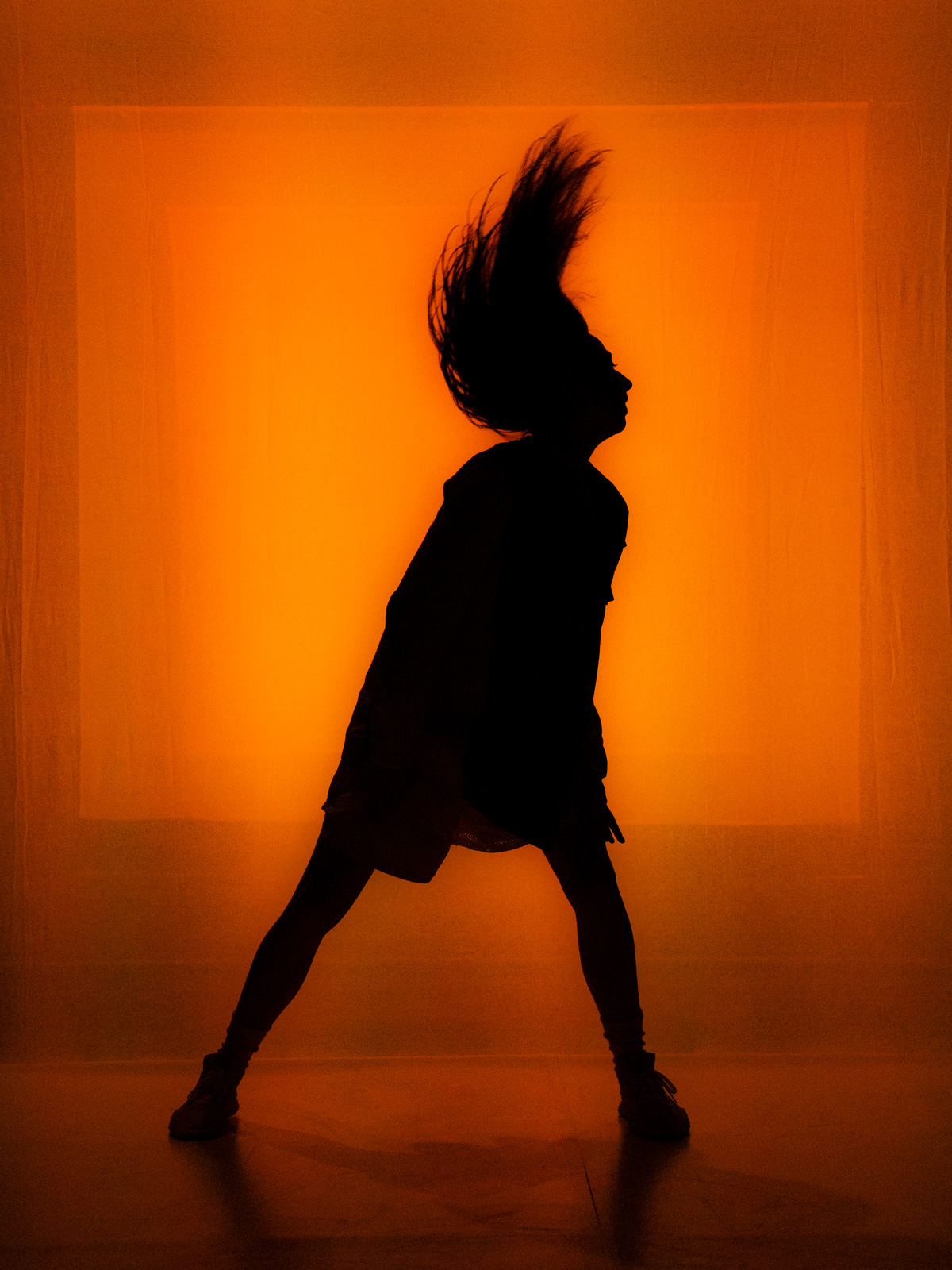
When the music and the dancing resume, the speed is faster, at times frantic; the movement follows the repetitive beat through a bouncy motion that makes Elliot’s gestures even more blurred and less recognisable. The lighting intervenes in the process of diffraction of the self by flickering from different angles and changing colours, thus adding to the kaleidoscopic effect of the performance and creating shadows on the floor in multiple directions. In a long sequence of several minutes, the dancer swings her hips left to right, while the light switches on and off from the front: here the movement is reduced to a minimum, the arms ‘framing’ the torso and the face in simple ways while the body sways side to side to the beat, with the lighting creating the impression that we are seeing a different person every time the figure reemerges from the dark.
Sometimes I have had to unstitch my work, to say, Oh so you know when I said I was happy to do that? Well, what I meant was the opposite. (Angel 2012, 160)
Although it employs choreographic devices such as framing, fragmentation, and speed changes, which resemble some of the effects used in social media videos to craft the transitioning of moving images through, for instance, trimming, splitting, or merging, Beat engages with these strategies to embody a critique of the self-promoting imperative that feeds contemporary (self-)portrayals of women, whether driven openly by capitalist consumerist culture or more covertly by the “self-congratulatory […] celebrat[ion of] individual identity” of what Nina Power (2009)—invoking Marcuse—calls “one-dimensional feminism”. The narrow form of feminism Power describes, which is a version of gender ideology coopted by neoliberal capitalism, is devoid of political struggle and social critique and is instead subservient to capitalist principles of self-improvement, empowerment, and individualistic choice, where radical feminist values and nuanced understandings of the racial, economic and class dimensions of feminist politics are substituted by a “perky, upbeat message of self-fulfilment and consumer emancipation” (69). This produces “one-dimensional” women who celebrate their successes and alleged emancipation without being aware of how these still exist within, and often reinforce, patriarchal, consumerist, or colonial structures.
Perhaps it’s the word radical that needs rethinking. But what could we angle ourselves toward instead, or in addition? Openness? Is that good enough, strong enough? You’re the only one who knows when you’re using things to protect yourself and keep your ego together and when you’re opening and letting things fall apart, letting the world come as it is—working with it rather than struggling against it. You’re the only one who knows [Pema Chödrön]. And the thing is, even you don’t always know. (Nelson 2015, 33–4)
Margherita Elliott in Igor and Moreno, Beat (2019). Photo by Alicia Clarke.
Although displaying a very sophisticated level of skill, Elliot’s dancing does not chase the performance of success; instead it resists the consumer capitalist compulsion to “capitalize on one’s assets at every moment” (Power 2009, 24). Its morphing sequences of interrupted gestures and movements constantly frustrate the very idea of accomplishment by never arriving and always being in the process of un/doing. They embody what Halberstam (2011) describes as “pok[ing] holes in the toxic positivity of contemporary life”, offering a visualisation through movement of “queer failure” (3). Advocating for “ways of being and knowing that stand outside of conventional understandings of success” (2), Halberstam argues that failure is a queer gesture insofar as it escapes normative behaviour and imagines alternative ways of relating to standards of knowledge, markers of achievement, levels of ability, social traditions, political rules, economic systems, models of care, relationship, and love. Halberstam’s queer conceptualisation of failure entails the acceptance of the finite, fragmentary, multi-dimensional, and also absurd and often silly and hopeless, nature of our lives. It engages with examples—from art and popular culture—that offer alternatives to mainstream models of success, which often stand in the way of creativity, criticality, and connection.
Elliot’s dance does not showcase different personas to impress the viewer with their versatility. Her fragments of actions and chains of substitutions of movements and attitudes tell the spectators that she is who she is—and they themselves are who they are—even through constant and substantial changes: that Argo is still Argo even when all its parts have been replaced, or that in fact there is no such thing as a singular Argo, as every living person and non-living thing is inextricably linked in a “unicum, [a] being that is both singular and plural” (Esposito 2012, 151). It is here that such dancing can be conceptualised as contributing not only to a poetics (in the sense of a creative practice that articulates a nomadic subject, in Braidotti’s terms) but also to a politics of plurality—that is, a critical response to the flattening and singling out of the neoliberal individual and an ethical awareness of the entangled nature of all life.
Margherita Elliott in Igor and Moreno, Beat (2019). Photo by Alicia Clarke.
[1] The novels in English translation are: My Brilliant Friend (2012), The Story of a New Name (2013); Those Who Leave and Those Who Stay (2014) and The Story of the Lost Child (2015).
[2] And one might also say colloquially, as Ferrante ascribes the word to Lila, whose Italian is heavily mixed with Neapolitan dialect and informal expressions.
[3] I have previously written about their duet Idiot-Syncrasy (2013): see Perazzo Domm (2018).
[4] Plutarch (1914) writes in The Life of Theseus (23): “The ship on which Theseus sailed with the youths and returned in safety, the thirty-oared galley, was preserved by the Athenians down to the time of Demetrius Phalereus. They took away the old timbers from time to time, and put new and sound ones in their places, so that the vessel became a standing illustration for the philosophers in the mooted question of growth, some declaring that it remained the same, others that it was not the same vessel”.
[5] “A frequent image: that of the ship Argo (luminous and white), each piece of which the Argonauts gradually replaced, so that they ended with an entirely new ship, without having to alter either its name or its form. This ship Argo is highly useful: it affords the allegory of an eminently structural object, created not by genius, inspiration, determination, evolution, but by two modest actions (which cannot be caught up in any mystique of creation): substitution (one part replaces another, as in a paradigm) and nomination (the name is in no way linked to the stability of the parts): by dint of combinations made within one and the same name, nothing is left of the origin: Argo is an object with no other cause than its name, with no other identity than its form.” (Barthes 1977, 46, emphasis in original)
[6] I use this term in the new materialist sense ascribed to it by Donna Haraway and Karen Barad—as I have written elsewhere (Perazzo Domm 2019; Perazzo Domm 2020).
Agamben, Giorgio. 2000. Means Without Ends: Notes on Politics. University of Minnesota Press.
Angel, Katherine. 2012. Unmastered: A Book on Desire, Most Difficult to Tell. Penguin Books.
Barthes, Roland. 1977. Roland Barthes by Roland Barthes. University of California Press.
Braidotti, Rosi. 2014. “Writing as a Nomadic Subject.” Comparative Critical Studies 11 (2–3): 163–84. https://doi.org/10.3366/ccs.2014.0122.
Brown, Wendy. 2015. Undoing the Demos: Neoliberalism’s Stealth Revolution. Zone Books.
Carvalho, Richard. 2018. “Smarginatura and Spiragli: Uses of Infinity in Ferrante’s Neapolitan Quartet.” Allegoria 77: 94–111.
Cvetkovich, Ann. 2012. Depression: A Public Feeling. Duke University Press. https://doi.org/10.1215/9780822391852.
Esposito, Roberto. 2012. Third Person. Translated by Z. Hanafi. Polity Press.
Ferrante, Elena. 2012. My Brilliant Friend. Translated by A. Goldstein. Europa Editions.
Ferrante, Elena. 2015. The Story of the Lost Child. Translated by A. Goldstein. Europa Editions.
Fournier, Lauren. 2021. Autotheory as Feminist Practice in Art, Writing, and Criticism. The Mit Press. https://doi.org/10.7551/mitpress/13573.001.0001.
Halberstam, Jack. 2011. The Queer Art of Failure. Duke University Press. https://doi.org/10.2307/j.ctv11sn283.
Leask, Josephine. 2019. “Igor and Moreno – BEAT – London.” DanceTabs. Accessed 19 April 2021. https://dancetabs.com/2019/11/igor-and-moreno-beat-london/.
Manning, Erin. 2009. Relationscapes: Movement, Art, Philosophy. The MIT Press. https://doi.org/10.7551/mitpress/9780262134903.001.0001.
Marcuse, Herbert. 2002. One-Dimensional Man. Routledge.
Nelson, Maggie. 2015. The Argonauts. Melville House.
Perazzo Domm, Daniela. 2018. “Crisis and the Emotional Body: Towards (Another) Freedom.” Performance Philosophy 4 (1): 188–205. https://doi.org/10.21476/PP.2018.41196.
Perazzo Domm, Daniela. 2019. “Im/possible Choreographies: Diffractive Processes and Ethical Entanglements in Current British Dance Practices.” Dance Research Journal 51 (3): 66–83. https://doi.org/10.1017/S0149767719000329.
Perazzo Domm, Daniela. 2020. “Diffracted temporalities: Trajal Harrell’s other dance histories.” Performance Research 25 (5): 56–62. https://doi.org/10.1080/13528165.2020.1868843.
Plutarch. 1914. The Life of Theseus, in Parallel Lives, Vol. I. Translated by B. Perrin. Loeb Classical Library 46. Harvard University Press.
Power, Nina. 2009. One-Dimensional Woman. O Books.
Ross, Janice. 2012. “The Solo That Isn’t a Solo: Ann Carlson’s Dances with Animals.” In On Stage Alone: Soloists and the Modern Dance Canon, edited by Claudia Gitelman and Barbara Palfy. University Press of Florida. https://doi.org/10.5744/florida/9780813040257.003.0004.
Schneider, Rebecca. 2005. “Solo Solo Solo.” In After Criticism: New Responses to Art and Performance, edited by Gavin Butt. Blackwell Publishing. https://doi.org/10.1002/9780470774243.ch1.
Singh, Julietta. 2018. No Archive Will Restore You. Punctum Books. https://doi.org/10.21983/P3.0231.1.00.
Dr Daniela Perazzo is Associate Professor in Dance Studies and Postgraduate Research Coordinator for the School of Arts at Kingston University London. Her research interrogates the intersections of the aesthetic and the political in movement practices. Her work has engaged with the Deleuzoguattarian notion of ‘minor’ practice and its articulation in current choreography; with diffractive methodologies and Karen Barad’s notion of entanglement and intra-action; with questions of subjectivity and collectivity in choreographic and dramaturgical processes; and with understandings of intimacy as relational and political. Her latest research explores notions of vulnerability and discomfort and attends to the gaps, difficulties, and entanglements of modes of being in relation. Her publications include articles in Performance Philosophy, Performance Research, Dance Research Journal, Choreographic Practices, Contemporary Theatre Review, and the Journal of Awareness-Based Systems Change. Her monograph Jonathan Burrows: Towards a Minor Dance was published by Palgrave in 2019 and her chapter “Vulnerable Practice: Thinking through discomfort and precarity in Project O’s Voodoo” is included in the third edition of Contemporary Choreography: A Critical Reader (Routledge 2026). Among other roles, she was co-convenor of the Theatre, Performance, and Philosophy Working Group of the Theatre and Performance Research Association (2018–22) and co-investigator on the AHRC-funded project “The Dancing Otherwise Network: Exploring Pluriversal Practices” (2023–25).
© 2025 Daniela Perazzo
Except where otherwise noted, this work is licensed under a Creative Commons Attribution-NonCommercial-ShareAlike 4.0 International License.